SKIES OF THUNDER/CAROLINE ALEXANDER

Gordons Goodreads along with countless books, movies and streaming documentaries have delved deeply into the European and Pacific Theaters of The Second World War. Caroline Alexander’s new work of non-fiction SKIES OF THUNDER takes the reader to a relatively lesser known WWII Theater, the BURMA HUMP.

During WWII one of the most deadly missions of the war flew hundreds of tons of supplies from India to China over the treacherous airoute above the Himalayas and the northern deep jungles of of Burma. (Now Myanmar). FDR was determined to supply the Nationalist Chinese Army to prevent a Japanese takeover of China. China’s Nationalist leader was none other than Chiang-Kai-shek. With the old Burma Road not accessible, the only supply access was by air. The flying conditions brought about by weather including the annual Monsoons, high altitude icing and the dangerous Himalayan peaks made for nearly impossible flying conditions. But fly they must and hundreds lost their lives.
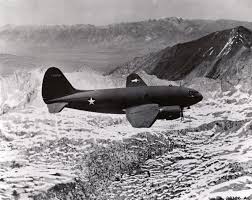
Alexander’s writing and research has no mercy for the military commanders in charge. Vinegar Joe Stilwell’s and Claire Lee Chennault’s ( Flying Tigers fame) reputations are left in tatters. Chiang-Kai-shek’s strongest supporter was perhaps FDR himself. The project became rife with a black market of American supplies. Through it all hundreds of brave pilots gave their lives, many bodies never recovered from snow covered mountain slopes and deep unexplored jungle.

Exactly what did the Hump accomplish? It demonstrated conclusively that a vast quantity of cargo could be delivered by air even under the most unfavorable circumstances if leadership was willing to pay the price in men and money. A Japanese takeover of China was prevented and millions of Japanese troops were diverted from the Pacific Theater to China. However, following the war, Chiang Ki-shek’s Nationalist Government ultimately fell to the Communists leaving the United States with Formosa which is now Taiwan.
AN UNFINISHED LOVE STORY/DORIS KEARNS GOODWIN

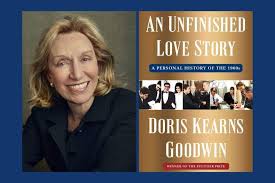
Anderson Cooper gave the perfect description of Doris Kearns Goodwin when he called her a national treasure. His quote appears on the dust cover of Kearns Goodwin’s new book AN UNFINISHED LOVE STORY, A PERSONAL HISTORY OF THE 1960S.

Richard Goodwin while in his twenties and early thirties was a speechwriter and inner circle advisor to Presidents Kennedy and Johnson and then later to Robert F. Kennedy. For years, all of Goodwin’s personal papers of the era sat collected in some thirty boxes stored in the Kearns Goodwin home at Concord, Massachusetts. In their later years after over 40 years of marriage Richard in his 80s and Kearns in her seventies decided it was time to open the boxes and write his personal history. By this time Kearns had established herself as among the most prestigious of presidential Pulitzer Prize winning historians. ( Search Gordons GoodReads).

What is remarkable about this book is the insiders look behind the scenes of the personalities and the inner workings of the campaigns and administrations of John F. Kennedy and Lyndon Johnson. Added to the narrative is the disruptive force of Robert Kennedy and how Richard Goodwin navigated his mixed loyalties. Those loyalties of course spilled over into the Kearns/Goodwin love story, she being an ardent loyalist of Johnson and Richard having left the Johnson inner circle for Bobby Kennedy’s ill fated primary campaign against LBJ.

The reader learns of the beginnings of the Peace Corps ( an off the cuff-JFK speech in Michigan), the LBJ Great Society the inside strategy of the Voting Rights Act, The Civil Rights Act and LBJ’s famous joint session of Congress speech in which Goodwin co-opted Martin Luther King’s We shall overcome. Insight into the transition from the Kennedy to the Johnson administration after JFK’s death evoke a combination of anger and empathy. The Robert Kennedy personality for all of its strength and weaknesses is on abundant display.

A remarkable aspect of AN UNFINISHED LOVE STORY is the lesson learned of how great writers and politicians learn how complicated and controversial legislation can be properly packaged and themed to insure success. Kennedy, Goodwin and LBJ were a brilliant combination in fulfilling this task.

As readers of Gordons Good Reads surely know I too elevate Doris Kearns Goodwin as a National Treasure. AN UNFINISHED LOVE STORY IS a must read for those interested in American political history of the 1960S.

THE MAKING OF THE ATOMIC BOMB

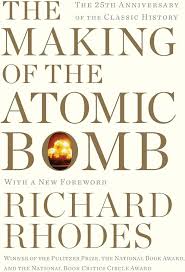
Richard RhodesTHE MAKING OF THE ATOMIC BOMB, first copyright 1986, is an extraordinary deeply scientific examination of the development of atomic energy. This work is so unique that this non-scientific reader( me), fascinated with the subject, found the narrative accessible, engrossing and understandable. This book is of far greater scientific depth than American Prometheus. (see Gordons Good Reads).

If a layman seeks an understanding of nuclear fission, the splitting of the atom, atomic chain reaction and the creation of a weapon of mass destruction THE MAKING OF THE ATOMIC BOMB brings together the history of the discovery of the atom, the groundbreaking scientists involved ( you will meet many more than Oppenheimer), the building of the atomic bomb itself and the resulting moral controversy over, how and when, and if ever it should be used.

Francis William Ashton ( Circa 1936): There are those who say that such research should be stopped by law, alleging that man’s destructive powers are already large enough. Personally I think that subatomic energy is all around us and that one day man will release and control its almost infinite power. We cannot prevent him from doing so and can only hope that he will not use it exclusively in blowing up his next door neighbor.

Rhodes expert, understandable and readable nuclear development research fast forwards to the ethical controversy of using atomic weapons and delves deeply into the decision making process prior to the deployment of Big Boy over Hiroshima and Nagasaki. Rhodes offers a substantial overview of the political and military strategy leading up to the decision that ended World War II.

Could the enemy not be warned in advance or a demonstration arranged? We feared that if the Japanese were told that the bomb would be used on a given locality they might bring our boys who were prisoners of war to that area.

The detail in Rhodes writing equals and in scientific terms( formulas, equations, graphs, charts, maps) exceeds what an educated reader expects from and author like Robert Caro.

THE MAKING OF THE ATOMIC BOMB together with AMERICAN PROMETHEUS are a giant step in understanding the scientific and ethical development of atomic energy. Both books are worth the effort.


/…….