It is no surprise that Percival Everett’sJames is leading multiple Best Seller Lists. A ride on a raft on the muddy Mississippi with Jim and Huck misses absolutely nothing of the strife and life of slaves and their society of oppressors in the American South. The dialogue is real:
Way I sees it is dis. If’n ya gotta hab a rule to tell ya wha’s good, if’n ya gots to hab good splaIned to ya, den ya cain’t be good. Good ain’t got nuttin to do wif da law. Law says I’m a slave.”
Funny, humorous and always insightful Percival James has delivered a brilliant portrait as the sounds, words, and message echo in the reader’s mind long after the cover is closed. Why of course.
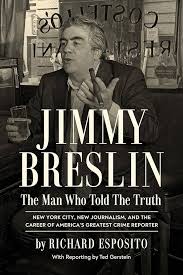
He created ” New Journalism”. He changed the work of a columnist from punditry to storytelling.Jimmy Breslin was unique, one of a kind, and the biography by Richard EspositoJIMMY BRESLIN The Man Who Told The Truth is excellent. Son of Sam, Kennedy Assassination, The Central Park Five,the big stories and those of the lessor known that make up the fabric of New York City.
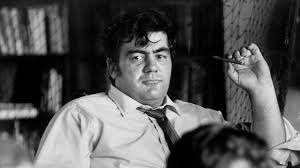
Breslin was not an easy man to either live or work with and Esposito defines him perfectly. ” Nearly everyone who met him has a Breslin story: Pugnacious, Passionate, Bombastic, Bully Buffoon, Heavy drinking, Grandstanding miserable bastard. With all of this baggage Breslin was the very best at The Trib, The Herald, The Herald Tribune, The Daily News, New York Newsday. He wrote in great company, Pete Hamill, Tom Wolfe, and in the shadow of Damon Runyon.
His columns rose from the neighborhoods of New York, especially his home turf in Queens. Tips and clues came from neighborhood bars eschewing news releases. He was a street reporter disappearing into where the stories and truths morphed into his columns. Breslin was rarely in the newsroom and then only at deadline. With whom did Son of Sam communicate? J.B. of course. Who had the insight to enlighten us of the “Gravedigger” and of the Priest who gave the Last Rights upon the death and burial of John Kennedy. Breslin with his great “storytelling” so often missed by others in a sea of ink, photos and noise.
In many ways JIMMY BRESLIN is a story of New York, by a New Yorker, for New Yorkers. It is a kaleidoscope of the 1960s, 1970s, 1980s and Esposito doesn’t miss an important player of scene. One great storyteller recognizes another.

 Gordon's Good Reads