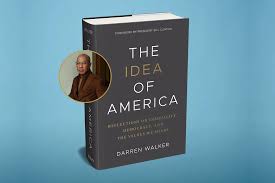
THE IDEA OF AMERICA/DARREN WALKER

I have not read a more incisive overview of inequality in all of its forms than in Darren Walker’s THE IDEA OF AMERICA.

The book is a series of speeches and essays written and delivered by Walker during his tenure as president of the Ford Foundation. It is the embodiment of his work in transforming the foundation’s mission from grant making to addressing the issues of inequality and social justice in America.

In many ways THE IDEA OF AMERICA is a history lesson based upon the premise that the founding father’s, however flawed, enshrined a fluid document of promise and hope for democracy’s future. That even, “All men are created equal,” allowed for a promise for a better future, even though codified by all white men over half of which were slaveholders and all women were excluded. Of the founders Walker adds, “They initiated a grand, complicated experiment in self-government. It led to abolition and suffrage and worker’s rights and women’s rights-however slowly, however unevenly.”

The book is not an optimistic treatise. Many thoughts are foreboding. Walker sees an America diminished by division in a climate worsening daily. ” As certain democratic norms fall away it becomes harder to motivate oneself to act. We get exhausted by, even acclimated to, the daily onslaught.”

Walker is cautious about America’s future. ” In the not-too-distant past the American people would turn to their elected leader’s the president- for guidance and moral clarity. Today, in a vacuum of such moral leadership, fear temps many Americans to hunker down , protect themselves and their interests and withdraw for the purposes of safety and self-preservation .”

Walter Isaacson casts an optimistic note in his praise for THE IDEA OF AMERICA. “Darren Walker summons us, on the 250th anniversary of our founding, to remember our higher calling.”

I commend to you this very important read on the 250th anniversary of our nation’s founding.

“`

THE BOYS IN THE LIGHT/NINA WILLNER

Nina Willner writes of her father Eddie Willner in this wonderfully crafted and researched narrative of non-fiction set in the height of WWII and the Holocaust. She merges the stories of two groups of young men one from across America the other including her father rounded up by Hitler’s SS and sent to forced labor concentration camps. Somehow fate brought them together as US Army Armored Division Company D and two Jewish teens, the author’s father and his best friend Mike met at the Battle of the Bulge.

He was just 18 when they found him, half dead after surviving five years in the camps, where both of his parents were killed. Eddie and Dutch friend Mike managed to flee their SS Guards while on a death march. With no one else left to help them Company D did.

Who were these men of Company D, what had they lived through and how was it possible that they would ultimately save the lives of two young Jewish teens who themselves defied all odds and survived?

Nina Willner tells this t story with passion as only a daughter’s love for her Dad could accomplish.

An important read during the 80th Anniversary year of the end of WWII.

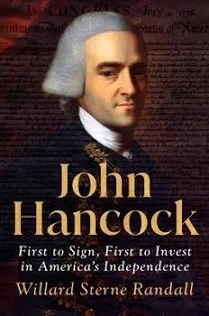
JOHN HANCOCK/WILLARD RANDALL

If you thought you knew John Hancock you are in for a great awakening!

Willard Sterne Randall’s John Hancock is most timely during this 250th year of the American Revolution. Hancock is so much more than his signature of great renown. Randall places Hancock’s importance to the American quest for democracy , the Revolution and the Continental Congresses along side Dr. Joseph Warren, Samuel Adams, John Adams and Paul Revere.

The book is far beyond a biography of Hancock but a through study of all of the critical events that led to the American Revolution. Hancock the rebel, the revolutionary, adroit politician, and incredibly successful businessman, among the wealthiest in the colony.

The son of a poor preacher sent to live with his wealthy uncle who prepared him to take over the family enterprise. He became the first governor of Massachusetts and throughout his life was an extraprdinary philanthropist during a period in which the Colonists had few resources due to British occupancy, trade restrictions, embargoes, and the war itself. The colony’s wealthiest person found food and fuel for those who had none.

A wonderful eye openming addition to your reading list of the American Revolution.

CARELESS PEOPLE/SARAH WYNN WILLIAMS

Followers of Gordon’s Good Reads know that I am not a big fan of tell all memoirs, political or otherwise. However, if you are not a fan of Mark Zuckerberg, Sara Wynn -Williams Careless People will likely confirm your feelings about the man and his company.

Here is one of the most revealing takeaways from William’s front row seat as Director of Global Public Policy for Facebook.

Facebook basically handed the election to Donald Trump. It’s pretty ( expletive) convincing and pretty( expletive) concerning Facebook embedded staff in Trump’s campaign team in San Antiono for months along side Trump campaign programmers, ad copywriters,media buyersd and data scientists. A Trump operative named Brad Parscale ran the operation together with the embedded Facebook staff, and he basically invented a new way for a political campaign.

THERE’S MORE:

Now I’m consumed by the worst of it. How facebook is helping some of the worst people in the world do terrible things. How its an astonishingly effective machine to turn people against each other and monitor people on a scale that was never possible before.

That’s what this company is and I was part of it. I failed when I tried to change it, and I carry that with me. (Williams)

It is no surprise Facebook tried to prevent publication. For what it is worth, this blogger cancelled his Facebook account several years ago.

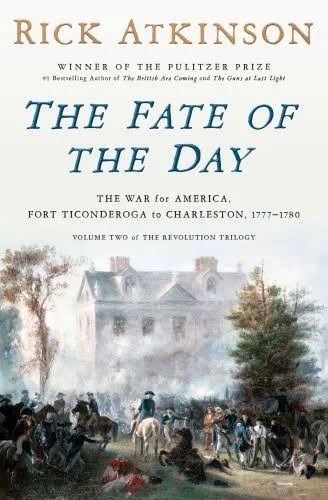
THE FATE OF THE DAY/ATKINSON

So much more to understand! That is my takeaway from Rick Atkinson’s THE FATE OF THE DAY. This is volume two of his THE REVOLUTION TRILOGY, the first being THE BRITISH ARE COMING. ( see gordons goodreads).

Volume two traces the Revolutionary War action from Fort Ticonderoga to Charleston, hardly a triumphant period for the Patriots and the Continental Army. With the exception of the astounding success at Saratoga the reader witnesses a war of attrition with insights into obscure battles, the intrigue within the British Parliament and the Crown, and the absolute inadequacy of political generals under Washington’s command.

Atkinson reveals the abject tragedy of the prolonged war. It is the very detail of Atkinson’s brilliant research that comes alive in this 618 page narrative that demands A Trilogy to tell the truth of the tale.

This reader came away with a previously unknown dimension of the Revolutionary War and volume two only builds a desire to reach for the conclusion and to understand how close we came to having no democracy at all.

The timing of THE FATE 0F THE DAY is perfect as we approach the 250th Anniversary of the Declaration of Independence. However, this volume is not a one off and is much more meaningful and relevant following THE BRITISH ARE COMING !

Reading these pages gives understanding the to enormity of the sacrifices made by those who preserved our democracy.

LEXINGTON AND CONCORD…250TH READING PREPARATION!

American independence and our nations history are of premium interest across all media. I would like to share with you three recommendations for enlightened reading of the events leading to the War of Independence and proceedings of the First and Second Congresses which lead to the Declaration of Independence of July 4th, 1776.

Nathaniel Philbrick’s Bunker Hill is a critical and remarkably readable history of events in the Massachusetts Bay Colony leading up to the ” Shot Heard Round The World” at Lexington and Concord on April 19th 1775. Though titled Bunker Hill the narrative goes far beyond that historic event putting the relationship between the Colonists and the British Parliament that lead to the war’s beginning in detailed perspective. The reader comes to an understanding of the City of Boston under Seige and how the colonist mindset there kindled a revolutionary spirit that ultimately encompassed all of the thirteen original Colonies.

A second remarkable read during this historic anniversary period is Our Lives, Our Fortunes & Our Sacred Honor, The Forging of American Independence 1774-1776, by Richard B. Beeman. While there is some historical overlap with Philbrick’s Bunker Hill, the additional perspective upon the familiar fixtures of the revolutionary movement is very worthwhile. Different takes on Samuel Adams, John Adams, John Hancock, Thomas Paine, John Dickinson, Thomas Jefferson and George Washington are found in each book. Beeman’s focus however is not on the military events of the day but more upon the First and Second Congresses in Philadelphia in 1775 and 1776 and the struggles between the patriots and the loyalists. Remember, these two conventions met while the early battles of the revolution were being fought with extremely mixed results. Beeman focuses upon the struggles for consensus that finally led to the wording of the declaration on July 2, 1776, and announced two days later on July 4th.

Who wrote the Declaration of Independence? Certainly not Jefferson as the sole author. Beeman is emphatic: The final product-Congress’s Declaration of Independence, not Jefferson’s-was in fact superior-more concise, more constrained, and, perhaps, even more elegant than the original.

Another very worthwhile read on events leading up to the Revolution is Rick Atkinson’s The British are Coming. ( see gordonsgoodreads). Atkinson has a new volume of this trilogy The Fate of the Day which will be released i later this month.

Enjoy this deep dive into American Revolutionary History.

THE FROZEN RIVER/LAWHON

Ariel Lawhon’s Novel The FROZEN RIVER continues to ride numerous Best Seller Lists. Take her advice and do not read the Author’s Notes before completing the manuscript. There is a backdrop to the story.

FROZEN RIVER is a page turner indeed. The story is set during the mid 1700s along the Kennebec River in Maine when that state was still part of Massachusetts. Meet Martha Ballard a midwife who sees all and knows all in the colonial settlement of Hallowell. Add a murder mystery that brings a cast of family, friends and long standing enemies into the center of Lawhon’s story line. It’s a small town with many not so secret secrets.

A good read by the fire during our frozen New England winter.

THE DEMON OF UNREST/ERIK LARSON/CODE DUELLO!

An enjoyable, readable academic approach to the lead up of the firing on Fort Sumter in Charleston, South Carolina Harbor and the beginning of the Civil War. THE DEMON OF UNREST by Erik Larson begins with Lincoln’s election and is a study of the pro-war extremists in the South, their hubris and misguided efforts to preserve slavery and the Cotton Kingdom. Cotton was the radicals scepter. A simple agricultural product could bring the North to its knees.

Ironically and timely, Larson also details the southern efforts to derail the counting of the electoral votes that ultimately ensured Lincoln’s victory. Often history proves that nothing is new.

Larson’s storytelling expertly reveals the heroism of Major Robert Anderson, Sumter’s commander and his beleaguered troops. The insight into Lincoln’s thought processes, often overwhelmed and extremely frustrating to his subordinates, is studied in detail. The workings of his ” Team of Rivals” cabinet is revealed as is President Buchanan’s duplicity. The plot to kill Lincoln before he took office somewhere on that long journey from Springfield, Illinois to Washington D.C. was real. Read of the ” real” life of Abner Doubleday.

Those of us who came to know diarist Mary Boykin Chesnut from Ken Burn’s Civil War will read her observations and understand her personality and the Southern pre-war mentality in even greater detail.

My takeaway from this best seller is to recommend it for those who will appreciate it’s detail and come to a greater understanding of Lincoln and the false sense of reality that drove South Carolina and the ultimate secession from the Union of the states that followed.

Also read and recommended by Gordon’s Good Reads, Erik Larson’s IN THE GARDEN OF BEASTS

James/Percival Everett/POWERFUL

It is no surprise that Percival Everett’s James is leading multiple Best Seller Lists. A ride on a raft on the muddy Mississippi with Jim and Huck misses absolutely nothing of the strife and life of slaves and their society of oppressors in the American South. The dialogue is real:

Way I sees it is dis. If’n ya gotta hab a rule to tell ya wha’s good, if’n ya gots to hab good splaIned to ya, den ya cain’t be good.  Good ain’t got nuttin to do wif da law.  Law says I’m a slave.”

Funny, humorous and always insightful Percival James has delivered a brilliant portrait as the sounds, words, and message echo in the reader’s mind long after the cover is closed. Why of course.

JIMMY BRESLIN/The Man Who Told The Truth

He created ” New Journalism”. He changed the work of a columnist from punditry to storytelling. Jimmy Breslin was unique, one of a kind, and the biography by Richard Esposito JIMMY BRESLIN The Man Who Told The Truth is excellent. Son of Sam, Kennedy Assassination, The Central Park Five, the big stories and those of the lessor known that make up the fabric of New York City.

Breslin was not an easy man to either live or work with and Esposito defines him perfectly. ” Nearly everyone who met him has a Breslin story: Pugnacious, Passionate, Bombastic, Bully Buffoon, Heavy drinking, Grandstanding miserable bastard. With all of this baggage Breslin was the very best at The Trib, The Herald, The Herald Tribune, The Daily News, New York Newsday. He wrote in great company, Pete Hamill, Tom Wolfe, and in the shadow of Damon Runyon.

His columns rose from the neighborhoods of New York, especially his home turf in Queens. Tips and clues came from neighborhood bars eschewing news releases. He was a street reporter disappearing into where the stories and truths morphed into his columns. Breslin was rarely in the newsroom and then only at deadline. With whom did Son of Sam communicate? J.B. of course. Who had the insight to enlighten us of the “Gravedigger” and of the Priest who gave the Last Rights upon the death and burial of John Kennedy. Breslin with his great “storytelling” so often missed by others in a sea of ink, photos and noise.

In many ways JIMMY BRESLIN is a story of New York, by a New Yorker, for New Yorkers. It is a kaleidoscope of the 1960s, 1970s, 1980s and Esposito doesn’t miss an important player of scene. One great storyteller recognizes another.