THE BOYS IN THE BOAT- AN EPIC STORY OF SEABISCUIT CALIBRE

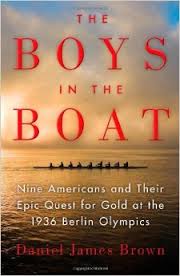
Daniel James Brown’s  THE BOYS IN THE BOAT ranks  among my top non-fiction reads of 2014.  It is a captivating human story made even more compelling by Brown’s remarkable story telling.  This book is much more than its brilliant depiction of the sport of crew with nine men acting as one in an eight pared shell.  Brown wraps their journey to victory in the 1936 Berlin Olympics  in the history of the times.  The culture of young men growing up in the lumber and mining towns of the Pacific Northwest with few prospects beyond a life of hardship and physical labor.  The author brilliantly captures the darkness of the depression  of the 1930s and its impact on families and family life. He incorporates the drumbeat of the Nazi’s, preceding the outbreak of  WW II, and the elaborate deception of Hitler surrounding the 1936 Olympic Games.

images-1

Out of this era of despair appear nine young working class men, eight oarsmen and a coxswain , who literally by chance  come together under a brilliant coach and an iconic boat builder at the University of Washington.  Among these young men is teenager Joe Rantz, a boy with few prospects in life after being abandoned at age ten by his father an step-mother.  His true story of grit and determination swells the heart of the reader right through the exciting climax of this great American drama.  The Washington eight-oared shell captured the imagination of the country much as did the underdog racehorse Seabiscuit, as so beautifully chronicled in Laura Hillenbrand’s book of the same name.

Could there ever again be nine young men more deserving of ultimate triumph ?  Could a nation in a great depression be uplifted by a sport so obscure as crew, which was  formerly dominated only by the eastern elite.  Shades of Seabiscuit versus Man O’ War!  Could Hitler’s propaganda machine receive a huge setback by nine determined young American’s in eight-oared-shell ?   It all happens because of  THE BOYS IN THE BOAT!

The legendary boat-builder and philosopher of human nature George Pocock, provides a narrative for each chapter of  THE BOYS IN THE  BOAT :  ” He came to understand how those almost mystical bonds of trust and affection, if nurtured correctly, might lift a crew above the ordinary sphere, transport it to a place where nine boys somehow become one thing-a thing that could not quite be defined, a thing that was so in tune with the water and the earth and the sky above that, as they rowed, effort was replaced by ecstasy. ”

images-2

Daniel James Brown: ” It occurred to me that when Hitler watched Joe and the boys fight their way back from the rear of the field to sweep ahead of Italy and Germany seventy-five years ago, he saw, but did not recognize, heralds of his own doom. He could not have known that one day hundreds of thousands of boys just like them, boys who shared their essential natures-decent and unassuming, not privileged or favored by anything in particular, just loyal, committed and perseverant- would return to Germany dressed in olive drab, hunting him down.”

I commend  THE BOYS IN THE BOAT to the very top of your summer reading list. Buy it in hardcover because it belongs in your library for future generations.  Also by Daniel James Brown, The Indifferent Stars Above and Under a Flaming Sky.


PIKETTY- CAPITAL IN THE TWENTY-FIRST CENTURY- THE NEWS IS NOT GOOD!

It is somewhat astonishing that Thomas Piketty’s  CAPITAL in the 21st Century remains at the very top of the New York Times Best Seller List! Not intending to be condescending, this is not an easy read even for the most ardent observers of the national and world economy.  The first 250 pages, filled with exhaustive research over a 250 year period, complete with charts and graphs, is a test of anyone’s concentration.  You may need to read many pages more than once! The good news is that once through this sophisticated and advanced course in economics, the reader will come to an understanding of the inexorable march of an economic matrix that appears to be leading to a dysfunctional environment for the capitalistic system as  we have known in America for over 300 years.  Ironically, there is  currently a billboard on the south bound FDR Drive  in New York City that reads,” The French Aristocracy Didn’t See It Coming Either! ”  images Piketty does not set out to be an alarmist but rather to lay out what he believes is the most definitive research ever completed on the subject of inequality and the distribution of wealth in America and Europe, dating back to the seventeenth century.  Admittedly, Piketty qualifies some of the early collection of data as anecdotal but at the same time has sought out all-available recorded records to track the distribution of wealth over three centuries. What is most troubling in the Piketty thesis is his substantiation of a mathematical paradigm that left unchecked , places  the concentration of wealth worldwide and particularly in the United States on an unstoppable course of disastrous inequality.  Not an exciting prospect. Piketty: ” If the growing concentration of income from labor that has been observed in the United States over the last few decades were to continue, the bottom 50% could earn just half as much in total compensation as the top 10% by 2030.”  In the United States, the most recent survey by the Federal Reserve, indicates that the top decile own 72 percent of America’s wealth,  of which the bottom half claim just 2% .  These figures clearly delineate the plight of the dwindling  middle class.  If the top ten percent  and the bottom 2 percent control 74 percent of all wealth in America, that leaves only 26% for everyone else! Fundamental to Piketty’s  thesis is that a predicted economic annual growth rate in America of 1.5 percent or less will force a greater concentration of wealth among the top decile because based upon a rate of return there will be no incentive to invest risk capital back into the economy.  The top ten percent can comfortably continue to invest capital at 4-5% ( with some hedge funds at 10-30%) and in essence keep these capital resources off the table in the hands of the super wealthy, further shrinking the middle class and decimating the lower class.  He also predicts that as future generations  of the wealthy mature, inherited wealth will be exclusively bequeathed, removing it from the general capitalistic economy, in the same manner as did the old European aristocracies.  Thus, a new American Aristocracy fueled by inherited wealth? Piketty: ” In my view, there is absolutely no doubt that the increase of inequality in the United States  prior to 2007 contributed to the nation’s financial instability. The reason is simple:  One consequence of increasing inequality was virtual stagnation of the purchasing power of the lower and middle classes in the United States , which inevitably  made it more likely that modest households would take on debt, especially since unscrupulous banks  and financial intermediaries, freed from regulation and eager to earn good yields on the enormous savings injected into the system by the well-to-do, offered  credit on increasingly generous terms.” ” If we consider the total growth of the U.S. economy in the thirty years prior to the crisis, we find that the richest appropriated three-quarters of the growth.The richest 1-percent absorbed 60 percent of the total increase of U.S. national income in this period.  It is hard to imagine an economy and society that can continue functioning indefinitely with such extreme divergence between social groups.” Capital In The Twenty First Century has raised considerably debate and the outright questioning of Piketty’s research and formulas ( r>g ). However, if you take him for his word, the forecast is not comforting and for sure,  don’t look for many rave reviews from the financial establishment! Unfortunately, if you have sensed something wrong with the economy, Piketty offers great insight but little comfort! Capital in The 21st Century  is well worth a major investment of time.

A NEW CHAPTER FOR PIKETTY’S CAPITAL IN THE TWENTY FIRST CENTURY

I have not completed Tom Piketty’s Capital in the 21st Century. I will hasten to add that  after completing the first 250 pages  I may apply for an advanced Economics Degree.   The reward for wading through research and formulas going back 200 years does however come after the academics but in the early reading the news is not good regarding income inequality  globally and in America in particular.  More on that in a future posting with another 500 pages still to complete.

images

There is breaking news today that may require an additional chapter in Piketty’s book!

Please indulge my own interpretative headline.

U.S. APPEALS COURT DEEMS TRUTH IRRELEVANT!

I was not shocked at the U.S. Federal Appeals Court decision overturning Judge Jed S. Rakoff’s rejection of the settlement deal with Citigroup, claiming that the bank had got off with a mere slap on the wrist.  The three-judge panel yesterday said Rakoff got it wrong by applying an “ incorrect legal standard.” Citigroup now pays a fine and its business as usual.

The decision becomes even more frightening, at least to the layperson, when you peel back the details of the ruling! It seems to me that the three judges were searching for a rationale to support a foregone conclusion, much like Elmer Gantry could always find a passage in the Bible to support a point of view!

Judges Rosemary S. Pooler, Raymond J. Lohier Jr. and Susan L. Carney — concluded that it “is not within the district court’s purview to demand ‘cold, hard, solid facts. ”

The appellate court instead outlined a checklist for judges to follow when weighing enforcement cases, saying they must “determine whether the proposed consent decree is fair and reasonable, with the additional requirement that the public interest would not be dis-served.” 

What a stretch!  That the public interest would not be dis-served!  How is that for a parsing of words to avoid saying that the greater public interest should be served!  Your honors, please!

The final affront comes in this quote from the appellate decision.“ Trials are primarily about truth. Consent decrees are primarily about pragmatism.”

The bottom line is that three federal judges ruling deemed Judge Rakoff the “ skunk” at the Citigroup, S.E.C. party.

A final irony in this sordid affair is that the appellate court, in closing, questioned its own judgment!

“On remand, if the district court ( Rakoff)  finds it necessary, it may ask the S.E.C. and Citigroup to provide additional information ( the truth) sufficient to allay any concerns the district court may have regarding improper collusion” between Citigroup and the S.E.C.”  I think that Judge Rakoff made it quite clear that he had MANY CONCERNS!

This disingenuous decision may require an additional 50 pages in Tom Piketty’s already voluminous   Capital in the Twenty-First Century!


REFLECTIONS ON D-DAY, JUNE 6, 1944

imgres-1

The 70th Anniversary of D-Day, June 6, 1944, has obviously peaked interested in this monumental, historic event. There are two  books I would like to recommend to those who wish to pursue the historic details of this epic event and a third which offers important insight into the citizen soldiers so critical to the ultimate Allied Victory.  Two of these books are by the same author, historian Stephen E. Ambrose.
One of the most definitive and detailed histories of D-Day:  OVERLORD D-DAY AND THE BATTLE FOR NORMANDY by  British Historian Max Hastings, first published in Great Britain  in 1984. Wrote the Englishman, ” Not the least remarkable aspect of the Second World War was the manner in which the United States, which might have been expected to regard the campaign in Europe as a diversion from the struggle against her principal aggressor, Japan, was persuaded to commit her chief strength in the west.  Not only that, but from December 1941 until June, 1944 it was the Americans who were passionately impatient to confront the German Army on the continent while the British, right up until the eve of D-Day, were haunted by the misgivings about doing do.”  “Why are we trying to do this? cried Winston Churchill.”


imgres

The author of Eisenhower, Stephen Ambrose,  wrote the quintessential  D-Day history:  D-DAY, JUNE 6, 1944, THE CLIMATIC BATTLE OF WORLD WAR II. First published in 1994 on the 50th anniversary of D-Day.  Dwight Eisenhower, ” The Fury of an aroused democracy.” Eisenhower on Omaha Beach in 1964 on the D-Day 20th Anniversary.  ” But it’s a wonderful thing to remember what those fellows twenty years ago were fighting for and sacrificing for, what they did to preserve  our way of life. Not to conquer any territory, not for any ambitions of our own. But to make sure that Hitler could not destroy freedom in the world.”


imagesHow ordinary enlisted men’s ability to assume leadership turned the tide for the Allies:  Stephen E. Ambrose, CITIZEN SOLDIERS.  First published in 1997.  From the memoir of  Bruce Eggert who rose from private to staff sergeant: ” Not a man among us would want to go through it again, but were all proud of having been so severely tested and found adequate. The only regret is for those of our friends who never returned.”

Any of these volumes would make a wonderful Fathers Day gift for lovers of history. All are still available in hard cover and paperback editions.


FINANCIAL CRISIS BOOKS-TWO GREAT OVERVIEWS

The Sunday May 18th  New York Times carried two wonderful overviews of two current books on the financial crisis. If you are following this odyssey both articles are most worthwhile. Gretchen Morgenson’s Fair Game column, Geithner Staying on Script  dissected Geithner’s Stress Test  self-defense book with precision!  In my view no reporter is better than Morgenson in getting to the bottom of  complex financial issues and her article is enlightening and the conclusions on point.  Writes Morgenson,

images

“Mr. Geithner does do some introspection. “I did not view Wall Street as a cabal of idiots or crooks,” he writes. “My jobs mostly exposed me to talented senior bankers, and selection bias probably gave me an impression that the U.S. financial sector was more capable and ethical than it really was.” That’s as close as he gets to saying that he was wrong to trust — not question — bankers he encountered.

A final flaw: In his book, Mr. Geithner boasts that the bailouts he helped design have been profitable to taxpayers. But his calculations do not take into account the cost of capital that the taxpayers extended to the banks.

Concludes Morgenson

“As for the oversight mistakes that he and his regulatory colleagues made, Mr. Geithner essentially says “We were human.” But this fails to address head-on the possibility that he was a captured regulator, a man locked into the mind-set of the very bankers he was supposed to oversee.”


http://nyti.ms/1oADWtM


images-1

The second article, written by Binyamin  Appelbaum, The Case Against The Bernanke-Obama Financial Rescue, reviews a new book by Atif  Mian and Amir Sufi titled House of Debt.  The authors flatly accuse Timothy Geithner and Ben Bernanke of focusing only on preserving the financial system ( the banks).  From Appelbaum’s  article ”

“If you actually look at the argument that people like Mr. Geithner make, they almost always point to financial metrics like risk spreads and interest rates,” he said. “But if you look at the real economy, it just tends to come out in our favor.” Millions of Americans remain unemployed almost five years after the formal end of the recession.”


http://nyti.ms/1lwE9YE

I have not as yet read either Stress Test or House of Debt.  These two overviews are great previews and set the table for two more good reads on this complex subject, a story which has no ending.


The Barbarous Years – The Original American Immigrants

Pulitzer Prize winning author Bernard Bailyn writing The Barbarous Years opens a sweeping and authoritative discourse into the  peopling of North American between 1600 and 1675.  From Jamestown, Virginia to Plymouth and the Massachusetts Bay Colony, who were these individuals who braved three plus months voyages on small, crowded and disease infested ships to arrive at the edge of the American wilderness? You will learn not only who they were but why some succeeded while others were destined to fail.

images

No one needs tout Bailey’s credentials as historian and researcher. He is brilliant. However, what is most remarkable is his ability to keep the subject flowing, fascinating and understandable for the lay reader. Bailyn delivers in brilliant digital display the complexity and challenges of the people responsible for the early settlement of North America.

Think of this:

Why did the Jamestown fail numerous times?

Why did the Catholics establish a foothold in Maryland and the Finns and Swedes in Delaware?

Why did The Massachusetts Bay Colony begin to work from day one.? Was it religious fervor or the composition of the settlers themselves?

What role did the varied Native American tribes play in the success or failure of early settlement.

How did the Pilgrims differ from the Puritans and the aforementioned from the  Quakers and the Dutch?

Were indentured servants a precursor to slavery?

Winthrop, Bradford ,Stuyvesant, Keift, Underhill, King Philips War.

The Barbarous Years that marked the original settling of America is a most accurate title for the book. Adventurers, scoundrels, orphans, preachers, doctors, lawyers, Native Americans, politicians, merchants and perhaps most important, the hundreds of unnamed families with children who came to America during the Great Migration of the 1630s , bringing with them the skills and the ethic to permanently settle on the land.

The ” New World” was British North America during its early settlement but Bailyn clearly identifies the complexity of cultures, trade and geography that would eventually become America. The Barbarous Years is a fabulous foundation for understanding colonial America’s formative years. Also by Bernard Bailyn: The Ideological Origins of the American Revolution, The Ordeal of Thomas Hutchinson, and Voyages to the West, which won a Pulitzer.

A wonderful different perspective of the  settlement of the Massachusetts Bay Colony comes from reading Anya Seton’s historical novel Winthrop Women. Search Gordonsgoodreads.com


BEN CARSON’S VIEW OF AMERICA THE BEAUTIFUL

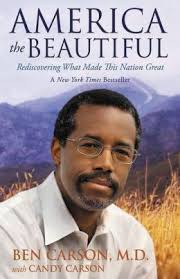
Two pieces of information converged upon me this week.  A family member sent me a book,America The Beautiful, written by acclaimed neurosurgeon Dr. Ben Carson.  Simultaneously I learned that in the straw poll at the CPAC conference in Washington that Carson finished third in the presidential poll behind Ted Cruz and Rand Paul.  Surprisingly he ranked ahead of Chris Christie!  I quickly turned to the book.

imagesBen Carson is an African-American who has distinguished himself in the medical profession after rising up from a childhood of poverty in Boston and Detroit to live the American Dream. He is also a much sought after speaker.  Without question Carson is a conservative with his credentials and beliefs clearly outlined in America The Beautiful.   He is also a devout Christian and strongly connects his social and political views to his belief in God. The book details much of Carson’s philosophy and substantiates many of his views with the historical founding fathers references to a higher power.

If Carson becomes a greater factor in Republican politics you may wish to read his narrative, and learn why he is at the opposite end of the spectrum from President Obama.  In some parts of the book Carson becomes a political moderate while elsewhere he rings the clarion that America is moving toward socialism and expresses great fears that President Obama’s desire to redistribute wealth will guarantee that outcome.

Carson willingly credits America’s social support system as playing a vital role in his own rise from poverty while at the same time he decries a welfare system that he believes spawns laziness. However, in an odd twist, he calls for nationalizing the health care system with the government limiting insurance company profits and establishing rates for hospital and medical services! Sounds a bit like Obama Care.

Dr. Carson poses an interesting option when looking at the Republican field of 2016 presidential candidates. Clearly he is very conservative but in comparison to Rick Santorum, Sarah Palin and even Ted Cruz and Ron Paul he is a moderate!

American The Beautiful was among the New York Times Best Sellers for many weeks.  If you are interested in following the GOP political mix this book is a good choice. My guess is that the country will be hearing more from Ben Carson.

TWELVE YEARS A SLAVE-THE BOOK-A DOCUMENT OF HISTORIC PROPORTION

It is astonishing to this reader that Solomon Northrop’s narrative TWELVE YEARS A SLAVE lay silent in literary archives for over 100 years. Each compelling paragraph cries out to be voiced and has not lost one syllable over the decades, as indicted in the book’s dedication to Harriet Beecher Stowe whose Uncle Tom’s Cabin is throughout the world, identified with the reform of slavery.

images-1

I have seen the Oscar-winning motion picture but if you have not I urge you to read the book first. No film could begin to capture the depth and emotion evoked in the 336 pages of this personal narrative. By reading the book, the movie will become enormously more meaningful because it fills in all of the subtleties that could not possibly be accomplished by directors and editors.

“The institution that tolerates such wrong and inhumanity as I have witnessed, is a cruel,unjust and barbarous one.  Men may write fictions portraying lowly life but let them toil with him in the field, sleep with him in the cabin, feed with him on husks; let them behold him scourged, hunted, trampled on, and they will come back with another  story in their mouths. ”   Northrup’s narrative describes how the ” institution ” passed from father to son. ” Mounted on his pony the 12-year-old child  rides into the field with his whip playing the overseer , greatly to the father’s delight.  Without discrimination he applies the rawhide, urging the slaves forward with shouts, while the old man laughs and commends him as a thorough-going boy.’

Solomon Northrup , in his own words: ” This is no fiction, no exaggeration.  If I have failed in anything, it has been in presenting to  the reader too prominently the bright side of the picture.Those who read this book may form their own opinions of this peculiar institution.”

TWELVE YEARS A SLAVE, the book and the movie combine to make a powerful testament to one of the darkest periods in American history.

HOW THE OTHER HALF LIVES- KEEP PRINT JOURNALISM ALIVE AND WELL!

Jacob Riis’s book How The Other Half Lives, written in 1890, remains an outstanding example of the importance of investigative journalism and the continued vitality of the Fourth Estate.

images-3

Jacob Riis was among the earliest of what Theodore Roosevelt later termed ” muckraker”, “taking the rake to uncover the most unpleasant conditions in American society.”  In Riis’s case, the issue was the plight of thousands of immigrants living and working in horrid conditions in the New York City tenements of the late 19th century. How The Other Half Lives is not a historical novel but rather a work of non-fiction, well researched reporting, personally witnessed by the journalist.

Riis was himself an  immigrant, born in Denmark among a family of fifteen children. He apprenticed as a carpenter in Copenhagen but discouraged by job availability he immigrated to the United States in 1870 at age  21.  Having caught a brief glimpse of the squalid living conditions among immigrants in New York’s tenement district, he left for western Pennsylvania and found work there as a carpenter. Perceived as being taken advantage of by his employers, he returned to New York as a salesman of flat irons whereupon he saw an advertisement for a Long Island newspaper looking for an editor. Thus, with no experience as a writer, he began his career in journalism.  He later accepted a position as a reporter for The New York News Association where he began writing with assignments covering both the rich and the impoverished. Riss was aware of conditions among the extremely poor in New York from his previous brief stay in and around the notorious Five Points. However, his job at the NYNA, the New York Sun and later in a big step up to the New York Tribune , he found a pulpit from which to begin informing the public on How The Other Half Lives .  Riis turned his print platform into a personal crusade, attempting  to alleviate the bad living and working conditions of the poor by exposing their horrid circumstances to the people who could make a difference, the middle and upper class of the city and its political establishment. Riis was perfectly willing to hold both the upper class and politicians accountable for the exploitation of men, women and children in both employment and housing. The pages of his early articles for Scribner’s Magazine and later in the complete volume How The Other Half Lives  are so vivid that uninformed critics, in disbelief, termed the details of his reporting an exaggeration and sensationalism.

Surely this work is an early reformist look at income inequality but  Riis referred to this large percentage of the New York City population as a class  unto itself, literally without identity or voice, enslaved by landlords who exploited their fears. The same people were recruited as the machinery of piecework in the early garment and cigar making industry at wages below any standards of decency.  The tenement  districts in New York exploded with thousands of men, women and children crowded into one or two rooms often without ventilation, sanitation or running water. Riss estimated that at one fifth of the city’s population lived under these conditions.

There is a major difference between Riis’s reporting and sensationalism. Riis spent months in the tenements, which were factories by day and barely livable sleeping quarters by night.  His research was impeccable and he was among the very first reporters to incorporate photo journalism into his stories, utilizing the newly invented flash to photograph his subjects in their darkened rooms. His work was the beginning of photo journalism, adding documentation to the written word.  The photos and editorial content had dramatic impact with his readers  and ultimately gained the attention of New York’s newly elected Police Commissioner, Theodore Roosevelt.  Riis became an advisor to Roosevelt, escorting him on nighttime  tours for the commissioner to see for himself how the poor were forced to live.  Many credit this educational relationship with Roosevelt as the beginning of the Progressive Movement, a hallmark of TR’s future  presidency.

After Roosevelt’s election he wrote this tribute to Riis. ” Recently a man, well  qualified to pass judgement, alluded to Mr. Jacob Riis as  ‘ the most useful citizen of New York.’  The countless evils which lurk in the dark corners of our civic institutions, which stalk abroad in the slums, and have their permanent abode in the  crowded tenement houses, have met in Mr. Riis the most formidable opponent  ever encountered by them in New York  City.”

How The Other Half Lives was first published as an article in Scribner’s  Magazine in 1889, but  while working for the New York Sun, Riis expanded the work into the book, complete with his photographs and published it a year later.  A much less famous work by Riis, Children of the Poor was published as a sequel in 1892. In it Riis wrote of children he had encountered while researching How The Other Half Lives.

images-2

Riis was not alone among a new breed of investigative {muckraker) journalists.  In 1872 Julius Chambers wrote an expose of institutional horrors in Bloomingdale Asylum  and in 1887 Nellie Bly wrote Ten Days in a Madhouse a story of patient abuse in Bellevue Hospital.   By the turn of the 20th century McClure’s Magazine had assembled a group of new muckrakers including Ida Tarbell, Lincoln Steffens and Ray Stannard Baker, exposing the Standard Oil Trusts and labor unrest in the coal mines and steel mills.

One wonders  how slowly  reform among the immigrants of New York’s tenements may have come without the reporting of Jacob Riis.  How The Other Half Lives  punctuates the importance of  investigative journalism in the fabric of a democracy. In the 20th Century we saw the results of the journalistic work of the Washington Post’s  Ben Bradlee, Bob Woodward and Carl Bernstein in their reporting of Watergate.  Currently we are witnessing excellent journalism in the New York Time’s recent series Invisible Child, the brilliant work of reporter Andrea Elliott and the ongoing reporting of Times business journalist Gretchen Morgenson,  together with her book Reckless Endangerment.  

In this readers view, Television, the 24-hour cable news cycle and the endless world of blogs have a long distance to travel before coming close to the credibility and impact  of the work of Jacob Riis and those following in his footsteps.  If you are a  student of New York, treat yourself to a journey back to the nineteenth century and read How The Other Half Lives.  It will make you want to keep buying a newspaper, print or digital!

THE BULLY PULPIT –NOT JUST TEDDY–A NEW LOOK AT TAFT–THE RISE OF THE MUCKRAKERS

Who would place in the same context Teddy Roosevelt and William Howard Taft?

images-2

Doris Kearns Goodwin, just as she did with Lyndon Johnson and the American Dream, No Ordinary Time (FDR and Eleanor), Team of Rivals (Lincoln) has humanized Teddy Roosevelt and William Howard Taft in The Bully Pulpit, Theodore Roosevelt, William Howard Taft and the Golden Age of Journalism.  It is remarkable that by comparing these two very different personalities, Goodwin has been able to create a finite understanding of the birth of the Progressive era in American politics.

This extremely well researched work probes so deeply into the personalities of the two that the reader is left wondering who might have been the better to successfully carry out the reforms of the Progressive Movement, TR or Taft! The book captures the two friends joined at the hip, partners in a mission of reform, and then torn apart by TR’s un-checked ” Bull Moose” ambition; finally coming together again after self-imposed mutual defeat. It reminds me of the deathbed reconciliation of Thomas Jefferson and John Adams so emotionally detailed in David McCulloch’s, John Adams.


The Bully Pulpit is four books in one! The reader is served up two great biographies, one of Theodore Roosevelt, the other of William Howard Taft. The other two Goodwin gifts are an understanding of the birth of the Progressive Movement in America and not by any means in descending order, the advent of investigative and advocacy journalism, Muckraking, in American politics. The Bully Pulpit establishes the critical role played by the press in determining public policy at the turn of the 20th Century. The term Muckraker has a new meaning in Goodwin’s book and the role of S.S. McClure’s  McClure’s magazine in promoting progressivism is a book unto itself.

Read about muckraker journalists Ida Tarbell, Ray Stannard Baker, Lincoln Steffens and William Allen White, including the unique relationships they established with both Roosevelt and Taft. The insight given into Publisher Sam McClure’s ambitious role of investigative journalism shaping national policy can be projected into the 21st Century. When asked by Sam McClure to embark on a series of investigative articles on labor strife, journalist Ray Baker replied, ” Why bother with fictional characters and plots when the world was full of more marvelous stories that were true: and characters so powerful, so fresh, so new that they stepped into the narratives under their own power.”

Great books stimulate and The Bully Pulpit, while is has the greatest emphasis on Teddy Roosevelt, raises dramatically the profile of President Taft and his wife Nellie. Taft defies a Progressive, Liberal or Conservative label. He could not be easily categorized in the 21st Century political vernacular. His wife Nellie, unlike Edith Roosevelt, played a large role in Taft’s decisions which was prescient indeed for the relationship that followed between his successor Woodrow Wilson and his wife, Edith.

One of the reasons that The Bully Pulpit is so compelling is that the philosophies, conflicts and important social issues of the time could just as well have been written about the beginning of this century.

The following paraphrase from The Bully Pulpit was made by President Roosevelt in 1905 at the beginning of his presidency, in effect separating the Republican Party into Progressive and Conservative factions. ” If the people at large perceived that the Republican Party had become unduly subservient to the so-called Wall Street men–to the men of mere wealth, the plutocracy, it would result in a dreadful calamity. To see the nation divided into two parties, one containing the bulk of the property owners and conservative people, the other the bulk of the wage workers and the less prosperous people generally, each party sullen and angered by real and fancied grievances would bring a calamitous future.”

With that perspective, in the spirit of Ray Baker’s ” why bother with fiction,” there is more grist for the mill for historians and Muckrakers to ponder in today’s America.

Note: For lovers of history one good read prompts another. I will seek out the biography  William Howard Taft by Louis Gould and one of Sam McClure, The Muckrakers by John Simkin.