BLACK RADICAL/WILLIAM MONROE TROTTER

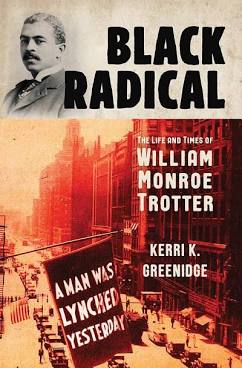
Kerri K. Greenidge in her book BLACK RADICAL THE LIFE AND TIMES OF WILLIAM MONROE TROTTER isa bold revelation of civil rights history in America. The insight into this heretofore obscure figure in the civil rights movement is a great historical contribution. The research and careful narrative evolve into a tableau of the life of this early activist who followed in the Boston tradition of William Lloyd Garrison’s Liberator with his own publication The Guardian.

F

Trotter turned Boston and New England civil rights activism on its head taking a no holds barred approach at his overflow rallies at Faneuil Hall and his in-your-face challenges to Teddy Roosevelt, Woodrow Wilson and Booker T. Washington. No Tuskegee philosophy for Monroe Trotter as his demands for equality were absolute. So strong were his protestations that even staunch advocates such as W.E.B. Dubois and Frederick Douglas stood back.

Unlike other members od Du Bois’s ‘talented tenth’ (mostly light-skinned black elites) Monroe Trotter would never confine his civil rights activism to the circle of black elite on Martha’s Vineyard, or the coterie of fellow light skinned northern born professionals with whom he socialized in Washington D.C., and Brooklyn.  Despite his New England upbringing and Victorian sensibilities, Trotter provided a voice for thousands of disenchanted, politically marginalized black working people for whom neither the National Negro Business League nor the NAACP had much relevance.”

Follow this Harvard man’s radical fight for a Federal antilynching bill and the enforcement of the Thirteenth, Fourteenth and Fifteenth Amendments as he defiantly confronted the white power brokers of the time.

I am thankful to Kerri Greenidge for telling this story.

FIRST Principles/THOMAS E. RICKS

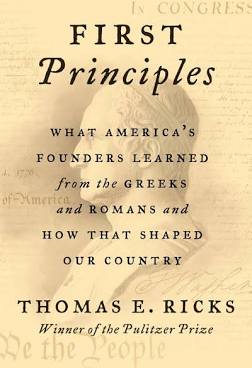
As readers of this blog may know I am a fan of John Adams and have within these pages questioned historian Gordon Wood and others regarding objectivity concerning Adams, in particular in comparison’s to Jefferson. Thomas E. Rick’s new book FiRST Principals, WHAT AMERICA’S FOUNDERS LEARNED from the GREEKS and ROMANS AND HOW THAT SHAPED OUR COUNTRY makes a herculean effort to connect the thinking of the Founding Fathers with that of the ancient Greeks and Romans as they organized their governments and laws.

Ricks authors an in depth analysis of the political and ruling organizations of those ancient times and attempts to connect them to the thinking of those who founded the fledging America. You will need to judge whether or not he succeeded.

In addition to the ancient perspective, throughout the book Ricks finds ways to circle back to his passion of comparing the thinking of John Adams and Thomas Jefferson during America’s daybreak. Like historian Gordon Wood his writing becomes clouded with his reverence for Jefferson and I think disdain for Adams. So often, Ricks seems to go out of his way to demean Adams’s thinking while praising, and in this readers view, making excuses for Jefferson’s shortcomings. He brushes past Jefferson’s slaveholding, his virtual disappearance during the Revolutionary War and his relationship with fourteen-year-old Sally Hemings. The book does not recognize the depth of Jefferson’s disdain for Federalism and his advancement of the superiority of states rights over a strong federal government. ( The continuation of the “Plantation” economy and expansion of slavery.)

In fairness, I think Ricks is himself conflicted about John Adams. On the one hand he references Adam’s best known work A Defense of the Constitutions of Government of the United States of America as, The sole piece of writing he finished that is longer than an essay. However just two paragraphs later Ricks writes, Adams in turn wrote , there can be no government of laws without a balance and there can be no balance without the three orders. Sounds like executive, judicial and legislative to me. No surprise here because John Adams is credited with authoring the Massachusetts Constitution which in 1788 became the blueprint for the U.S. Constitution.

With regard to what the founders learned from the Greeks and Romans I must confess that Ricks gives Adams his due. Quoting from a famous John Adams essay in the Boston Gazette in 1765 titled Let Us Dare , Let us dare to read, think, speak and write. Let every order and degree among the people rouse their attention and animate their resolution. Let them all become attentive to the grounds and principles of government, ecclesiastical and civil. Let us study the law of nature; search into the spirit of the British Constitution; read the histories of ancient ages; contemplate the great examples of Greece and Rome.

This essay was written just as the Stamp Act was passed by the British Parliament which many consider to be the final spark that ignited the American Revolution. This is Adam’s prescient thought in the opening lines of Let Us Dare. Liberty. . .which has never been enjoyed, in its full perfection, by more than ten or twelve millions of men at any Time, since the Creation, will reign in America, over hundreds and thousands of millions at a Time.

Getting past my defense of Adams, Rick’s book creates a superior condensed history of the Revolutionary War, the rise of George Washington, the telling of the Adams, Jefferson, Burr election of 1800, the impact of James Madison and the evolution of political parties in America. His epilogue ” What We Can Do” is filled with positive responses to what America has learned from history and the founding fathers.

First Principles is a great read for those who are looking for a deep dive into a slice on early American history.

BETWEEN THE WORLD AND ME/ TA-NEHISI COATES

TA NEHISI COATES, BETWEEN THE WORLD AND ME . A letter to an adolescent son.  Not unlike  The Soul of Black Folks by W.E.B. Dubois. ( search gordonsgoodreads).  An extraordinarily powerful book. Toni Morrison is correct, “This is required Reading.”   Think of writing this to your own son or daughter:  At the onset of the Civil War, our stolen bodies were worth four billion dollars, more than all of America industry, all of American Railroads, workshops and factories combined.

BETWEEN THE WORLD AND ME  could not be more relevant than in today’s discourse. The  messaging is profound, deep, touching and real.  The type of book that those who need to read it most likely will not.  Please choose yes and be enlightened.

THE DEFICIT MYTH/ A MUST READ FOR THE TIME

Stephenie Kelton’s book The DEFICIT MYTH, Modern Monetary Theory and the Birth of the People’s Economy explodes the economic myths that have been dictating the U.S. economy for generations.  The title speaks for itself and I could not recommend a more timely read to understand and explore a new approach for our economy to serve the needs of this generation. Kelton’s explodes  time honored “bromides:”   “We can’t afford it, We are mortgaging our children’s future, SS will go broke,”  ” If our generation continues to use the wrong lens, we will not make the right investments at the scale and pace needed to avert ever greater social and ecological crises.”

Kelton’s Modern Monetary Theory pushes the envelope of economic thought and the book is even more appropriate during the current pandemic and economic disaster.  Kelton advances MMT as new wave problem solving that ironically has its roots in 1936 with John Maynard Keynes.  A perfect read for the time for those who are looking for answers beyond the myths of current economic thinking.

This is an A List recommendation from GGR.

THE PRICE OF PEACE/THE LIFE OF JOHN MAYNARD KEYNES/ TIMELY!

Zachary Carter’s  THE PRICE OF PEACE, MONEY, DEMOCRACY AND THE LIFE OF JOHN MAYNARD KEYNES  Is  a timely biography of the world’s most famous economist.  The Keynesian economic philosophy, so prominent in the 20th Century, strikes a relevant chord in today’s economic disarray. The book strikes at the heart of income inequality, an inegalitarian society, racism, and the damage to  American by the economic control of nearly all wealth the top ten percent.

THE PRICE OF PEACE tracks the life of Keynes and the Keynes philosophy from the lead up to WWI through  the Great Depression, the New Deal and WWII.  Carter makes every word in every paragraph count. The book is for those seeking a serious look at Keynes’ brilliant insights and yes, not always popular solutions.  Current events in America suggest that  ” Keynesian Economics” has stood the test of time and may be more relevant that ever.” If you believe that systemic change is needed in the polemic and the economic structure in the United States, you will find support and comfort on these pages. i

“Keynesianism in this purest, simplest form is not so much a school of economic thought as a spirit of radical optimism, unjustified by most of human history and extremely difficult to conjure up, preciously when it is most needed.

Put the work into this book. You will be richly rewarded.

SAVING THE MEDIA/ PRINT/RADIO/TELEVISION/ WHAT’S NEXT? A REVOLUTION?

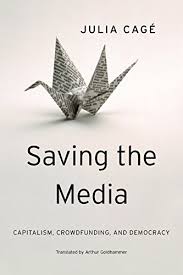
Economist Julia Cage in her book Saving the Media  offers critical insight into the closing of hundreds of newspapers in both large American cities and small communities.  The sum total of the decrease in local news coverage has created a void in political and civic accountability in America and around the world. ” In the United States the decline in the number of journalists employed by the daily press began in 1990, when there were 57,000 daily journalists as compared with 38,000 today. Both the 2008 financial crisis and the Internet have much to do with the decline. The impact of the Internet has greatly reduced print media advertising. It has also impacted to a somewhat lesser degree both radio and television. The result has been cost saving dramatic  reductions of journalists across the spectrum.

Cage’s book is a consolidated read. It is filled with thoughtful analysis of the impact that reduced news coverage is having on the body politic and the very existence of the democratic process.  Not to be left on a cliff, Cage offers potential creative and far sighted options for journalism. ” What must be recognized is that the news media provide a public good, just as universities and other contributors to the knowledge economy of the twenty-first century do. For that reason they deserve special treatment by the government.” Cage brilliantly advocates for a new form of non-profit organization for the news media!

I highly recommend this French Economist’s insight into the future of journalism worldwide.   She has worked closely with Tom Piketty, the famous French Economist who has researched and written extensively on income inequality. Search overviews  of his two most recent books here at gordonsgoodreads.


CAPITAL AND IDEOLOGY IN A PANDEMIC WORLD

The Coronavirus Pandemic, among many other great issues, has laid bare the deep divisions in America caused by income inequality. It is clear that those at the bottom of the economic spectrum, for a variety of reasons  including access to health care, are suffering the most. So what does this have to do with economics?  A great  deal.

Capital and Ideology, the new volume by economist Thomas Piketty traces the history of income inequality from ancient eras to modern day America, Europe and Asia.  Not an easy read, the 1000 plus pages of narrative and graphs define in depth all aspects of inequality and its impact upon the human condition. Piketty’s  historical research is impeccable.  Will the persistent growth of income inequality change society forever?  Will it  create a modern day aristocracy passing wealth from one generation to the next,  permanently dividing the economic class structure in all of the world’s democracies. The research places America at particular risk with 75% of all wealth already controlled by the 10% wealthiest.  Piketty clearly demonstrates his belief that this  ratio of income distribution is not sustainable.

Capital and Ideology is a sequel to Piketty’s Capital in the 21st Century which lays the groundwork for his new book.  ( search gordonsgoodreads.com)

THE SOULS OF BLACK FOLK/ W.E.B. Du Bois

THE SOULS OF BLACK FOLK written in 1903 by W.E.B. Du Bois is a remarkable and insightful read, most relevant during Black History Month. This narrative which begins following the Emancipation Proclamation peels back every layer of the condition of the former slaves lives in the post Civil War era through the early years of the 20th Century. ” The Nation has not yet found peace from its sins; the freedman has not yet found in  freedom his promised land.”  

There is a contemporary book, a perfect companion read to Du Bois.  Eric Foner’s THE SECOND FOUNDING/ HOW THE CIVIL WAR AND RECONSTRUCTION REMADE THE CONSTITUTION.   The  book is an in depth academic study of the Thirteenth, Fourteenth and Fifteenth Amendments to the U.S. Constitution.


THE EDUCATION OF AN IDEALIST/ SAMANTHA POWER/ DIPLOMACY MATTERS

I just completed former UN Ambassador Samantha Power’s memoir THE EDUCATION OF AN IDEALIST. She is also the author of A Problem from Hell, America and the Age of Genocide which was awarded a Pulitzer Prize. Her latest book is extremely timely in light of the current focus on diplomacy as the result of the Trump impeachment inquiry. It’s insight  during Power’s earlier career as a reporter in Bosnia has direct ties to what is currently happening to the Kurds in Syria.

THE EDUCATION OF AN IDEALIST is a deep dive into foreign policy during the Obama Administration and how diplomacy and the UN functions.  Power writes, It is true that the foundation of US leadership abroad is the strength of our democracy at home. But it is also indisputable that the policies we pursue overseas can have huge effects-good and bad-on our daily lives.

Let me hasten to add that Power is remarkably candid in this memoir. She came to America with her divorced mother as an immigrant from Ireland. She prospered, became an acclaimed reporter starting from the ground up filing stories on spec from the war zone in Bosnia. That background led her to serving in the Obama administration and ultimately being appointed and con firmed to the UN Ambassadorship. In light of current events the book is extremely relevant as evidenced in this Power quote. The insistence of diplomats to go on serving their country, even when being ignored and insulted, because they know that our nation is bigger than any one leader. Prescient!

Presidential historian Doris Kearns Goodwin says it best.  Samantha Power’s captivating memoir is a rare and intimate revelation of the inner workings of international diplomacy as well as a heartwarming beacon of a book for young women and men everywhere.


FREDERICK DOUGLASS/ PROPHET OF FREEDOM

FREDERICK DOUGLASS/ Prophet of Freedom by Yale University Professor David W. Blight is a definitive insight into slavery, the abolitionist movement, The Civil War, Reconstruction and Jim Crow.  Moreover, this essential biography delivers a remarkable look into the personal life and character of Frederick Douglass, the remarkable man and his devotion to humanity.  This in depth work by Blight is an education, and as I have previously referenced in other great works of biography, every single word printed upon the 764 pages counts. There is little wonder that The New York Times honored this work as one of the Ten Best Books of the Year.  I wholeheartedly agree.


Frederick Douglass followed William Lloyd Garrison to become the single most important voice of the abolitionist movement. Douglass, the self educated escaped slave was among the greatest writers and the unequaled orator of his time. He wrote three autobiographies, edited two newspapers and delivered hundreds of lectures in small and large communities throughout the country.   Blight captures the enormity of Douglass’s impact on a segregated slave holding nation during the mid-eighteenth century and throughout the Civil War. Following the war, Blight unveils Douglass’s sense of extreme urgency over the fate of his people throughout the tragedy of Reconstruction, and the coming of Jim Crow. Blight leaves no doubt that Frederick Douglass was a revolutionary in his time.

‘’For it is not light that Is needed, but fire; it is not the gentle shower but thunder. We need the storm, the whirlwind and the earthquake. The feeling of the nation must be quickened….the hypocrisy of the nation must be exposed.”   Frederick Douglass, July 4th 1850,  Corinthian Hall, Rochester New York. Douglass could move an audience at will.

FREDERICK DOUGLASS/Prophet of Freedom, a biography of the most important African American of the 19th Century.

This book is an excellent companion read for anyone following The New York Times Podcast 1619.