WikiLeaks,The Brooklyn Bridge,Suspension

The New York Times revealed on Wednesday April 26th that the latest WikiLeaks distribution tells a story of plots to bring down the Brooklyn Bridge. “Al Qaeda has long had a fascination with suspension bridges, especially the Brooklyn Bridge. New documents reveal that before Sept. 11, 2001, methods for bringing down bridges were being taught at a terrorist training camp in Afghanistan, ” says the Times.
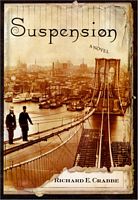
The longer I write this blog the more flashbacks I have to books I have read that connect with current events.  If you are interested in reading of terrorist plots, sabotage and sophisticated murder mysteries written on the level of Caleb Carr and wish at the same time to connect with the glorious history and construction of the Brooklyn Bridge I commend Suspension, a novel by Richard Crabbe. You will also discover an important Civil War connection with the bridge.

Written in 2010, Crabbe builds his story around a murder mystery that leads to a plot to sabotage the bridge by seven former Confederate soldiers who labored for years to hatch a plot to destroy the bridge because of a deep hatred for the Yankees who vanquished them in the Civil War. The Brooklyn Bridge?  Of Course! Washington Roebling the son of  Brooklyn Bridge designer John Roebling was placed in charge of the project upon the death of his father.  Washington Roebling was a distinguished Union Army Civil War officer having served with particular distinction at the Battle of  Gettysburg.  Thus Roebling’s ” Yankee-Bridge” became an even more meaningful target!

A wonderful mystery with vivid details on the construction and history of the most famous bridge in the world. Crabbe’s first novel qualifies as excellent in both plot and storytelling.

GOOD READS AT THE MOVIES

Two movies open in the next week that I am hopeful are worthy of the book Water for Elephants and the subject of many great reads the Lincoln assassination. Robert Redford’s The Conspirator opens on April 15 and Water for Elephants opens on April 22. Should be good films from good reads! I know, it is not always the case but lets be hopeful.

Civil War/ Lincoln Assassination/ Anniversary Week

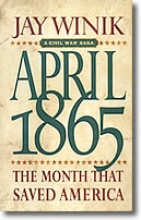
Today, April 12, marks the 150th anniversary of the beginning of the Civil War with the firing on Fort Sumter, South Carolina.  April 15, Friday, marks the 146 anniversary of the assassination of Abraham Lincoln.  Earlier this week I commended to you Jay Winik’s April 1865,  an important work of non-fiction on the assassination and the tumultuous period that followed.

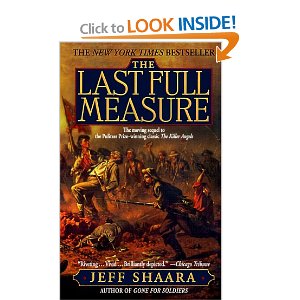
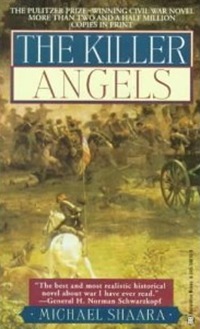
Hundreds of volumes have been written on the Civil War. On this anniversary I suggest to you three writings of fiction that I believe will give the reader the most vivid portrait of this monumental period in American History.  If you choose to read them all, I would suggest the following order.  Jeff Shaara’s  Gods & Generals, Michael Shaara’s Killer Angels ( The battle at Gettysburgand then Jeff Shaara’s The Last Full Measure. Jeff Shaara is the son of Michael Shaara.

These three historical novels describe the Civil War from the viewpoint of those who fought in and directed the great battles.  You will be present at the siege of Richmond, at Pickett’s Charge and on Little Round Top with the 20th Maine at Gettysburg and at the  Confederate surrender at Appomattox Courthouse .

The knowledge of the Civil War that you will gain from these three works of historical fiction is  priceless!

Jay Winik, April 1865 The Month That Saved America

Robert Redford’s latest  offering as a movie director, The Conspirator opens across the country on April 15, which is the 146th anniversary of the assassination of Abraham Lincoln. The movie encompasses the trial of four accused conspirators including Mary Surratt. The publicity surrounding the release of this film, which I intend to see, caused my immediate recall of Jay Winik’s fabulous 2001 book April 1865, The Month That Saved America. 

Winik’s insightful analysis of what really happened during that last month of the Civil War and following Lincoln’s assassination is frightening.  He writes in detail of what occurred as the country fell into chaos and how a  few statesman turned to the United States Constitution to maintain order and establish a  transition not only of the presidency but for the country itself.

Whether you read April 1865 in conjunction with the movie or separately it is most worthy of the time of all who  have a passion for American History.

FOR DAVID BROOKS, A DEBT OF GRATITUDE

The  writing in the dust cover of  David Brook’s The Social Animal concludes with these words ” The Social Animal is a moving and nuanced intellectual adventure, a story of achievement and a defense of progress. Impossible to put down, it is an essential book for our time. ”  

That brief summary, though accurate, misses thousands of emotion packed paragraphs and words that help the reader understand the human condition and the  conscious but more importantly the unconscious actions and perceptions of the human mind.  You will ask yourself time and again, ” Is that me?”

You may keep turning back to the cover just to check if David Brooks wrote this book!  That is not criticism but rather a joyful revelation into the depth of a  writer whom I have always admired but on a more superficial level.  The Social Animal, among all  he has written , is in my view the most profound of  his literary accomplishments.

It is sheer brilliance that Brook’s enlightens the reader on the evolution of human emotion , combines theory with impeccable research and tells the story in the narrative of the lives of two very different people, Erica and Harold.   Just when the facts and scientific detail becomes almost overwhelming,  Erica and Harold reappear and alas reality, at the breakfast table , the office, in bed.  I see now! I get it!

Here is my The Social Animal index but do not look for page numbers.  You will make the discoveries yourself.    Love, Sex,  Marriage, Children, Pride, Fear, Career,  Egos, Bosses, Corporations,  Politics, Glass Ceilings,  Retirement, Aging, God. 

During your The Social Animal journey you may quip to yourself, ” Am I reading Dr. Spock or Alvin Toffler? Did David McCulloch ghost write a paragraph or two?  Is this book auto-biographical?”

I have sent a  fatherly  note to all of my children  titled ” Command Performance” which is usually a reference to appearances at holiday dinners.  This command is to read The Social Animal!

 I was moved to leave you with a few lines from the last page of The Social Animal . Erica and Harold are in the autumn of their years and Harold is near death. Brooks writes, “In his last moments there were neither boundaries nor features. He was unable to wield the power of self-consciousness but was also freed from its shackles. He made some gestures and twitches, which the doctors would call involuntary but which in this case were more deeply felt than any other gesture could be.  And one of them was a long squeeze of the hand, which Erica took to mean goodbye.  What had been there at the start was there at the end, the tangle of  sensations, perceptions, drives, and needs that we call, antiseptically, the unconscious. “

Vox Populi

Bill O’Shaughnessy’s books run the risk of unfairly falling into the category of vanity publications. The Westchester County radio broadcaster, who is equally prominent as a political insider dating back to the Rockefeller era, is out with his latest tome titled VOX POPULI the O’Shaughnessy Files, Fordham University Press, 2011. His three previous anthologies are AirWAVES, It all Comes Back to Me Now and More Riffs, Rants and Raves.

Most who read Bill’s books go immediately to the index look for their name and quickly turn to those pages. There are very few names from the New York media, political and social elite that are missing!

Turning through this fourth O’Shaughnessy volume (not easy at 700 pages) it is best to go directly to the content, and discover that time spent with VOX POPULI will be very worthwhile indeed.  While O’ Shaughnessy is himself an excellent interviewer and he has made a great effort to make this publication exactly what the title implies, VOX POPULI ( The Voice of the People) with access through The O’Shaughnessy Files.( Thanks to Cindy Hall Gallagher, O’Shaughnessy’s right hand and the keeper of every detail for over thirty years)

Where else might you read THE UNDOING OF DON IMUS, (Page 5) written by Jonathan Bush, brother of President George W. Bush.  A DAUGHTERS LAST BREATH by Jimmy Breslin (page 554) will uplift you. BRUCE SNYDER  AT THE TWENTY-ONE CLUB about a special time and place.

Referencing Don Imus reminds me of the interview he did with Katherine Graham when she was introducing her own book Personal History.  O’Shaughnessy’s 2004 interview in VOX POPULI with Marian Javits, wife of Senator Jacob Javits, (Page 230) earns a place in the same category of excellence as the Graham interview.  The conversation is just one example of Bill’s ability to place his guests at ease and despite a few cream puff questions, his relaxed style encourages openness. If you had heard the audio of this interview on WVIP-WVOX you recognize that O’Shaughnessy’s approach is not dissimilar to that of Larry King.  

Bill O’Shaughnessy is a great friend of Governor Mario Cuomo. VOX POPULI shares some of Cuomo’s marvelous speeches made at occasions where Bill personally invited him. An example of an O’Shaughnessy- Cuomo pulpit was the one-hundredth-anniversary of the Dutch Treat Club on October 5, 2004 in New York City.  Regardless of your political persuasion, the remarks made there (Page 415) typify Governor Cuomo at his passionate best.  Also, “REASON TO BELIEVE.” LIFE LESSONS-MARIO CUOMO AT THE 92nd  STREET Y, January 25, 2010. It is still being rebroadcast on Public Television.

VOX POPULI is abundant with O’Shaughnessy writings and musings about the famous. However, Bill is often at his very best when focusing upon the less known.  MAMA ROSE MIGLIUCCI “The First Lady of Little Italy” (Page 524) is an excellent example of O’Shaughnessy empathy. His eulogy to “Mama Rose” of the famous Mario’s restaurant in the Bronx is extraordinary in its warmth and understanding of both his personal and the community’s feelings for this remarkable and legendary woman. Another piece falling in this same category is COMPOSER-SONGWRITER-SALOON SINGER: MURRAY GRAND AT EIGHTY-FIVE (Page 213).  Who but O’Shaughnessy would prepare this essay and interview?  I am not sure.

Mount St. Mary’s College is not among the country’s most prominent but on the day O’Shaughnessy delivered its 46th commencement address, he placed it and its graduates among the most special in the nation. (Page 364)

Two writings in VOX POPULI are among the most insightful. The first is Bill’s eulogy to Nancy O’Shaughnessy’s twenty-two year-old son Michael at St. Pius X Church in Scarsdale, New York on January 29, 2005. (Page 499). The remarks of Father John O’Brien (Page 504) for Michael Pasquale which followed Bill’s eulogy on that same sad occasion are worthy of every parent’s eyes. 

VOX POPULI indeed focuses a spotlight on Bill O’Shaughnessy’s writings but do yourself a favor and take advantage of the author’s generosity in sharing many of his radio interviews and the heretofore-unpublished works from his enormous community of friends. If you have the time, the new volume will stimulate your desire to page back through his previous three.

VOX POPULI the book shares the same ethos and namesake as O’Shaughnessy’s radio stations WVOX and WVIP. The coupling of the two is no surprise

WORKING- STUDS TERKEL AND TOM BROKAW

Tom Brokaw  is doing a series this week on NBC Nightly News about jobs in America. His reporting incorporates the dramatically changing workplace, the need to re-educate workers and the rather old-fashioned concept of apprenticeship.

I urge anyone interested in this subject to read Studs Terkel’s book  WORKING ,written in 1974. ( I am sure Tom Brokaw has already done so, and I believe he interviewed Terkel  before his death in 2008.)  Terkel’s WORKING is typical of his attitude driven writing and reporting.  No one ever questioned that Studs Turkel had a point of view. 

However, through hundreds of interviews into the life of working men and women Terkel developed in WORKING a panoramic view from the factory floor, stock yards,  the highway crew, the ditch,  of just how people make a living. He writes exactly what workers think about their daily labors.

Anyone with more than a passing interest in the current crisis faced by many American working men and woman, please read this book!  It is a great platform for understanding the workplace of the 21st century and exactly how we  arrived at where we are today.  You may recall that Terkel won a Pulitzer for his 1985 book Hard Times an Oral History of the Great Depression.  Another timely read. 

This is one more instance whereby I can say, ” I am dam glad I read that book!”  I am tempted to read WORKING again!  Please share your thoughts in the comments below.

Atlantic/ Simon Winchester

Simon Winchester’s study of the history of the Atlantic Ocean, Atlantic,  is an examination of  the ocean’s creation and the evolution of civilization along its shores  

The Phoenicians venturing beyond the Pillars of Hercules, The Norsemen, The Age of Exploration, the great naval battles on Atlantic waters, Codfish,  Pirates, the Slave Trade, the Atlantic Cable, buried nuclear waste. Winchester examines in-depth the environmental concerns and of course envisions the great ocean’s geological destiny.

Atlantic is another respected scholarly work by Winchester but don’t expect the appearance of the characters you would find in a Michener novel. 

Atlantic is full of little known facts including speculation that the first rudiments of a democratic form of government were probably devised by Norsemen in Iceland in the fifteenth century.  You will learn that Canadian fisherman, after the Grand Banks had been placed under their protection by the Canadian Government, did more to devastate the native Atlantic Cod than had been previously done in all of history!

If you enjoy are a student of the Age of Exploration and the period of discovery of the New World, Atlantic fits very nicely into this body of knowledge.

AN OSCAR FOR JACK VALENTI, A MEMOIR

Since beginning this blog I have been waiting for the right time to  recognize Jack Valenti.  There is a sentimental background to this posting as I was one of those incidental folks who worked with him tangentially on  some media events.  I mention that only to allow me to say that Jack Valenti made every individual he touched feel special.  In Jack’s world no one was ” incidental.”  His respect for all individuals was a basic tenet of his success.

Oscar week is the perfect time to remember his memoir This Time, This Place, My Life in War, the White House  and Hollywood. His last most prominent professional position was as  the legendary CEO of The Motion Picture Association of America. Jack Valenti died in  2007, the very year that this memoir was published.

Jack Valenti grew up poor in Texas, put himself through school delivering groceries,  graduated from Harvard and joined the Army Air Corps in World War Two.  He flew 52 combat missions as the pilot of a B-25 attack bomber based in Italy.

Upon his return, Valenti formed a small advertising and public relations agency in Houston and as fate would have it  then Vice-President Lyndon Johnson heard about this bright young man and in the summer of 1963 secured his services  as an advance man for the  Kennedy-Johnson 1964 campaign.  Valenti was in the Dallas motorcade on that fateful  November day, and flew to Washington on Air Force One  to remain at now President Johnson’s side. He became Special Assistant to President Johnson and served as his most trusted confidant.

The stories that Valenti recalls in his memoir are historically revealing and  personally insightful, including LBJ’s reaction when Jack announced  he was quitting to take the job at the MPAA!

As MPAA CEO Valenti transitioned into the Hollywood circles with the deftness of the master politician that he was. He accomplished his goals in those treacherous ego filled waters because he was good, trusted and loved. You will travel with Jack , in his element, among the moguls, stars and starlets of Hollywood.  The stories are wonderful. He star is on the Hollywood Walk of Fame.

I can not recommend more highly this well written and fascinating look at  a great American story with all the elements of the child of emigrants working his way to navigate and thrive in the highest levels of the land. It is if course also a special and unique look inside the Johnson Presidency.

If you are one who is  fascinated by the persona of LBJ there is one other great book that must be mentioned here, Doris Kearns Goodwin’s Lyndon Johnson and The American Dream.

These are not  ” text-book reads” they are fascinating page turners with characters and personalities as good as in the best novel!

A Surprise President’s Week Finale. GRANT!

It would have been easy to wrap up my President’s  week blog with a most deserving biography, Truman by David McCullough. Few could question that salute. However,  Jean Edward Smith author of GRANT  will get the honor of closing out President’s Week.  Smith’s work is a remarkable eye opener and a re-evaluation of  General in Chief Grant and President Grant. 

 Lovers of history understand that time often serves former presidents better than the present.  Then again, history is not a science but rather observations of mortals.  Smith’s full-scale biography of Grant sheds tremendous perspective regarding  his accomplishments on the battlefield and as the first two term president since Andrew Jackson. The detailed study of Grant’s childhood and early life provide the framework for this great piece of historical writing.

I must admit that before tackling Grant I had somewhat of a dim view of his presidency based  in great part upon popular conceptions.  What Jean Edward Smith accomplished so well in this biography was to reconcile many of these popular views with the facts. As just one example, few would remember that following the disastrous Andrew Johnson term after Lincoln’s assassination, Grant did more to help Reconstruction than anyone and the same was true for his efforts to enforce constitutional freedoms to the newly freed slaves as American  Citizens.  In retrospect, Grant’s accomplishments as president are outlined as remarkable as his on the battlefield!

If you love American History,  you will do yourself a great favor  by heading for the library or Amazon. Not only is GRANT  the story of his presidency but it is a battle by battle description of Grant’s  skilful leadership during the Civil War. Jean Edward Smith is a scholar and you will come away from his book  with a scholarly view of Grant at this important time and place in American History.