THE MAKING OF THE ATOMIC BOMB

Richard RhodesTHE MAKING OF THE ATOMIC BOMB, first copyright 1986, is an extraordinary deeply scientific examination of the development of atomic energy. This work is so unique that this non-scientific reader( me), fascinated with the subject, found the narrative accessible, engrossing and understandable. This book is of far greater scientific depth than American Prometheus. (see Gordons Good Reads).
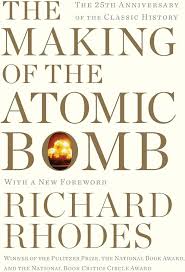
If a layman seeks an understanding of nuclear fission, the splitting of the atom, atomic chain reaction and the creation of a weapon of mass destruction THE MAKING OF THE ATOMIC BOMB brings together the history of the discovery of the atom, the groundbreaking scientists involved ( you will meet many more than Oppenheimer), the building of the atomic bomb itself and the resulting moral controversy over, how and when, and if ever it should be used.

Francis William Ashton ( Circa 1936): There are those who say that such research should be stopped by law, alleging that man’s destructive powers are already large enough. Personally I think that subatomic energy is all around us and that one day man will release and control its almost infinite power. We cannot prevent him from doing so and can only hope that he will not use it exclusively in blowing up his next door neighbor.

Rhodes expert, understandable and readable nuclear development research fast forwards to the ethical controversy of using atomic weapons and delves deeply into the decision making process prior to the deployment of Big Boy over Hiroshima and Nagasaki. Rhodes offers a substantial overview of the political and military strategy leading up to the decision that ended World War II.

Could the enemy not be warned in advance or a demonstration arranged? We feared that if the Japanese were told that the bomb would be used on a given locality they might bring our boys who were prisoners of war to that area.

The detail in Rhodes writing equals and in scientific terms( formulas, equations, graphs, charts, maps) exceeds what an educated reader expects from and author like Robert Caro.

THE MAKING OF THE ATOMIC BOMB together with AMERICAN PROMETHEUS are a giant step in understanding the scientific and ethical development of atomic energy. Both books are worth the effort.


/…….

AMERICAN PROMETHEUS/J.ROBERT OPPENHEIMER

Without hesitation, this superb work by Kai Bird and Martin J. Sherwin is among the very best biographies I have read in recent years. I place the writing and research on a level with Robert Caro and Jon Meacham.

The wonder of this book is the understanding of Oppenheimer and his time and place in American History. The story of the Atomic Bomb is well known to many. However, the complexity and passages of Oppenheimer himself amid the social and political atmosphere in which he lived and worked is a revelation. The beauty of Bird’s and Sherwin’s writing is that you need not be a physicist to wrap yourself around the life and story of this complex scientist, intellectual and iconic American figure. The dimension of the book is enormous, foremost in its content, but also in size!

I am confident that reading THE TRIUMPH AND TRAGEDY of J. ROBERT OPPENHEIMER is a plus before seeing OPPENHEIMER the movie.

THE GIRLS OF ATOMIC CITY/ EVIDENCE OF THINGS UNSEEN

The title of this posting  incorporates  two books, a work of non fiction and a novel. Both detail the secrets of the U.S. government’s  World War II  Oak Ridge Tennessee Laboratory from its creation in 1943 to the end of the Second World War in 1945.

images

Denise Kiernan’s book The Girls of Atomic City, The Untold Story of the Women Who Helped Win World War II , tells the incredible story of the overnight construction of  a  secret huge industrial complex ( Site X)  in Oak Ridge Tennessee, the sole purpose of which was to convert uranium into enriched nuclear fuel for the construction of the first atomic bomb under the stealth Manhattan Project. Within a year, Oak Ridge Tennessee grew to a community of 75,000 inhabitants and into one of the largest industrial complexes in the world!

Kiernan details  how thousands of young women were recruited to Oak Ridge from throughout the country  with the promise of good paying  jobs that would ,” Help Win The War.”   These young recruits , mostly in their early 20s ,  boarded buses and trains without knowing exactly where they were going and  not having any idea of the position they were about to assume.  Adding to this remarkable story is that for the duration  of their stay, none of the workers at Oak Ridge  ever knew the true nature of the work.  Only after the atomic bomb was dropped on Hiroshima in 1945 was the nature of their work revealed to them.

The Girls of Atomic City  tells the Oak Ridge story from the standpoint of the sociological  interaction of the thousands of young men and women living together in camp-like accommodations, finding a way to establish a social life while at the same time working on a top-secret project that even talking about to friends was forbidden.  Additionally, the book translates into layman’s language  the scientific process of creating the fuel ( enriched uranium)  for  ( The  Gadget )  which was to become the atomic bomb.

images-1

What Kiernan does not develop  is the story of the enormous health hazards that these young women  and everyone at Oak Ridge were exposed to every day.  Marianne Wiggins’  novel  Evidence of Things Unseen,  accomplishes that in a beautiful love story that winds its way from Tennessee to the  eastern shore of North Carolina and the  back to the Oak Ridge Laboratory  to uncover the horror of the impact of radiation sickness upon unknowing workers.  In an odd twist, Wiggins’ novel completes Kiernan’s  work of non-fiction.

Denise Kiernan is also the author of Signing Their Lives Away and Signing Their Rights Away, the fame and mis-fortune of the men who signed The Declaration  of Independence.   Her work has appeared in The New York Times and the Wall Street Journal.