FREEDOM SHIP/MARCUS REDIKER

Much has been written about the Underground Railroad, the incredible network that led many in bondage in the south to freedom in the northern free states. FREEDON SHIP by Marcus Rediker tells of a different story of a route to freedom.
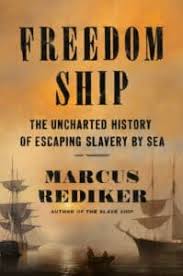
FREEDOM SHIP reveals how crew members, dock workers and even some merchant ship operators collaborated to board and hide salves on merchant ships plying the US Atlantic Coast from South Carolina to Boston. This is the very metrhod taken by Frederick Douglass in his espape from Baltimore.

Thousands of slaves embarked on the treacherous journey over land and local waterways to reach local Atlantic harbors and with stealth find friendlies who would hide them aboard a ship heading north. It was a risky business, so much so that in South Carolina laws were past that crews of merchant ships from the North would be impounded while in the local harbor to prevent them from assisting runaways. Many merchant crews were made up of free blacks from the northern states.

The high risk did not end upon boarding and setting sail. Slave catchers awaited incoming ships from the south at harbors in New York, Boston and New Bedford. However. abolitionists successfully set up dozens of safe houses for escaped slaves, providing food, clothing and in some cases help in moving north to Canada. Some successfully blended into northern society. Others who landed in New Bedford signed up as crew on whaling ships to avoid capture.

A fascinating story of teamwork among like minds that for some successfully thwarted the Fugitive Slave Act and the brutal slave culture.
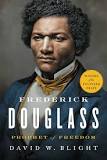
FREDERICK DOUGLASS/ PROPHET OF FREEDOM

FREDERICK DOUGLASS/ Prophet of Freedom by Yale University Professor David W. Blight is a definitive insight into slavery, the abolitionist movement, The Civil War, Reconstruction and Jim Crow.  Moreover, this essential biography delivers a remarkable look into the personal life and character of Frederick Douglass, the remarkable man and his devotion to humanity.  This in depth work by Blight is an education, and as I have previously referenced in other great works of biography, every single word printed upon the 764 pages counts. There is little wonder that The New York Times honored this work as one of the Ten Best Books of the Year.  I wholeheartedly agree.


Frederick Douglass followed William Lloyd Garrison to become the single most important voice of the abolitionist movement. Douglass, the self educated escaped slave was among the greatest writers and the unequaled orator of his time. He wrote three autobiographies, edited two newspapers and delivered hundreds of lectures in small and large communities throughout the country.   Blight captures the enormity of Douglass’s impact on a segregated slave holding nation during the mid-eighteenth century and throughout the Civil War. Following the war, Blight unveils Douglass’s sense of extreme urgency over the fate of his people throughout the tragedy of Reconstruction, and the coming of Jim Crow. Blight leaves no doubt that Frederick Douglass was a revolutionary in his time.

‘’For it is not light that Is needed, but fire; it is not the gentle shower but thunder. We need the storm, the whirlwind and the earthquake. The feeling of the nation must be quickened….the hypocrisy of the nation must be exposed.”   Frederick Douglass, July 4th 1850,  Corinthian Hall, Rochester New York. Douglass could move an audience at will.

FREDERICK DOUGLASS/Prophet of Freedom, a biography of the most important African American of the 19th Century.

This book is an excellent companion read for anyone following The New York Times Podcast 1619.