THE FATE OF THE DAY/ATKINSON

So much more to understand! That is my takeaway from Rick Atkinson’s THE FATE OF THE DAY. This is volume two of his THE REVOLUTION TRILOGY, the first being THE BRITISH ARE COMING. ( see gordons goodreads).

Volume two traces the Revolutionary War action from Fort Ticonderoga to Charleston, hardly a triumphant period for the Patriots and the Continental Army. With the exception of the astounding success at Saratoga the reader witnesses a war of attrition with insights into obscure battles, the intrigue within the British Parliament and the Crown, and the absolute inadequacy of political generals under Washington’s command.

Atkinson reveals the abject tragedy of the prolonged war. It is the very detail of Atkinson’s brilliant research that comes alive in this 618 page narrative that demands A Trilogy to tell the truth of the tale.

This reader came away with a previously unknown dimension of the Revolutionary War and volume two only builds a desire to reach for the conclusion and to understand how close we came to having no democracy at all.

The timing of THE FATE 0F THE DAY is perfect as we approach the 250th Anniversary of the Declaration of Independence. However, this volume is not a one off and is much more meaningful and relevant following THE BRITISH ARE COMING !

Reading these pages gives understanding the to enormity of the sacrifices made by those who preserved our democracy.

LEXINGTON AND CONCORD…250TH READING PREPARATION!

American independence and our nations history are of premium interest across all media. I would like to share with you three recommendations for enlightened reading of the events leading to the War of Independence and proceedings of the First and Second Congresses which lead to the Declaration of Independence of July 4th, 1776.

Nathaniel Philbrick’s Bunker Hill is a critical and remarkably readable history of events in the Massachusetts Bay Colony leading up to the ” Shot Heard Round The World” at Lexington and Concord on April 19th 1775. Though titled Bunker Hill the narrative goes far beyond that historic event putting the relationship between the Colonists and the British Parliament that lead to the war’s beginning in detailed perspective. The reader comes to an understanding of the City of Boston under Seige and how the colonist mindset there kindled a revolutionary spirit that ultimately encompassed all of the thirteen original Colonies.

A second remarkable read during this historic anniversary period is Our Lives, Our Fortunes & Our Sacred Honor, The Forging of American Independence 1774-1776, by Richard B. Beeman. While there is some historical overlap with Philbrick’s Bunker Hill, the additional perspective upon the familiar fixtures of the revolutionary movement is very worthwhile. Different takes on Samuel Adams, John Adams, John Hancock, Thomas Paine, John Dickinson, Thomas Jefferson and George Washington are found in each book. Beeman’s focus however is not on the military events of the day but more upon the First and Second Congresses in Philadelphia in 1775 and 1776 and the struggles between the patriots and the loyalists. Remember, these two conventions met while the early battles of the revolution were being fought with extremely mixed results. Beeman focuses upon the struggles for consensus that finally led to the wording of the declaration on July 2, 1776, and announced two days later on July 4th.

Who wrote the Declaration of Independence? Certainly not Jefferson as the sole author. Beeman is emphatic: The final product-Congress’s Declaration of Independence, not Jefferson’s-was in fact superior-more concise, more constrained, and, perhaps, even more elegant than the original.

Another very worthwhile read on events leading up to the Revolution is Rick Atkinson’s The British are Coming. ( see gordonsgoodreads). Atkinson has a new volume of this trilogy The Fate of the Day which will be released i later this month.

Enjoy this deep dive into American Revolutionary History.

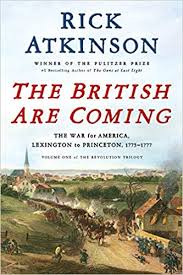
THE BRITISH ARE COMING/RICK ATKINSON

It’s here, Volume One of Rick Atkinson’s The Revolution Trilogy!   At last, the story of the Revolutionary War, beyond the limits of a single volume. Volume one, THE BRITISH ARE COMING, is extraordinary and that comes as no surprise to those who have read his  WWII Liberation Trilogy, An Army at Dawn, The Day of Battle, The Guns at Last Light.

Volume One of the Revolution Trilogy  tells the story from both the American and British perspective of the first 21 months of America’s war for independence. Incredible detail and a volume of characters with many new heroes and knaves. Atkinson’s narrative is in living color.  The Continental Army is indeed ragtag,  and Ben Franklin, Henry Knox, Nathaniel Greene, George Washington and many others are all seen in a new and very much alive perspective.  Even though history has unveiled the outcome, Atkinson entices the reader to plead for more intricate detail on just how that ending unfolded.  Volume Two is on the way.

THE GUNS OF LAST LIGHT/ THE TRAGIC REALITY OF 1944-1945

The final installment of Rick Atkinson’s WWII trilogy, THE GUNS  OF LAST LIGHT, offers prodigious unsettling detail of the final push to defeat Hitler during the winter of 1944 and the spring of 1945.  The book begins with D-Day  continues through the Normandy hedgerows, the liberation of Paris, Operation Market Garden and the Battle of the Bulge.

imgres-1

Atkinson’s narrative spares no detail  and his criticisms  of Allied leadership are jaw dropping. In his epic account  of the final months of the war, Atkinson creates no heroes.  His depth of research renders judgement on the good and bad.

American deaths in the winter of 1944 at the Bulge alone totaled 19,276.  In the final year of the  campaign of 135, 576 American soldiers  were killed on the Western Front while military bureaucrats meticulously planned the  up coming  Yalta conference between Roosevelt, Stalin and Churchill. Millions of dollars  and endless hours of planning and logistics were spent on caviar, wild game, wines of every description, imported silver, cigars,  china and furniture. Little was accomplished  at Yalta, increasing speculation on how Germany would later  be  carved up among  the victors.

bulge_gallery_05

This is a book for students of WWII history and the reader will be well rewarded by the depth of its six hundred plus pages. Atkinson’s work qualifies for my Every Word Counts honor. The two other volumes equally worthy of accolades are An Army at Dawn, the North Africa Campaign, (search gordonsgoodreads)The  Day of Battle, the war in Italy.

I can not resist sharing this quotation from the book.  Patricia O’ Malley was  a one year old when her father, Major Richard James O’Malley  was killed by a sniper at Normandy. Later as an adult she  wrote this following a visit to  her father’s  grave at the cemetery at Collerville above Omaha Beach. I cried for the joy of being there and the sadness of my father’s death. I cried for all the times I needed a  father and never had one. I cried for all the words I wanted to say and wanted to hear but had not.  I cried and cried.


AN ARMY AT DAWN-NORTH AFRICA-DRESS REHEARSAL FOR EUROPEAN INVASION

Rick Atkinson’s  first volume of his World War II Trilogy An Army At Dawn is an extraordinarily candid appraisal of the performance of the U.S. Military during its initial foray into the Second World War in North Africa.

imgres

This excellent historical work portrays the North Africa Campaign of 1942-1943 as a painful dress rehearsal for a green U.S. Command and Army, embarking on its first and often catastrophic combat missions since the First World War.  ” A great sorting out was underway: the competent from the incompetent, the courageous from the fearful, the lucky from the unlucky.”   Atkinson spares no one in his  harsh analysis of both the American and British forces and their leadership.  The takeaway is that if the Allies had invaded across the channel in 1942 as originally envisioned, D-Day would have been a disaster only rivaled by Dunkirk.  A move up the boot of Italy or into southern France according to Atkinson’s read would have also been doomed from the outset.

The North Africa Campaign learning curve was critical to the final Allied victory in Europe. ” Eisenhower had been naive, sycophantic,  unsure of his judgement, insufficiently vigorous and more a titular than actual commander.” Atkinson is blunt in his appraisal that North Africa taught the American Infantryman the necessity of  ” ruthless killer instinct”  in battle.”  ” A soldier is not effective until he has learned to hate. When he lives for one thing, to kill the enemy, he becomes of value. ”  The collaboration in the North Africa Campaign with the British under Montgomery  foretold difficulties to come in the invasion of Europe.

Eisenhower, Patton, Bradley, Montgomery, Rommel, all portrayed  by historian Atkinson at their very worst and very best. The book is scholarly in its approach and yet very readable, filled with humanity, heroism,  and battlefield reality. After months of failure with enormous and often needless casualties,  American forces finally morphed into fighting form and marched through the Kasserine Pass and on to the sea at Tunis.

An Army at Dawn was written in 2002. The remaining volumes in Atkinson’s trilogy are The Day of Battle, the war in  Sicily and Italy ( 2007 ),  from 1943-1944 and The Guns at Last Light, (2012),  the war in Western Europe, 1944-1945. Atkinson also authored The Long Grey Line and Crusade.