TAKEOVER-HITLER’S FINAL RISE TO POWER

I have read two volumes by Timothy W. Ryback on this subject but in reverse order. Whereas I read 53 DAYS first, I suggest initially reading TAKEOVER.
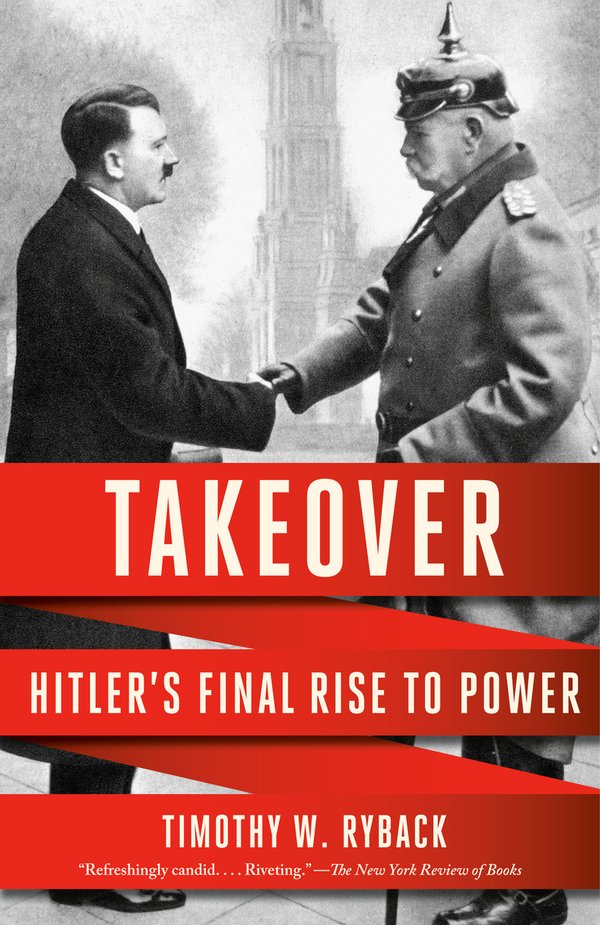
TAKEOVER is an in depth examination of the step by step crusade by which Hitler took over control of the Weimar Republic and became absolute dictator of the democracy that had been established after WWI.

By 1932 the Weimar Republic was in economic and social chaos. The draconian restrictions placed upon the German people by the Treaty of Versailles had led to high rates of unemployment and civil unrest. Ryback outlines in exacting detail how Hitler seized upon these circumstances to begin his campaign to replace the German Republic with an autocracy.

Through Hitler’s National Socialist party he began the campaign to takeover the German government. The irony is that Hitler accomplished his goal through the very democratic process within the Weimar Constitution. Though his National Socialists Brown Shirts were deliberately intimidating there was not a revolution or an outright government overthrow. Hitler had learned a bitter lesson from his failed PUTSCH of the 1920s which resulted in his imprisonment.

In reading both of Ryback’s books the reader realizes the fragility of a democracy. Hitler became president through a forced constitutional transition and almost immediately the assassination of those who had stood in his way began.

The Ryback books are a stark reminder of the famous Benjamin Franklin quote in 1787. When the Constitutional Convention wrapped up in Philadelphia Franklin was asked, “What kind of government they had created? ” Franklin’s reply A Republic if you can keep it.
HOW HITLER DISMANTLED A DEMOCRACY

53 DAYS. Timothy W. Ryback’s book describes how Adolf Hitler through manipulation of the constitution of the German Republic transformed a democracy into an authoritarian state. For followers of Hitler’s playbook Mein Kampf it would come as no surprise. What is shocking are the similarities evoked by historian RyBack to threats to democracy currently taking place in America.

It is uncanny to read the 1930s impressions of Hitler of Theodor Heuss. Heuss was an avid pro-democracy Reichstag delegate with the German State Party.

Hitler, Heuss claimed, was possed of an oversensitive vanity that was quick to detect any perceived insult or disrespect, along with an insatiable need to be the center of attention, always, anywhere, everywhere. He not only claims, but demands, that nothing happens without him.

Hitler maneuvers and gets himself appointed Chancellor and almost immediately declares war on the press, banning newspapers critical of the new government. He coined the term fake news castigating any publication that opposed his policies. Eventually, 171 out of 190 social democratic newspapers were shuttered. Beginning in 1933 he used radio to further his campaign to destroy the democratic Weimar Republic. Within the Weimar constitution there existed the Enabling Act which if approved would dissolve the Reichstag and establish Hitler’s authoritarian rule.

On March 23, 1933, 53 Days after Hitler was named chancellor of the German Republic institution of the Enabling Act was approved with Hitler receiving an eighty percent mandate. In that moment by a legislative act The Weimar Republic ceased to exist and Adolf Hitler held supreme power.

History tells the results of that vote.

The detail in Ryback’s research and writing furnishes the reader with the details of Hitler’s ability to manipulate individuals, the courts and the constitution itself.