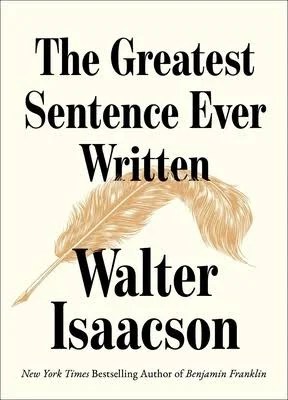
Walter Isaacson is not known for single sentences or even paragraphs for that matter. He is also not known for a book of only sixty=seven pages, including the complete Declaration of Independence. The books title, The Greatest Sentence Ever Written, is an important personal insight into the meaning and application of the declaration’s historic words.
We hold these truths to be self-evident that all men are created equal and endowed by their cretor with certain unalienable rights, that among these are Life, Liberty and the pursuit of Happiness.
These self-evident truths laid down by the founders (not Jefferson alone) became the foundation that bound together a diverse group of pilgrims and immigrants into one nation.
I had the privilege of meeting and listening to Walter Isaacson at a lecture held at the Athenaeum in Boston discuss where America is today in comparison to this lofty composition of two hundred and fifty years ago.
Isaacson makes clear thatof these truths, all men are created equal was not self-evident. Of the fifty six signers of the declaration, forty one owned slaves and all thirteen colonies permitted slavery. All Men excluded all women and at that time what remained of the coastal Native Americans.
What Isaacson described on that Sunday afternoon was a document that was conceived by the founders as aspirational but admittedly not for practical application at that time. But like the eminent founder Benjamin Franklin, Isaacson believes that the hope of the document was to bind disparate interests together for the common good. He writes, Their goal on contentious issues was not to triumph, but to find the right balance. Isaacson adds, An art that has been lost today.
And so how has this Greatest Sentence Ever Written, this aspirational document evolved? Sadly the hope of binding the nation together has not materialized in the twenty first century. Isaacson sights gross income inequality, the lack of opportunity for all, the bifurcation of the media into opposing political camps, advanced technology that was supposed to connect us has in fact added to the nation’s divisiveness.He raises serious questions of exactly what America will look like going forward. Can the nation find common ground?
Fittingly, Isaacson one again draws upon Franklin, Compromisers may not make great heros, Franklin liked to say, but they do make great democracies.
Isaacson adds, That’s the ideal of common ground and the American Dream that our founders fought for 250 years ago. And that’s what we must continue to fight for today so that we can preserve, for ourselves and our posterity, the rights and aspirations that we all share, including to life, liberty and the pursuit of happiness.
Am important read, especially during this 250th anniversary year.