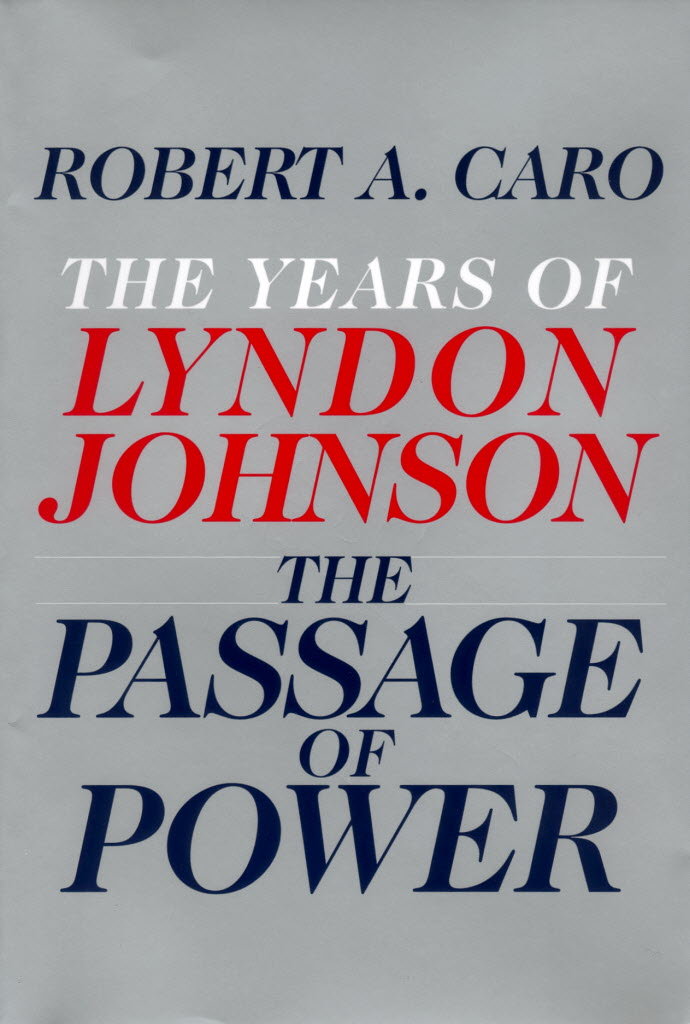
My immediate take-away after completing all 605 pages of Robert Caro’s The Years of Lyndon Johnson The Passage of Power is both awe and marvel at Lyndon Johnson’s accidental presence at the pinnacle of power from November, 1963 through 1965. If Lyndon Johnson was president or senate majority leader in today’s political environment, for better or worse, there would likely be no gridlock in Washington D.C. Never in the modern presidency has more of significance been accomplished in such short period then what transpired in the year and a half of the Lyndon Johnson presidency following the assassination of President John F. Kennedy.

This incomparable work by Caro illuminates, for both the student of history and the observer, that regardless of a like or dislike of his tactics or the man himself, Lyndon Johnson’s accomplishment in moving historic legislation through a gridlocked congress is beyond comparison. The Civil Rights Act of 1964 and the Voting Rights Act of 1965 turned years of political rhetoric and decades of delay into law, and Lyndon Johnson made that happen during a most improbable time in American history. LBJ with all of his ruthlessness, cajoling, bravado, insecurity, impatience and meanness did what no other president had done. Deeply seeded in the memory of the poverty of his youth, LBJ’s empathy for the poor and underprivileged surfaced, often with a vengeance, to overcome the impossible obstacles standing before these two pieces of landmark legislation. For this reader, understanding how the aforementioned was accomplished became the centerpiece of this Pulitzer destined work. But, there is so much more.
The mutual hatred that existed between Lyndon Johnson and Robert Kennedy and the inordinate effect that it had upon a functioning government is made manifest throughout the book. Robert Kennedy’s unsuccessful multiple efforts to convince Johnson to withdraw from his brother’s selection of Johnson as the vice-presidential candidate in 1960 depicts a near maniacal RFK. The relegation of LBJ’s vice-presidency to a meaningless and often humiliating position often punctuated by RFK’s ” corn pone vice-president” references are almost unimaginable and would normally be thought relegated to a school-yard bully. While LBJ is often lionized in Caro’s pages, Robert Kennedy is given faint if any praise at all in this carefully researched book.
Caro details the brilliance with which Johnson handled the passage of power upon Kennedy’s assassination . How LBJ managed the emotional devastation of the Kennedy team is a remarkable story in itself. He convinced the great majority of them to stay on because , ” I need you , the country needs you and John Kennedy’s legacy needs you.” The overnight transformation of the ruthless master of the senate and insignificant, irrelevant vice-president to become the nation’s hope, healer and steady hand is so magnificently detailed by Caro, so real, that it places the reader in the midst of a current event, not a bygone era!
You will learn from Caro’s research sources that it was widely speculated that Robert Kennedy’s inability to move beyond the grief over his brother’s death may have been tied to a feeling of self guilt; that he and the president’s pursuit of the assassination of Fidel Castro ( Operation Moongose) and the Mafia may have in fact been a direct retaliation that killed President Kennedy. Caro, despite the Warren Commission report, raises that speculation to the level of plausibility.
The Passage of Power at times elevates Johnson to the heroic level but the narrative is equally balanced with the reality of the often brutal, threatening and unforgiving methods by which LBJ accomplished his goals. From Johnson’s euphoric highs and the compassion demonstrated for minorities and the downtrodden surrounding of the passage of the Civil Rights and Voting Rights Acts, Caro, concludes Passage of Power with bombs dropping upon helpless villagers in Vietnam. That era is left for another telling.
This is the fourth in Caro’s The Years of Lyndon Johnson. The Passage of Power will have even greater meaning if you have already consumed The Path to Power ( 1982), Means of Ascent ( 1990) and Master of the Senate ( 2002). However, Caro does such a good job in placing The Passage of Power in the context of Johnson’s lifetime that it is easily stand-alone read. Throughout the book, Caro makes numerous references to another great work on Lyndon Johnson which I wholeheartedly commend to you, Lyndon Johnson and the American Dream by Doris Kearns Goodwin. I also recommend This Time,This Place, by Johnson aid and confidant Jack Valenti, who later left government for a distinguished career as the president on the Motion Picture Association of America. ( Check Gordon’s Good Reads Archives).
A Robert Caro book of equal substance and a Pulitzer honoree is his The Power Broker, Robert Moses and the Fall of New York. Use of power to accomplish common good or abuse of power for personal gain; both books in a different time and place tell a significantly similar story.

 Gordon's Good Reads