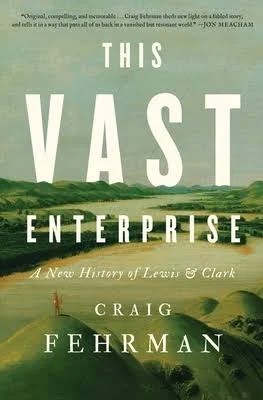
It is difficult task to author a living history of events that took place in 1804. It is obvious that there is no-one who was present to interview. That is the challenge faced by author and historian Craig Fehrman in his new book THIS VAST ENTERPRISE, A New History of Lewis and Clark. Thus the book which attempts to fill in the blanks of past research on this enterprise uses much oral history, sometimes based on interviews with the recollections and traditions of living Native Americans, passed on to them through the fog generations.
Fehrman narrates a compelling story of Thomas Jefferson’s Corps of Discovery bringing new insight into those other than Meriwether Lewis and William Clark themselves. We learn about York an African American slave owned by William Clark initially brought along to serve Clark’s personal needs. York’s impact on the success of the great adventure was legion. John Ordway a working class soldier on many occasions saved the day through his heroics.The story of Sacajawea with a new born on her back is told in great depth with deep insight into the Blackfoot culture. This part of the narrative is superior in its insight of her character.
This is of course a story of Manifest Destiny . However, the Thomas Jefferson philosophy adds a new dimension which he called ” our right of preemption.”” When an imperial nation came across ” new” land it could claim the territory through rituals of discovery-planting flags-making maps and through occupation.” Little did the Blackfoot, Sioux, Mandam, Nez Perce and others understand the meaning of “preemption.” By the end of the century their decendents would know.
This is a tale of courage, suspense and mystery and speculation upon the unknown circumstances of heros and villians. The mission to find a water communication to the Pacific Ocean was a failure only because Lewis and Clark with the help of Sacagawea and Blackfoot Tribe’s horses proved that after the Missouri River ended, the final leg was an arduous and treacherous mountain journey to the Columbia River.
The book is great storytelling and I think necessarily wanders between non-fiction and a historical novel. An important read for those who wish to immerse themselves in this important part of American History. It also gives further insight into Jefferson’s thinking of America’s future as an agricultural enterprise supported by slavery from sea to sea. Ironically, part of the expeditions lasting legacy may be the children that both Lewis and Clark fathered whose ancestors now live to tell the tale.