ANYA SETON’S WINTHROP WOMEN, A TREASURE FROM THE 1950s

The republishing of the prodigious historical novels of Anya Seton in the first decade of this century brings to light the treasure trove encompassed in her work.

Winthrop Women, first published in 1958 and later released in 2006 is a particular gift for those whose interests lie in the history of the Puritans, the Massachusetts Bay Colony and the early settlement of the environs of Greenwich, Connecticut.  Above all, it is a great love story and the saga of a strong and independent woman richly entwined in the region’s history.

Winthrop Women  embraces a broad  historical web, set in the 1600s (1617-1655)  centered around the family of  John Winthrop, a fanatical practitioner of the Puritan faith  who became the first governor of the Massachusetts Bay Colony and his rebellious niece and daughter-in-law Elizabeth Fons. Their descendents  remain in Connecticut and  throughout New England.  Seton tells the Winthrop family and  Elizabeth Fons’  story in three parts: The early years in England living a near aristocratic lifestyle; the great Puritan migration to the New World with the establishment of the Massachusetts Bay Colony;  Elizabeth’s  banishment from Massachusetts and her emergence in Greenwich, Connecticut with husbands (correct) , lovers and children joining in the journey!

Anya Seton’s story of Elizabeth is written in ” high-definition.”  From childhood, “Bess”  is of independent thought and passionate in her views. She was born on a collision course with the beliefs of her Puritan elders, especially John  Winthrop.  Long before boarding the ship Lyon for the journey to  the New World, this child of luxury and  high social status had established herself as the Fons’ and Winthrop family non-conformist.

Proudly leading his flock beneath the banner of religious freedom to the colonies in New England,  far away from the dictates of King Charles, Cromwell and the ruling British establishment, John Winthrop becomes a  zealot and religious tyrant, ruling over his domain, with a wrathful “God” as his enforcer.

Elizabeth’s ever complicated life, saturated with her passion for men and her non-conformist beliefs, provides the framework for an abundant tableau of what life and love was like in 1630s New England. The drudgery of daily survival, the absence of  luxuries, disease and Indians both friend and foe. Foremost, the woman’s role of being, above all, a necessary  “good breeder,” upon which the future of the faith and the colony itself depended!

Elizabeth, having fallen in love with John Winthrop’s son, her cousin Henry, became pregnant and was hastily married before leaving England!  Henry, a kindred free spirit was not traveling with Elizabeth on the ship Lyon but was under his father’s supervision on the Arabella. Elizabeth learned  upon her arrival in Massachusetts that Henry had drowned in a boating accident upon landing. There would be two more husbands and many children, living and still-born before her story concludes thirty years later.

During a brief period when Winthrop had been ousted as Massachusetts Bay Colony Governor, the community rose up against Elizabeth’s behavior with rumors and  speculation that she and her Indian servant Telaka  were possessed by the devil. The outcry became witchcraft! Banishment from the colony, the final solution in those days short of hanging, saw Elizabeth, her family and Telaka ( whom Elizabeth had rescued from a slave auction) on their way to Greenwich where under Dutch law there was greater respect for individual freedom and religious beliefs. This novel is so wonderfully written and researched  that of course, Telaka, had ended up in Boston only after being kidnapped from her tribe, the Siwanoy Indians who populated the area in and around Greenwich! A homecoming for Telaka and a new most welcoming home for Elizabeth, her husband and brood?  Not quite that simple!

In the Greenwich chapters you will walk with Elizabeth on the white beaches of  Monakewago ( Tods Point), follow the Mianus River, witness the massacre of over 1000 Siwanoy Indians ( Telaka’s family) in what is today Cos Cob. There will be yet another husband and more “breeding, ”  and another banishment with the loss of thousands of acres of land that today encompass the entire Town of Greenwich.

History is taught in many ways and Seton is deserving of  high praise both as a novelist and historian for Winthrop Women.  Seton wrote Winthrop Women while living in Old Greenwich, Connecticut where she died in 1990 at age 86. She is buried there in Putnam cemetery.

Other highly acclaimed novels by Anya Seton  include, Foxfire ( 1950),  Katherine (1954),  The Mistletoe and the Sword (1956).

THE SHAARA TRADITION OF EXCELLENCE CONTINUES MOVING WEST TO SHILOH

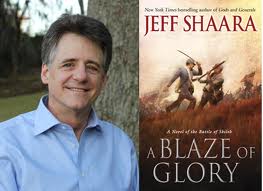
Jeff Shaara continues his magnificent writing  with another Civil War historical novel.  A Blaze of Glory takes the reader to the western theater of the war and the battle of Shiloh. It is the first of  a new Shaara trilogy.  Jeff is the son of  Michael Shaara, author of  the Pulitzer Prize winning Killer Angels. 

Gordon’s Good Reads last reviewed Shaara’s The Final Storm , the World War II battle of Okinawa. (June, 2011)   A Blaze of Glory uses the same Shaara style by viewing the horror of battle through characters with boots on the ground. In this case, a Confederate Cavalry Lieutenant and a Union Private. Shaara holds nothing back in the vivid portrayal of the hand to combat and carnage that occurred when armies lined in formation across from one another enduring volleys of musket fire, artillery canister and grape-shot. He captures egos and indecision as well as bravery and heroism.

” The fight around Shiloh Church had come from the plans and ambitions of generals, and no matter the disaster of that, it was the foot soldiers who would still do the deed, who would be asked to decide the fate of the town, of the country, and more important to many, the fate of the men around them.”  You will walk in the footsteps of Lieutenant James Seeley and Private Fritz “Dutchie” Bauer.

April 6, 1862, 100,000 troops on the field of battle, 25,000 casualties,  including the death of a Confederate General that many say could have determined the outcome of the Civil War and the fate of the Union. Egos abound!  Grant, Beauregard, Johnston, Buell and Sherman are all present. A surprise Confederate attack on superior Union forces. Victory is in hand and then, a stunning decision that is the subject of discussion by Civil War historians to this day. Did  a need for personal glory determine the outcome at Shiloh?

Several years ago Shaara completed the initial Civil war trilogy begun by his father’s Killer Angels by writing Gods and Generals and The Last Full Measure. This new trilogy which begins with A Blaze of Glory will concentrate on the war in the western theater and follow Grant’s rise to his appointment by President Lincoln as General in Chief of all Union Forces.

Jeff  Shaara’s historical novels on World War II in addition to The Final Storm ( Okinawa and the dropping of the atomic bomb) are: No Less than Victory ( The Battle of the Bulge, and the fall of the Third Reich)The Steel Wave, ( The Normandy Invasion) and The Rising Tide ( The North Africa and Italy campaign).  He also wrote Gone for Soldiers a novel on the war with Mexico and two books on the American revolution Rise to Rebellion and The Glorious Cause. In Gone for Soldiers you will meet many of the Mexican War officers that later became the generals in Shaara’s Civil War novels.


COMING TO GGR

Two new books on subjects frequently followed by GGR. Jeff Shaara’s A Blaze of Glory, a novel of the Battle of Shiloh and BAILOUT  by Neil Barofsky an inside account of the Wall Street bailout.

E.M. FORSTER’S HOWARDS END

Howards End, first published in 1906, is E.M. Forster’s fourth novel and quickly placed him among the elite English writers. Indeed, this is a classic English novel! Some patience is advised for those who have not delved into this genre but once the plots and sub-plots are established and the characters evolve this great read unfolds rapidly into hours of enjoyment. The language of the period is rhythmical and you will quickly become accustomed to ” Crane is bringing the motor around.”

Most recently, in large part because of Downton Abby , much of  the focus on English society has been on the aristocracy. In writing  Howards End, Forster is unveiling not the aristocracy but the class warfare in the emerging English middle class, set among those in the mercantile order of  British society.  It is also very clearly exposes the  social  war between men and women over power within the households of the rich, moderately wealthy and the poor.

Forster tells the story through the voices of two sisters, immigrants to London from a well established and sophisticated German family. One has an illicit affair during a summer excursion with  the son within an upwardly mobile English businessman.  The second sister  ends up marrying the father following the death of his wife in a marriage that is more of an arrangement than a love affair. And so Howards End passes through further affairs, children out-of-wedlock, and the resolution of who will inherit Howards End, the generational family country home.

There is a sexual theme throughout the novel but don’t look for Lady Chatterley descriptions or dialogue. In this novel , love and sex is all about impact on ones status in society, nothing physical , with all detail in the imagination.  Forster treats the subject much like Henry James , always there but never explicit.

The late 19th and early 20th Century saw an explosion of great English novelists and E.M. Forster ranks  well among them.  Howards End is listed as 38th among the 100 best novels of the 20th Century. A Room With a View by Forster is ranked 79th. Forster’s final novel, A Passage to India written in 1924, ranks 25th on the Modern Library’s list.

Aldous Huxley’s Island – 21st Century Themes In 1962!

The prolific English writer Aldous Huxley is most famous for his novel Brave New World, published in 1932.  Many comparisons have been drawn between the aforementioned and George Orwell’s 1984. In Huxley’s last novel, Island, published in 1962, the author creates a “better place.” While you may well have read Brave New World (required reading for many), the perspective in the pages of Island is well worthwhile.

Island is set in the nineteenth century. Unlike any other place on earth, the island of Pala and the Palanese people have created a utopian society, isolated and virtually free from the influences of the modern industrialized world, while at the same time selectively adapting to scientific development and worldly knowledge that will enhance their idyllic lifestyle.  In Island, Huxley examines whether the best of both worlds is possible.

 The author, whom some have referred to as a social scientist, delves head long into the great issues looming in the 1960s; overpopulation, drugs, money, ecology, religion, Buddhism and even obliquely advances ideas on raising teenagers!  Will Pala become part of Greater Rendang, the surrounding territory controlled by decades of greedy Sultans, now that Pala’s rich deposits of oil, gold and other minerals have become objects of desire?    Will the modernity of a new generation of Palanese leadership sell out to the temptations of vast wealth and the “  creature comforts” of the outside world?

In reading Island  you will be amazed at the  contemporary themes!  “ We don’t give ourselves coronaries by guzzling six times as  much saturated fat as we need. We don’t spend a quarter of the gross national product preparing for World War III. Our economic system doesn’t permit anyone to become more than four or five times as rich as the average.  Electricity minus heavy industry plus birth control equals democracy and plenty.  We never allowed ourselves to produce more children than we could feed, clothe and house. We have managed to resist the temptation to which the West has now succumbed , over consumption. ” 

Wonderful writing here. Huxley tells all, exposes his very soul through a protagonist that comes full-circle in the midst of a predictable downward spiral fueled by that all to common twenty-first-century destructive force, greed. “ If you’d been shown how to do things with the minimum of strain and the maximum of awareness, you’d enjoy even honest toil.”

In lieu of a Preface Huxley quotes Aristotle: In framing an ideal we may assume what we wish, but should avoid impossibilities.

You may wish to read Huxley’s Brave New World Revisited ( 1958) , abundant with many of the themes astutely developed in Island.

NO PULITZER FOR FICTION -DON’T DESPAIR-SONS AND LOVERS PREDATED THE HONOR

Surely there was great disappointment when no winner was chosen for this year’s Pulitzer for fiction. However, considered by many one of the greatest novels written in the 20th Century, D.H. Lawrence’s Sons and Lovers never received one either! Published in 1913, it pre-dated the establishment of the awards in 1917 by four years! It would be interesting if the Pulitzer Board created a retroactive category.  In a sense, the Modern Library has done just that by ranking Sons and Lovers the 9th greatest novel of the 20th century. Quite right, quite right indeed!

Though technically a novel, Sons and Lovers is without doubt auto-biographical. D.H. Lawrence  is clearly writing of the struggles of growing up in a dysfunctional family in a poor mining community in England. The mother had married below her class to a husband that turned out to be not much beyond the daily retreat to the local pub with his co-workers.  In the novel, the mother is left with only her son to whom to direct all of her affection and emotion.  She would not let go of  what she perceived as all that remained important in her life.

I opened my Modern Library paperback version of Sons and Lovers and by chance the following paragraph unfolded. You will understand quickly why this great novel, once read, may erase any disappointment over their being no 2012 Pulitzer for fiction.

“Paul and Miriam stood close together, silent and watched…Paul looked into Miriam’s eyes…She was pale and expectant with wonder, her lips were parted, and her dark eyes lay open to him…Lets go, he said…Something made him feel anxious and imprisoned…The two walked in silence…Till Sunday he said quietly and left her and she walked home slowly feeling her soul satisfied with the holiness of the night…Always when he went with Miriam his mother was fretting and getting angry with him…when he walked into the house his mother had been sitting thinking…She could feel Paul being drawn by this girl and she did not care for Miriam…That there was any love growing between him and Mariam, neither of them would have acknowledged…She is one of those who will want to suck a man’s soul out til he has none of his own left.”

This magnificent novel rises to new heights on each page. If you have not read Sons and Lovers I commend it to you now. At 99 years of age it is contemporary and worthy of every accolade and honor that has been bestowed upon the book and its author.  Lawrence’s other better known novels are The Rainbow, Women in Love and of course Lady Chatterley’s Lover.  His last novel was The Virgin and the Gypsy written in 1930.

A footnote. In 1920, the year that Women In Love was published no Pulitzer was given for fiction! Also published in that same year was F. Scott Fitzgerald’s This Side of Paradise and Sinclair Lewis’  Main Street.  Good company!

THE ART OF FIELDING- A MOST WELCOME GUEST BLOG

The Art of Fielding by Chad Harbach
Adult Fiction

                I was honored a few months back when Gordon asked me if I would be a guest blogger on Gordon’s Good Reads. I am, however, a young adult school librarian by trade and as a result I spend most of my time reading young adult fiction and nonfiction. The Hunger Games? I’ve probably read the first book in the trilogy six times. I have always been an avid reader and I do read an adult book every third book or so―I just had to wait for the right book to come along in order to honor Gordon’s guest blogger request. Well, it has. The Art of Fielding by Chad Harbach is a stunning book. It’s got everything―phenomenal characters, a little Moby Dick and Melville lore, romance, and baseball. I don’t even particularly like baseball, but I longed to be a member of a baseball team while reading this amazing novel.

                It all starts with Mike Schwartz, aka Schwartzy. He’s a born leader, or more accurately a natural coach from a hard-knock background. He also happens to be a sophomore at Westish College, a small liberal arts college on the shores of  Wisconsin’s Lake Michigan, when he spots Henry Skrimshander playing baseball at a summer tournament. Henry is a shortstop, small and rather scrawny, but with an uncanny ability to field a baseball. Schwartz recruits the recent high school grad for the Westish Harpooner’s Division III baseball team. Henry is not much of a student, in fact the only book he has ever truly read is his dog-eared copy of The Art of Fielding by Aparicio Rodriguez, where Rodriguez, the greatest defensive shortstop who ever lived, manages to successfully equate the act of fielding a baseball with a Zen-like practice. Henry has committed to memory most of the numbered bits of advice, such as:

59. To field a ground ball must be considered a generous act and an act of comprehension. One moves not against the ball but with it. Bad fielders stab at the ball like an enemy. This is antagonism. The true fielder lets the path of the ball become his own path, thereby comprehending the ball and dissipating the self, which is the source of all suffering and poor defense.

When Henry arrives on campus and meets Owen, his beautiful, biracial, gay roommate,  we, as readers, are reassured that Henry will survive his new circumstances when he spots Owen’s own copy of The Art of Fielding on his meticulously kept bookshelves.
                It is on the Westish campus that we get to know Mike, Henry, Owen, President Affenlight and his daughter Pella(escaping a failed marriage), as well as the entire Westish baseball team. And lest you think that baseball is the only glue that holds the novel together, Harbach has had fun incorporating myriad literary references . Although Westish could be any struggling small liberal arts college, Harbach  created a singular, distinctive institution. The Westish Harpooners are a purposeful reference to Herman Melville’s Moby Dick. It was President Affenlight, as an undergraduate at the college, who discovered a ream of papers in the library which turned out to be a transcript of a speech given by Herman Melville when he visited the college in 1880. Westish College made the most of the Melville association, as did Afflenlight himself, who went on to become a renowned academic, the pinnacle of his career being the widely acclaimed scholarly book called The Sperm-Squeezers. His career come full circle, he is back as president of the college where he began his academic pursuits.
                The characters, both on and off the team, intersect and cross paths, with the meteoric rise of the Harpooners in the league standings serving as backdrop. Henry’s career is on the rise as well―scouts flock to game after game,  promising vast sums of money when he gets signed to the major leagues. But then Henry comes down with Steve Blass disease (named for the infamous Pirates pitcher who, all of a sudden, could no longer throw the ball accurately). Henry has fallen off his path, he has lost The Way. As he struggles, the other characters meander along their own paths, each trying to field their own game, so to speak. This is one baseball story that left me wishing there were a few more innings.

Wonder. Thanks RO. You are welecome at GGR anytime! Keep reading!

The Bostonians by Henry James

The Bostonians (1886) by Henry James is another extraordinary example of character development and story telling.  In that sense, The Bostonians is not unlike James’ The Wings of the Dove which he wrote in 1902. 

 A love triangle between two women and a southern gentleman set in Boston, New York and Cape Cod.  Olive Chancellor, a wealthy leading citizen of Boston, becomes fascinated with a young and ravishing Verena Tarrant, who was being promoted by her parents as a sort of mystic for hire to perform at fashionable Boston salons.  Olive, a leader in the early feminist movement in Boston, sees Verena’s talents and speaking skills better used as an advocate for women’s rights. She literally buys her from her parents! A bit of satire from James about Olive, the zealot reformer.

Arriving upon the scene is Basil Ransom, Olive’s distant cousin from Mississippi who outspokenly detests the feminist movement.  Instantly, Ransom falls in love with Verena. “My dear madam,” says Ransom to Olive, “does a woman consist of nothing but her opinions? I like Miss Tarrant’s lovely face better, to begin with.”  I need say no more about where the narrative for this epic conflict takes the reader, especially as Ransom discovers  that Olive’s love for the young evangelist is equal to his own.

Henry James has great ability to develop astonishing female characters in his novels. I first discovered that in The Wings of the Dove. The women in his books evolve in wonderful detail of personality and emotion.  Verena:  “She appeared to him as a creature of brightness, but now she lighted up the place, she irradiated, she made everything that surrounded her of no consequence, dropping upon the shabby sofa with an effect as charming as if she had been a nymph sinking on a leopard-skin, and with the native sweetness of her voice forcing him to listen till she spoke again.”

In writing The Bostonians, James is coming back to his roots in the United States but in retrospect, the novel may well have been set in the parlors of New York.  However, the venerable Miss Birdseye is definitely a Bostonian!

 Unlike his later novels,  The Wings of the Dove and The Ambassadors,  The Bostonians received little acclaim and was in fact scoffed upon by writers including Mark Twain. The Bostonians was made into a movie in 1984 starring Vanessa Redgrave and Christopher Reeve, which also received  modest notices. 

A footnote.  Henry James novels always seem to contain favorite words. In The Wings of the Dove  the word is  ” prodigious.” In The Bostonians time and again James uses the word “rejoinder,”  which  means to  answer a question. Henry James , writing the word   “answer” would be much too simple. ” Rejoinder” heightens the magnitude of simple prose. I believe Henry James accomplishes the same in every paragraph he wrote.

While reading The Bostonians I wondered if in 1926 Sinclair Lewis could possibly have developed the idea for his Elmer Gantry after discovering Verena Tarrant in The Bostonians?  Possible?

The Bostonians is one more reason why looking back for a “good read.” is so rewarding. Great novels are never dated.

RULES OF CIVILITY…OR… RULES OF NEW YORK?

Amor Towles  debut novel Rules of Civility captures the rules of New York and places George Washington’s  110 Rules of Civility in the Appendix  where they rightfully belong! This read is a love relationship with New York, a city that authors its own rules!

What could be more compelling?  The earnest daughter of hard-working Russian immigrants born and raised on the Lower East Side.  A near-do-well wanna-be who will do anything to be accepted and regain lost riches. A sweet and adventurous mid-western transplant.  The swells of the Upper East Side trust fund gang, a hard charging publisher and of course “ladies who lunch .”  The players are all there and their personalities explode in a wonderful page-turning story set in the post depression era of the late 1930s.  New York is  bouncing back, regaining its lost energy, wealth, world status and rebuilding with money, music, bricks, mortar and unlimited opportunity for those willing to dare a ride on a rainbow.

The  book’s intimacy with New York is reminicent of Pete Hamill’s Downtown and Tabloid City.   There is a hint of F. Scott Fitzgerald and even a flash of Hemingway. ” By nine o-clock the restaurant would feel like the center of the universe.”  The 21 Club, the village jazz clubs before red velvet rope lines, the big bands, the after swing parties and the glorious and transparent lives  of trust fund swells of the Upper East Side and Oyster Bay.  Towles builds characters  who are looking out, looking in and some who don’t give a damn about all the action swirling around them. Falling in and out of love with intimacy left to the imigination.

Rules of Civility  is a New Yorker’s book but just like  the city, it is there for the  enjoyment of anyone willing to seize the moment.  This is a very, very good first novel which may well  have a movie running through its veins.

Simply said, enjoy!

A HANDFUL OF DUST-EVELYN WAUGH-YOU CHOOSE THE ENDING!

Followers of this blog know that I enjoy delving  back among the best known authors and retrieving works that I have not read. Evelyn Waugh’s A Handful of Dust is one more example. Written in 1934, A Handful of Dust is listed as number 34 of the Modern Library’s 100 Best English Language Novels of the 20th Century. 

A Handful of Dust  is set in 1930s Victorian England, and focuses on the breakdown of the marriage of Tony and Brenda Last. The aristocratic Tony is preoccupied with the maintenance of his family country estate, Brenda is bored with her isolation there and also with Tony. Enter John Beaver, a self-interested and impoverished social climber who invites himself to Hetton ( Tony’s estate)  for the weekend. The affair with Brenda, who yearns for urban excitement, begins when she takes a flat in London and “goes back to school!”

In his introduction to the Everyman’s Library publication ,  William Boyd quotes from  Waugh’s Labels, a travel book Waugh wrote after his own broken marriage. “Fortune is the least capricious of deities, and arranges things on the just and rigid system that no one shall be very happy for very long.”  Are many great novels autobiographical? You bet!

And so the story of infidelity unfolds often reminiscent to me of  Idina Sackville in The Bolter although a littler less tawdry!  In an amazing twist, the reader of the Everyman’s Library publication of A Handful of Dust gets the option of the two endings!  When the book was to be serialized in an American magazine they determined Waugh’s original ending too dreary so he wrote a new one!  I like the latter the best which includes a sort of just rewards for Tony Last.   I think it made Waugh feel better.  Enjoy!

The best known of Waugh’s novels is Brideshead Revisited ( 1945)  and later Sword of Honor ( 1952-1961),  his World War II Trilogy. A Handful of Dust and Brideshead Revisited were made into motion pictures.