SHORT NIGHTS OF THE SHADOW CATCHER

Author Timothy Egan in his book Short Nights of the Shadow Catcher  crafts a splendid and enjoyable biography of  world-renowned  American Indian anthropologist, photographer  and chronicler  Edward Curtis.

images


Egan captures the epic story of Curtis’s extraordinary creation of the 20-volume The North American Indian, an incomparable photographic and narrative now considered a work of art, documenting the complex and tragic story of the vanishing Native Americans. Egan writes in extensive detail of the thirty years during which Curtis became a slave to the completion of the work, capturing the personal sacrifices and near death adventures necessary for the narrative to be “preciously”  Edward Curtis. “This was a place like no other he had seen through three decades of portrait foraging, ”  writes Egan.  ” Think of it,”  Curtis wrote in his diary, ” At last, and for the first time in all my thirty years work with the natives, I have found a place where no  missionary has worked.”

Edward Curtis

Edward Curtis

At the Little Big Horn  battlefield and only after extensively interviewing Sioux who were present  that day, Edward Curtis uncovers a very different story of what actually happened at Custer’s Last Stand. ” Let them fight, there will be plenty of fighting left for us to do.”  George Armstrong Custer as told to Curtis by Crow Scout White Man Runs Him overlooking the  battlefield where General Marcus’s troops were slaughtered.

The reader will meet those who inspired Curtis to pursue his dream including Teddy Roosevelt, Gifford Pinchot, J.P. Morgan, George Bird Grinnell , Chief Joseph and Geronimo. Egan’s portrait of Curtis is explicit in that it would be impossible to find another American who sacrificed  to the extent of Edward  Curtis to pursue the documentation and preservation of the vanishing way of life of the first Americans.

More than a biography, Short Nights of the Shadow Catcher shares with the reader Curtis’s depth of knowledge and understanding of the widely different cultures, rituals, and beliefs of the various American Indian tribes.  It is also a wonderfully crafted story of how the creative work of those who possess incomparable talent and vision are often  lost in their own time only to attain rightful acclaim by future generations.
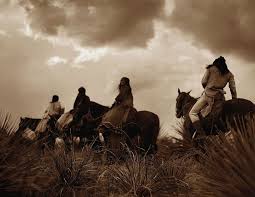
Before The Storm--Apache 1906--Edward Curtis

Before The Storm–Apache 1906–Edward Curtis

I commend Short Nights Of The Shadow Catcher to all who have interest in poignant literature surrounding our first Americans.

Other books I have posted on gordonsgoodreads by Timothy Egan include The Worst Hard Time and The Big Burn.  Utilize the search tab found here.
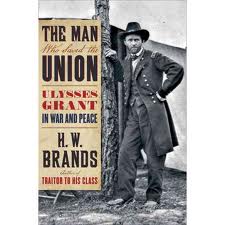
THE MAN WHO SAVED THE UNION-ULYSSES GRANT IN WAR AND PEACE

In the excitement of  the release of  the Steven Spielberg  movie Lincoln, I have coincidentally just completed H.W. Brands’ The Man Who Saved The Union , Ulysses Grant in War and Peace.  Grant, not Lincoln, the man who saved the union?  On the surface, the book’s title is a dichotomy of  enormous proportion. In reality, Grant accomplished much of Lincoln’s vision and the movie Lincoln  should encourage renewed interest in the presidency of Ulysses Grant.

Historian Brands takes nothing away from the great emancipator. To the contrary, he highlights Lincoln’s wisdom in plucking Grant from the western theater of the Civil War and rapidly promoting him to command all Union forces.  Brands forcefully makes the case for Lincoln’s stubborn confidence in General Grant amid repeated periods of doubt, chaos and defeat. Following the war, Lincoln relied on General Grant to carry out the challenge of reconstruction it’s the South including its return to civil order.

Spielberg’s  Lincoln, is based in part of Doris Kerns Goodwin’s book Team of Rivals.  Brands’ biography of Grant portrays how together, two of the greatest figures in American history, Lincoln and Grant, crafted an outcome that did indeed preserve the union. Ironically, through an act of fate, it was the hand-picked military general who carried out the brilliant politicians foresight. The movie Lincoln, and the books Team of Rivals and The Man Who Saved The Union embrace the same cast of historical figures.  Following a biographical review of Grant’s early and then wartime years, Brands continues his narrative after Lincoln’s assassination and the debacle of Andrew Johnson’s ascension to the presidency, leading to Grant’s election as president.

Brands leaves no doubt that General Grant, as the overseer of reconstruction while Johnson was president, used every tool within his power as commanding general, to carry out Lincoln’s philosophy toward bringing the rebel states back into the union. Grant’s zeal was equal to Lincoln’s regarding equality and the rights of full-citizenship for the recently emancipated slaves, while at the same time finding the way to keep the Southern States in The Union.   Lincoln ‘s death and the Johnson presidency made the task nearly impossible.  It was during this period that Grant came to fully understand and embrace Lincoln’s intellect which laid the foundation  for a Grant presidency that would bring into fruition Lincoln’s dream.

General Ulysses Grant, the man who disavowed politics and  as General in Chief refused an office in Washington, casts aside his disdain for public office and accepts the nomination of the Republican Party for President of the United States. It is Grant who carries forth the Lincoln legacy by navigating  passage of the, Fourteenth and Fifteenth Amendments to the Constitution through a bitterly divided congress.  In order, these amendments granted equal citizenship under the U.S. Constitution and created the voting rights act.  Brands details Grant’s deft handling of reconstruction during his two terms in the White House utilizing diplomacy and the military to neutralize the Klu Klux Clan and other White Citizens Organizations.  You see in Grant’s ability do deal with the disparate forces in congress much of the same political savvy wielded  by Lyndon Johnson over a half century later!

I caution readers not to look here for a battlefield  history of the Civil War although there is substantial detail on the capture by Grant of Fort Donelson and Fort Henry in the west and the epic battle at Spotsylvania in Virginia.  While the military overview of the war is complete, this book is mainly about Grant, the man, the general and the president.  You will find many of Lincoln’s Team of Rivals still in play while Grant begins his ascendency and assumes the presidency.

Team of Rivals by Doris Kerns Goodwin is an obvious read before seeing Lincoln.  The Man Who Saved The Union by H.W. Brands is a must sequel.  Brands is also the author of the great FDR biography Traitor to his Class.

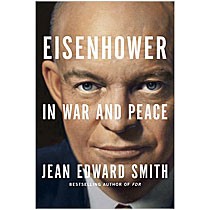
EISENHOWER IN WAR AND PEACE-ANOTHER GREAT VICTORY FOR JEAN EDWARD SMITH!

The passage of time is the greatest gift to the biographer possessing the brilliance  and patience to seize upon that window to bring to readers a modern-day perspective of iconic historical figures and events. 

Jean Edward Smith has accomplished in EISENHOWER IN WAR AND PEACE, exactly what he offered his readers in his remarkable works Grant and FDR. Historian and biographer Jean Edward Smith is rightfully in the company of  historians Robert Caro, Edmund Morris, David McCullough and Max HastingsEISENHOWER IN WAR AND PEACE, places Eisenhower in  an objective perspective within his military career, the presidency and his personal life.  Don’t look for an in-depth history of D-Day.  While there is plenty of  detail of  the European Theater in WW II, this book steps back to place the  enormity of the impact of Eisenhower’s  approach to leadership  in a sweeping overview of the war in Europe .

Smith takes a similar approach to the eight years of Eisenhower’s presidency and the manner in which he organized and staffed the White House, dealt with both political supporters and opponents and world affairs.  There is vivid detail on decisions, relevant today, (The building of the Interstate Highway System as a stimulus to help reverse a post Korean War recession), school desegregation in Little Rock, Vietnam, Formosa, China and the Cold War. 

Readers of EISENHOWER IN WAR AND PEACE will be left with no doubt about Ike’s  intimate relationship with Kay Summersby and the impact on his marriage to Mamie. Smith writes this narrative in a most factual manner and details the openness with which Eisenhower and Summersby were together publicly and privately throughout the war. Smith also details Eisenhower’s  changing relationship with his wife Mamie over the course of four decades.

The book clearly reveals that Eisenhower’s brilliance as Supreme Commander of the Allied Expeditionary Forces was in his political dexterity in contrast to his grasp of battlefield strategy. With the exception of marginal success ( that may be a generous assessment) in the North Africa Campaign, Eisenhower had no battlefield command experience prior to D-Day!  However, his ability to bring discordant bigger than life individuals together and promote cooperation ( Churchill, FDR, Montgomery, Patton,  Bradley, de Gaulle)  was exactly why FDR chose Eisenhower over Marshall to lead the European Campaign.

I have previously read considerably about Eisenhower, but just as in Smith’s  biography Grant, I now have a  view through a twenty-first-century lens of the two famous generals who became two-term presidents.  Many popular conceptions and mis-conceptions are clarified.  Smith peels away the Eisenhower myths and reveals his brilliant mind and the thought processes by which as a leader, not a battlefield commander, Eisenhower established his legacy.

Some interesting insight from EISENHOWER IN WAR AND PEACE:

Ike was not the first president to embrace golf.  Actually Woodrow Wilson secretly played more rounds during his president than Eisenhower!  However, Eisenhower made no secret of his love of golf and is credited with the explosion of the national popularity of the game.

In his first term in office, Eisenhower increased the budget of the National Institute of Health ten-fold.

Eisenhower may have prevented World War III by forcing Britain and France to withdraw from its invasion of Egypt over the closing of the Suez Canal.

A coalition of Democrats led by Senate Majority Leader Lyndon Johnson was responsible for the passage of most of Eisenhower’s domestic programs.  Ike was considered “too liberal ”  by the old guard right-wing of the Republican Party.

It was Eisenhower who  carried out Harry Truman’s earlier attempts to desegregate all branches of the U.S. Armed Forces.

At the end of the war Ike wrote in a letter to his boss General Marshall that he planned to return to the U.S., divorce Mamie and marry Kay Summersby. Marshall in the strongest terms admonished him not to destroy his reputation and career! Eisenhower took the advice. Later, out of respect for Eisenhower and fearful that if the letter became public it would become a campaign issue in 1952,  President Truman, who was at that time at  political and personal odds with Ike, ordered the letter destroyed!

There is much, much more! Look for many literary honors for EISENHOWER IN WAR AND PEACE

ROBERT CARO’S PASSAGE OF POWER-HISTORICALLY IMPECCABLE-RELEVANT TODAY

My immediate take-away after completing all 605 pages of Robert Caro’s The Years of  Lyndon Johnson The Passage of Power  is both awe and marvel at Lyndon Johnson’s  accidental presence at the pinnacle of power from November, 1963 through 1965.  If Lyndon Johnson was president or senate majority leader in today’s political environment, for better or worse, there would likely be no gridlock in Washington D.C.  Never in the modern presidency has more of significance been accomplished in such short period then what transpired in the year and a half  of the Lyndon Johnson  presidency following the assassination of President  John F. Kennedy.

This incomparable work by Caro illuminates, for both the student of history and the observer, that regardless of a like or dislike of his tactics or the man himself, Lyndon Johnson’s accomplishment in moving historic legislation through a gridlocked congress is beyond comparison.  The Civil Rights Act of 1964 and the Voting Rights Act of 1965 turned years of political rhetoric and decades of delay into law, and Lyndon Johnson made that happen during a most improbable time in  American history.  LBJ with all of his ruthlessness,  cajoling, bravado, insecurity, impatience and meanness did what no other president had done.  Deeply seeded in the memory of the poverty of his youth, LBJ’s empathy for the poor and underprivileged surfaced, often with a vengeance, to overcome the impossible obstacles standing before these two pieces of landmark legislation. For this reader, understanding how the  aforementioned was accomplished became the centerpiece of this Pulitzer destined work.  But, there is so much more.

The mutual hatred that existed between Lyndon Johnson and Robert Kennedy and the inordinate effect that it had upon a functioning government is made manifest throughout the book. Robert Kennedy’s unsuccessful multiple efforts to convince Johnson to withdraw from  his brother’s selection of Johnson as the vice-presidential candidate in 1960 depicts a near maniacal RFK. The relegation of LBJ’s vice-presidency to a meaningless and often humiliating position often punctuated by RFK’s ” corn pone vice-president” references are almost unimaginable and would normally be thought relegated to a school-yard bully.  While LBJ is often lionized in Caro’s pages, Robert Kennedy is given faint if any praise at all in this carefully researched book.

Caro details the brilliance with which Johnson handled the passage of power upon Kennedy’s assassination . How LBJ managed the emotional devastation of the Kennedy team  is a remarkable story in itself. He convinced the great majority of them to stay on because , ” I need you , the country needs you and John  Kennedy’s legacy needs you.”  The overnight transformation of the ruthless master of the senate and insignificant, irrelevant  vice-president to become the nation’s hope, healer and steady hand is so magnificently detailed by Caro, so real, that it places the reader in the midst of a current event, not a bygone era!

You will learn from Caro’s research sources that  it was widely speculated that Robert Kennedy’s inability to move beyond the grief over his brother’s death may have been tied to a feeling of self guilt; that he and the president’s pursuit of  the assassination of Fidel Castro ( Operation Moongose) and the Mafia  may have in  fact been  a direct retaliation that killed President Kennedy.  Caro, despite the Warren Commission report, raises that speculation to the level of plausibility.

The Passage of Power  at times elevates Johnson to the heroic level but the narrative is equally balanced with the reality of the often brutal, threatening and unforgiving methods by which LBJ accomplished his goals.  From Johnson’s euphoric highs and the compassion demonstrated for minorities and the downtrodden surrounding of the passage of the Civil Rights and Voting Rights Acts, Caro, concludes Passage of Power with bombs dropping upon helpless villagers in Vietnam.  That era is left for another telling.

This is the fourth in Caro’s  The Years of Lyndon Johnson. The Passage of Power will have even greater meaning if you have already consumed The Path to Power ( 1982), Means of Ascent ( 1990) and Master of the Senate ( 2002).  However, Caro does such a good job in placing The Passage of Power in the context of Johnson’s lifetime that it is easily stand-alone read.  Throughout the book, Caro makes numerous references to another great work on Lyndon Johnson which I wholeheartedly commend to you, Lyndon Johnson and the American Dream by Doris Kearns Goodwin. I also recommend This Time,This Place, by Johnson aid and confidant Jack Valenti, who later left government for a distinguished career as the president on the Motion Picture Association of America. ( Check Gordon’s Good Reads Archives).

A  Robert Caro book of equal substance and a Pulitzer honoree  is his The Power Broker, Robert Moses and the Fall of New York.   Use of power to accomplish common good or abuse of power for personal gain; both books in a different time and place tell a significantly similar story.

NEW FROM ROBERT CARO- GREAT NEW YORK TIMES PREVIEW PERSPECTIVE

I am an unabashed fan of Pulitzer Prize winning historian Robert Caro.  Ever since first reading The Path to Power, the beginning of his epic study of the life of Lyndon Johnson. My second and equally enlightening exposure to Caro’s work was The Power Broker his Pulitzer prize-winning biography of Robert Moses. Next month the fourth book in Caro’s study of Johnson , The Path to Power will be published, in a process that began in 1976. Caro’s other Johnson volumes are in order of publication are Means of Ascent and Master of the Senate.

I commend to all Robert Caro fans a marvelous article by Charles McGrath published in The New York Times on April 14 putting all of Caro’s works in an insightful perspective.  A most worthwhile article for those of us anticipating The Path to Power.

Income Inequality Threatens Capitalism- Who Said That- Surprise!

You might be surprised but here is the direct quote from non other than Andrew Carnegie who was one of the first capitalists, along with John D. Rockefeller Sr, to become American billionaires.  Here is Carnegie’s exact quote from 1889. 

” The gulf between rich and poor threatened the very survival of capitalism.” 

You might not think that view was espoused by the self-made bobbin boy who came to America and worked his way into the founding of U.S.  Steel!  Carnegie and John D. Rockefeller Sr.  competed daily to see who would become the wealthiest magnate in America! Rockefeller with Standard Oil may have edged out Carnegie for the title but the great irony is that both men  became two of the world’s greatest philanthropists benefiting nearly every conceivable worthwhile socially important endeavor. However, as both biographies clearly reveal, it was not pretty along the way. Just ask Ida Tarbell!

I write this post today after reading  in the New York Times the latest government figures on the distribution of wealth in America . It ties in perfectly with my Occupy Wall Street post of earlier this week.  In that post I commended to you Gretchen Morgenson’s Reckless Endangerment and Tom Friedman’s  That Used To Be Us.

Why Carnegie and Rockefeller?  If you want a solid historical perspective on the accumulation of wealth by two of America’s richest men , Ron Chernow’s TITAN The Life of John D. Rockefeller Sr. and Peter Krass’s  CARNEGIE offer the reader tremendous insight. 

Never before in the  American capitalistic system had so much wealth been accumulated by just two industrialists.  Both books are complete in their historical perspective of the personal lives of Carnegie and Rockefeller and admirably translate their personas into their business and later their philanthropic philosophy. 

As  I have read the daily accounts of Occupy Wall Street my memory clicked upon these two most worthy biographies.  They provide a meaningful and  necessary historical backdrop to the discourse of today. Chernow’s book was published in 1998 and Krass’s work  in 2002. 

If you have the time, these are wonderful back to back reads.  By chance , I read TITAN first and having done so would recommend that order. Each is of course deserving of a stand alone read.

UNBROKEN-LAURA HILLENBRAND-ASTONISHING!

There is little wonder why Unbroken by Laura Hillenbrand has been atop the New York Times Best Seller List since its publication last year.

The epic story  of the survival, resilience and redemption of  Lieutenant Louis Zamperini is a triumphant accomplishment . It is a literary and historical work by Hillenbrand worthy of the highest accolades. Unbroken equals and in its research even surpasses the excellence of Hillenbrand’s wonderful  Seabiscuit . Warning, it is a disturbing read

Hillenbrand traces the life of Louis Zamperini from delinquent teen to local track hero and Olympian to a World War Two  B-24 bombardier shot down with his crew over the Pacific. Forty seven days in a raft first with three fellow crew members, then  only two. The horror of that ordeal is trumped by his capture and incarceration for two and a half years as a  Japanese POW under the most sadistic circumstances imaginable. Zamperini’s story of human survival defies belief. Hillenbrand’s  research and writing misses no detail, including the story of Louie’s Post Traumatic Syndrome long before anyone had diagnosed the tragedy of post combat emotional illness.

Unbroken’s historical perspective on the war in the Pacific ranks Hillenbrand’s writing in a league with  Stephen Ambrose (D-Day) and ( Citizen Soldiers), James Bradley ( Flyboys),  Jeff Shaara ( The Final Storm), and Doug Stanton ( In Harms Way-The Sinking of the USS Indianapolis).

It is not easy to  digest Hillenbrand’s  descriptions of the horror’s faced by Louie Zamperini and thousands of other POW’s but the outcome is triumphant for the author, the reader and Louie Zamperini! 

There are many months ahead for this great book on top of best seller lists, and it is most deserving of a place in your personal library.

Thank you Laura Hillendrand.

Midnight in Paris, Hemingway, Hadley, The Paris Wife

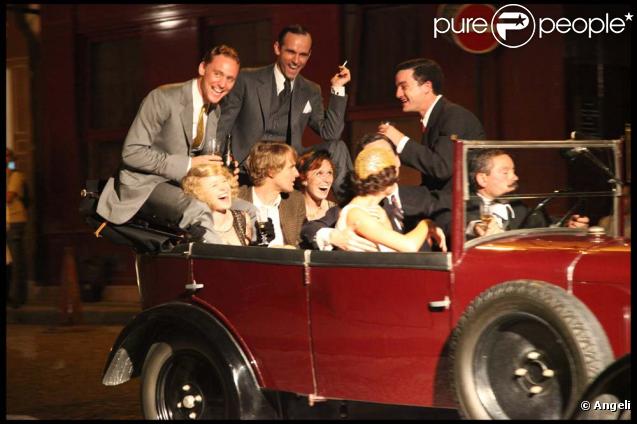
Several months ago on this blog I posted a review of Hadley by Gioia Diliberto. ( Biography blog archives February 11)  Hadley is a wonderful biography of Hemingway’s first wife and their early life together including their move to Paris in 1921.  Woody Allen may well have read the book before writing Midnight in Paris the newly released movie receiving rave reviews, including mine! I saw it this week and it is a wonderful movie, even better having read Hadley first!  The irony is that Hadley Hemingway does not appear in the film but the scenario set by Deliberto in her book makes the movie all the more impactful. All the  characters are there, Ernest , LuTrec, Gertrude Stein, Picasso , T.S. Eliot, et al!  

Another book on Hadley Hemingway which I have not read as yet, The Paris Wife by Paula McLain, is also appearing on best seller lists and receiving good reviews.  Hadley Hemingway is receiving much attention from both the new book by McLain and from Midnight in Paris . In the past week it has topped all hits on this blog! Not bad for a book published in 1992!

Personally, I am delighted to have read Hadley before seeing Midnight in Paris because it set the scene  for the movie’s Moveable Feast,  in a sense reincarnated in the Woody Allen film. I am sure that reading The Paris Wife  would work in the same manner.   It is a Hemingway renaissance! Enjoy the new but if you have not already done so, please go back to the originals! There lies the prose including a wonderful lines by Hemingway in the movie that begs you to read or re-read The Sun Also Rises and For Whom The Bell Tolls!

American Lion/ Andrew Jackson/ President’s Week Continues

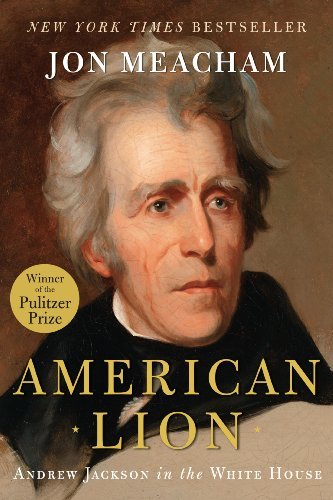
Jon Meacham is back on my blog today with another great book on the American Presidency, American Lion a biography of  Andrew Jackson, the eighth President of the United States ( 1829-1837).   Reviewers  generally agree that American Lion is a definitive work on the Jackson presidency. I will readily admit that I knew little detail about Jackson before picking up this Pulitzer winner and I remain thrilled that it was recommended to me. 

” Old Hickory” was one of the more incredible characters  to ever inhabit the White House.  He was a zealot in his beliefs and in particular hated the Bank of United States which be believed was the basis of past, present and future corruption in America and a threat to the Federal Government itself.  He was a staunch  states rights advocate, believed in the sovereignty of the individual but at the same time believed that the Federal Government was essential!

There was no contradiction in the zealotry of his Indian removal policy. In 1830, just a year after taking office, Jackson pushed a new piece of legislation called the “Indian Removal Act” through both houses of Congress. It gave the president power to negotiate removal treaties with Indian tribes living east of the Mississippi. Under these treaties, the Indians were to give up their lands east of the Mississippi in exchange for lands to the west leading to the black-mark on his presidency and the nation itself,  “The Trail of Tears.”

Despite all of the controversy that surrounds the Jackson presidency he in reality created the foundation of the modern-day Democratic Party.  He is considered by historians to be the first ‘populist” president.

American Lion is a marvelous journey for the reader and once again Meacham exhibits excellence!  No matter how much material Meacham covers, his work is always manageable.

David McCullough/John Adams/ A Gift to all Americans

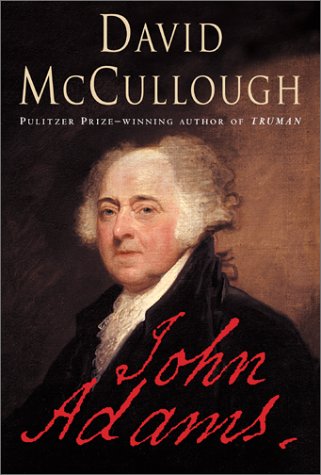
David McCullough’s  biography  John Adams can be credited with introducing 20th and 21st century Americans to the enormous impact John Admas, from patriot to president, had on early American History including The Revolution, The Presidency and the U.S. Constitution.

This magnificent work, incredibly well researched  is also a beautifully written story.  As one would expect from McCullough, all of the facts are in place, but the story of Adams the person and his relationship with his wife Abigail  is truly moving.  You will come to understand just how difficult it was to be President of the United States in 18th Century America.   You will read quotes from the trove of Adam’s letters both personal and public that are so enlightening about how critical decisions were made.  You will learn that the fact that America was born was itself a miracle!

Within the pages of John Adams, McCullough  portrays beautifully the love story between John  and Abigail.   He also captures the ruptured relationship between Adams and Thomas Jefferson and the reader is thrilled to learn of the two coming together as friends  in the later years of their lives.

You need not be a student of history to enjoy every page of John Adams.  It is a story about an incredibly gifted man’s love for his country, his wife and family.

David McCullough is a national treasure and his generosity in creativity is a gift to all Americans.