WHAT WOULD EMMA LAZARUS THINK? THOUGHTS FOR THE FOURTH OF JULY!


If the Statue of Liberty were moved to America’s southern border, how  would the hundreds of children detained there react to Emma Lazarus’  famous 1883 sonnet  engraved on the base of the statue?

imagesThe New Colossus

Not like the brazen giant of Greek fame,

With conquering limbs astride from land to land;

Here at our sea-washed, sunset gates shall stand

A mighty woman with a torch, whose flame

Is the imprisoned lightning, and her name

Mother of Exiles. From her beacon-hand

Glows world-wide welcome; her mild eyes command

The air-bridged harbor that twin cities frame.

“Keep, ancient lands, your storied pomp!” cries she

With silent lips. “Give me your tired, your poor,

Your huddled masses yearning to breathe free,

The wretched refuse of your teeming shore.

Send these, the homeless, tempest-tost to me,

I lift my lamp beside the golden door!”


Or this famous quote from

Alexis de Tocqueville

“America is great because she is good. If America ceases to be good, America will cease to be great.”

FROM GORDON’S GOOD READS

ALL GOOD FOOD FOR THOUGHT AS WE CELEBRATE INDEPENDENCE DAY!


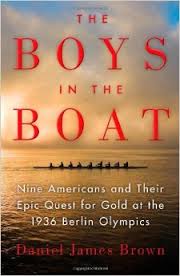
THE BOYS IN THE BOAT- AN EPIC STORY OF SEABISCUIT CALIBRE

Daniel James Brown’s  THE BOYS IN THE BOAT ranks  among my top non-fiction reads of 2014.  It is a captivating human story made even more compelling by Brown’s remarkable story telling.  This book is much more than its brilliant depiction of the sport of crew with nine men acting as one in an eight pared shell.  Brown wraps their journey to victory in the 1936 Berlin Olympics  in the history of the times.  The culture of young men growing up in the lumber and mining towns of the Pacific Northwest with few prospects beyond a life of hardship and physical labor.  The author brilliantly captures the darkness of the depression  of the 1930s and its impact on families and family life. He incorporates the drumbeat of the Nazi’s, preceding the outbreak of  WW II, and the elaborate deception of Hitler surrounding the 1936 Olympic Games.

images-1

Out of this era of despair appear nine young working class men, eight oarsmen and a coxswain , who literally by chance  come together under a brilliant coach and an iconic boat builder at the University of Washington.  Among these young men is teenager Joe Rantz, a boy with few prospects in life after being abandoned at age ten by his father an step-mother.  His true story of grit and determination swells the heart of the reader right through the exciting climax of this great American drama.  The Washington eight-oared shell captured the imagination of the country much as did the underdog racehorse Seabiscuit, as so beautifully chronicled in Laura Hillenbrand’s book of the same name.

Could there ever again be nine young men more deserving of ultimate triumph ?  Could a nation in a great depression be uplifted by a sport so obscure as crew, which was  formerly dominated only by the eastern elite.  Shades of Seabiscuit versus Man O’ War!  Could Hitler’s propaganda machine receive a huge setback by nine determined young American’s in eight-oared-shell ?   It all happens because of  THE BOYS IN THE BOAT!

The legendary boat-builder and philosopher of human nature George Pocock, provides a narrative for each chapter of  THE BOYS IN THE  BOAT :  ” He came to understand how those almost mystical bonds of trust and affection, if nurtured correctly, might lift a crew above the ordinary sphere, transport it to a place where nine boys somehow become one thing-a thing that could not quite be defined, a thing that was so in tune with the water and the earth and the sky above that, as they rowed, effort was replaced by ecstasy. ”

images-2

Daniel James Brown: ” It occurred to me that when Hitler watched Joe and the boys fight their way back from the rear of the field to sweep ahead of Italy and Germany seventy-five years ago, he saw, but did not recognize, heralds of his own doom. He could not have known that one day hundreds of thousands of boys just like them, boys who shared their essential natures-decent and unassuming, not privileged or favored by anything in particular, just loyal, committed and perseverant- would return to Germany dressed in olive drab, hunting him down.”

I commend  THE BOYS IN THE BOAT to the very top of your summer reading list. Buy it in hardcover because it belongs in your library for future generations.  Also by Daniel James Brown, The Indifferent Stars Above and Under a Flaming Sky.


PIKETTY- CAPITAL IN THE TWENTY-FIRST CENTURY- THE NEWS IS NOT GOOD!

It is somewhat astonishing that Thomas Piketty’s  CAPITAL in the 21st Century remains at the very top of the New York Times Best Seller List! Not intending to be condescending, this is not an easy read even for the most ardent observers of the national and world economy.  The first 250 pages, filled with exhaustive research over a 250 year period, complete with charts and graphs, is a test of anyone’s concentration.  You may need to read many pages more than once! The good news is that once through this sophisticated and advanced course in economics, the reader will come to an understanding of the inexorable march of an economic matrix that appears to be leading to a dysfunctional environment for the capitalistic system as  we have known in America for over 300 years.  Ironically, there is  currently a billboard on the south bound FDR Drive  in New York City that reads,” The French Aristocracy Didn’t See It Coming Either! ”  images Piketty does not set out to be an alarmist but rather to lay out what he believes is the most definitive research ever completed on the subject of inequality and the distribution of wealth in America and Europe, dating back to the seventeenth century.  Admittedly, Piketty qualifies some of the early collection of data as anecdotal but at the same time has sought out all-available recorded records to track the distribution of wealth over three centuries. What is most troubling in the Piketty thesis is his substantiation of a mathematical paradigm that left unchecked , places  the concentration of wealth worldwide and particularly in the United States on an unstoppable course of disastrous inequality.  Not an exciting prospect. Piketty: ” If the growing concentration of income from labor that has been observed in the United States over the last few decades were to continue, the bottom 50% could earn just half as much in total compensation as the top 10% by 2030.”  In the United States, the most recent survey by the Federal Reserve, indicates that the top decile own 72 percent of America’s wealth,  of which the bottom half claim just 2% .  These figures clearly delineate the plight of the dwindling  middle class.  If the top ten percent  and the bottom 2 percent control 74 percent of all wealth in America, that leaves only 26% for everyone else! Fundamental to Piketty’s  thesis is that a predicted economic annual growth rate in America of 1.5 percent or less will force a greater concentration of wealth among the top decile because based upon a rate of return there will be no incentive to invest risk capital back into the economy.  The top ten percent can comfortably continue to invest capital at 4-5% ( with some hedge funds at 10-30%) and in essence keep these capital resources off the table in the hands of the super wealthy, further shrinking the middle class and decimating the lower class.  He also predicts that as future generations  of the wealthy mature, inherited wealth will be exclusively bequeathed, removing it from the general capitalistic economy, in the same manner as did the old European aristocracies.  Thus, a new American Aristocracy fueled by inherited wealth? Piketty: ” In my view, there is absolutely no doubt that the increase of inequality in the United States  prior to 2007 contributed to the nation’s financial instability. The reason is simple:  One consequence of increasing inequality was virtual stagnation of the purchasing power of the lower and middle classes in the United States , which inevitably  made it more likely that modest households would take on debt, especially since unscrupulous banks  and financial intermediaries, freed from regulation and eager to earn good yields on the enormous savings injected into the system by the well-to-do, offered  credit on increasingly generous terms.” ” If we consider the total growth of the U.S. economy in the thirty years prior to the crisis, we find that the richest appropriated three-quarters of the growth.The richest 1-percent absorbed 60 percent of the total increase of U.S. national income in this period.  It is hard to imagine an economy and society that can continue functioning indefinitely with such extreme divergence between social groups.” Capital In The Twenty First Century has raised considerably debate and the outright questioning of Piketty’s research and formulas ( r>g ). However, if you take him for his word, the forecast is not comforting and for sure,  don’t look for many rave reviews from the financial establishment! Unfortunately, if you have sensed something wrong with the economy, Piketty offers great insight but little comfort! Capital in The 21st Century  is well worth a major investment of time.

A NEW CHAPTER FOR PIKETTY’S CAPITAL IN THE TWENTY FIRST CENTURY

I have not completed Tom Piketty’s Capital in the 21st Century. I will hasten to add that  after completing the first 250 pages  I may apply for an advanced Economics Degree.   The reward for wading through research and formulas going back 200 years does however come after the academics but in the early reading the news is not good regarding income inequality  globally and in America in particular.  More on that in a future posting with another 500 pages still to complete.

images

There is breaking news today that may require an additional chapter in Piketty’s book!

Please indulge my own interpretative headline.

U.S. APPEALS COURT DEEMS TRUTH IRRELEVANT!

I was not shocked at the U.S. Federal Appeals Court decision overturning Judge Jed S. Rakoff’s rejection of the settlement deal with Citigroup, claiming that the bank had got off with a mere slap on the wrist.  The three-judge panel yesterday said Rakoff got it wrong by applying an “ incorrect legal standard.” Citigroup now pays a fine and its business as usual.

The decision becomes even more frightening, at least to the layperson, when you peel back the details of the ruling! It seems to me that the three judges were searching for a rationale to support a foregone conclusion, much like Elmer Gantry could always find a passage in the Bible to support a point of view!

Judges Rosemary S. Pooler, Raymond J. Lohier Jr. and Susan L. Carney — concluded that it “is not within the district court’s purview to demand ‘cold, hard, solid facts. ”

The appellate court instead outlined a checklist for judges to follow when weighing enforcement cases, saying they must “determine whether the proposed consent decree is fair and reasonable, with the additional requirement that the public interest would not be dis-served.” 

What a stretch!  That the public interest would not be dis-served!  How is that for a parsing of words to avoid saying that the greater public interest should be served!  Your honors, please!

The final affront comes in this quote from the appellate decision.“ Trials are primarily about truth. Consent decrees are primarily about pragmatism.”

The bottom line is that three federal judges ruling deemed Judge Rakoff the “ skunk” at the Citigroup, S.E.C. party.

A final irony in this sordid affair is that the appellate court, in closing, questioned its own judgment!

“On remand, if the district court ( Rakoff)  finds it necessary, it may ask the S.E.C. and Citigroup to provide additional information ( the truth) sufficient to allay any concerns the district court may have regarding improper collusion” between Citigroup and the S.E.C.”  I think that Judge Rakoff made it quite clear that he had MANY CONCERNS!

This disingenuous decision may require an additional 50 pages in Tom Piketty’s already voluminous   Capital in the Twenty-First Century!


REFLECTIONS ON D-DAY, JUNE 6, 1944

imgres-1

The 70th Anniversary of D-Day, June 6, 1944, has obviously peaked interested in this monumental, historic event. There are two  books I would like to recommend to those who wish to pursue the historic details of this epic event and a third which offers important insight into the citizen soldiers so critical to the ultimate Allied Victory.  Two of these books are by the same author, historian Stephen E. Ambrose.
One of the most definitive and detailed histories of D-Day:  OVERLORD D-DAY AND THE BATTLE FOR NORMANDY by  British Historian Max Hastings, first published in Great Britain  in 1984. Wrote the Englishman, ” Not the least remarkable aspect of the Second World War was the manner in which the United States, which might have been expected to regard the campaign in Europe as a diversion from the struggle against her principal aggressor, Japan, was persuaded to commit her chief strength in the west.  Not only that, but from December 1941 until June, 1944 it was the Americans who were passionately impatient to confront the German Army on the continent while the British, right up until the eve of D-Day, were haunted by the misgivings about doing do.”  “Why are we trying to do this? cried Winston Churchill.”


imgres

The author of Eisenhower, Stephen Ambrose,  wrote the quintessential  D-Day history:  D-DAY, JUNE 6, 1944, THE CLIMATIC BATTLE OF WORLD WAR II. First published in 1994 on the 50th anniversary of D-Day.  Dwight Eisenhower, ” The Fury of an aroused democracy.” Eisenhower on Omaha Beach in 1964 on the D-Day 20th Anniversary.  ” But it’s a wonderful thing to remember what those fellows twenty years ago were fighting for and sacrificing for, what they did to preserve  our way of life. Not to conquer any territory, not for any ambitions of our own. But to make sure that Hitler could not destroy freedom in the world.”


imagesHow ordinary enlisted men’s ability to assume leadership turned the tide for the Allies:  Stephen E. Ambrose, CITIZEN SOLDIERS.  First published in 1997.  From the memoir of  Bruce Eggert who rose from private to staff sergeant: ” Not a man among us would want to go through it again, but were all proud of having been so severely tested and found adequate. The only regret is for those of our friends who never returned.”

Any of these volumes would make a wonderful Fathers Day gift for lovers of history. All are still available in hard cover and paperback editions.


THE LAST KIND WORDS SALOON-SUNSET ON THE WESTERN FRONTIER

Larry McMurtry’s new novel The Last Kind Words Saloon  takes the reader on an imagery ride into the sunset of the Old Wild West that he pictured so vividly in his previous classic Lonesome Dove.  Don’t look for a traditional story line in this latest McMurtry offering. Rather, this is what I call a chapter book ,which moves very quickly through images of the fading  lives  and lifestyles of  some of the Old West’s  iconic figures.

images-3

Through short , crisp chapters,  the reader glimpses  days and nights with Wyatt Earp, Doc Holliday,  and Jessie Earp the keeper of The Last Kind Words Saloon.   You will be re-acquainted with  Charlie Goodnight, the one-time Texas Ranger turned cattleman that was prominent in McMurtry’s fabulous novel Comanche Moon.  The trail passes through McMurtry’s home Texas turf from Long Grass  to Mobetie, then on to Tombstone, Arizona and of course the O.K. Corral. Men in search of  a last frontier.

The Last Kind Words Saloon  is  a last watering hole, a lost way of life, a friend fading with age as the Old West disappears before the eyes of the very men who established the treasured folklore.  With hope , they journey with a  faded marquee, The Last Kind Words Saloon, seeking to find a new place, which time has now forever lost.

Search Gordonsgoodreads.com for other great McMurtry books including  Lonesome Dove, Comanche Moon,  Dead Man’s Walk, Streets of Laredo and The Last Picture Show. 


BUSINESS AS USUAL AT CREDIT SUISSE– WITH ADDED CEO AUDACITY!

An Article in today’s New York Times  Deal book by Jenny Anderson summarizes the impact of the U.S. Justice Departments handling  of the Credit Suisse settlement.

Credit Suisse Chief Executive Brady W. Dougan seems less than contrite.

images-2

Quoting the New York Times article:

” A day after Credit Suisse pleaded guilty to tax evasion in the United States, the Swiss bank says that it is able to conduct its business as normal despite its criminal conviction. Swiss officials and investors seemed to welcome the fact that the resolution allows the bank to put the matter behind it.

On Tuesday, the Credit Suisse top management spread out around the world to calm employees and clients after its felony conviction. Mr. Dougan was in New York while Urs Rohner, the chairman, was in Switzerland and David Mathers, the company’s chief financial officer, was in London.

In call with media and analysts, Mr. Dougan again said the bank took full responsibility for its actions, but emphasized that it had seen little business impact as a result of the plea.

“We have found no instances where clients cannot do business with us,” he said. “Our discussions with clients have been very reassuring and we haven’t seen very many issues at all.”

Adds the NYT Article, “Mr. Dougan also said that he never considered resigning over the incident, even as opposition politicians continue to call for his ouster. “

Am I wrong or did Dougan really say Credit Suisse Clients  don’t give a dam about the banks felony conviction!  A good follow-up question: Does Dougan care?

I wonder how Eric Holder enjoyed reading this story this morning?


FINANCIAL CRISIS BOOKS-TWO GREAT OVERVIEWS

The Sunday May 18th  New York Times carried two wonderful overviews of two current books on the financial crisis. If you are following this odyssey both articles are most worthwhile. Gretchen Morgenson’s Fair Game column, Geithner Staying on Script  dissected Geithner’s Stress Test  self-defense book with precision!  In my view no reporter is better than Morgenson in getting to the bottom of  complex financial issues and her article is enlightening and the conclusions on point.  Writes Morgenson,

images

“Mr. Geithner does do some introspection. “I did not view Wall Street as a cabal of idiots or crooks,” he writes. “My jobs mostly exposed me to talented senior bankers, and selection bias probably gave me an impression that the U.S. financial sector was more capable and ethical than it really was.” That’s as close as he gets to saying that he was wrong to trust — not question — bankers he encountered.

A final flaw: In his book, Mr. Geithner boasts that the bailouts he helped design have been profitable to taxpayers. But his calculations do not take into account the cost of capital that the taxpayers extended to the banks.

Concludes Morgenson

“As for the oversight mistakes that he and his regulatory colleagues made, Mr. Geithner essentially says “We were human.” But this fails to address head-on the possibility that he was a captured regulator, a man locked into the mind-set of the very bankers he was supposed to oversee.”


http://nyti.ms/1oADWtM


images-1

The second article, written by Binyamin  Appelbaum, The Case Against The Bernanke-Obama Financial Rescue, reviews a new book by Atif  Mian and Amir Sufi titled House of Debt.  The authors flatly accuse Timothy Geithner and Ben Bernanke of focusing only on preserving the financial system ( the banks).  From Appelbaum’s  article ”

“If you actually look at the argument that people like Mr. Geithner make, they almost always point to financial metrics like risk spreads and interest rates,” he said. “But if you look at the real economy, it just tends to come out in our favor.” Millions of Americans remain unemployed almost five years after the formal end of the recession.”


http://nyti.ms/1lwE9YE

I have not as yet read either Stress Test or House of Debt.  These two overviews are great previews and set the table for two more good reads on this complex subject, a story which has no ending.


THE GOLDFINCH-ALLEGORY TAKES WING

Since completing The Goldfinch by Donna Tartt the novel has won a Pulitzer Prize for fiction. Forgive me , but I had speculated that to myself prior to the announcement, after reading only a hundred pages.

images

The plot is indeed complicated and the characters surrounding Theo Decker’s evolution into young adulthood evolve in pyramids of detail that can at times be overwhelming. However, Tartt never leaves any doubt as why each player in her cast influences  life choices made by the protagonist.

Park Avenue, Las Vegas, Lower East Side, Amsterdam. The societal character of these destinations is ingrained in the story. Tartt’s research and attention to subtile nuance is extraordinary. Tartt will immerse even the knowledgable New Yorker in the sounds, sights, energy and social theatrics of the city. Her descriptions remind one of  a Pete Hamill character in a smoke-filled  Daily News City Room banging on an Underwood under a green eye shade lamp at 1 AM , amid a torrential rainstorm roaring  against window panes!

Theo’s mother is killed in a bombing at the Metropolitan Museum of Art and there begins the connection with The Goldfinch a 17th Century painting by a Dutch Master that is worth millions. Of course, it was his mother’s favorite work of art and remains both symbolically and physically the centerpiece  and road map of the novel.

Theo’s life after his mother’s death could have been traditional Park Avenue, thanks to loving parents of a classmate. Even after Theo’s alcoholic father appears with his latest love , Xandra , and whisks him off to Las Vegas , the caring Barbour’s do not disappear. Each of Tartt’s characters stay in the mainstream until the very end, including Hobie the master of antique restoration and Theo’s only rock.

Without revealing the story, this book will take you to the worlds of drugs, antiquities, New York Society , the art world underground and dozens of subtile stops including a decaying Las Vegas subdivision offering no hope to residents of foreclosed abandoned homes. The landscape of this novel is immense and the attention to intricate detail ( Peal and Co.) and antique restoration is of the calibre of a well researched treatise on the subject. Yet, it all comes together with meaning and purpose, but not without expecting much time, thought and introspection on the readers part. The use of the editors marker was sparse.

From Theo, late in the journey. ” Only here’s what I really, really want someone to explain to me. What if one happens to be possessed of a heart than can’t be trusted–? What if the heart , for its own unfathomable reasons, leads one willfully and in a cloud of unspeakable radiance away from health, domesticity, civil responsibility and strong social connections and all the blandly held common virtues and instead toward a beautiful flare of ruin, self-immolation, disaster? ” Get the picture? Theo traversed all of the aforementioned territory and lived to tell the tale.

Other books by Donna Tartt: The Secret History and The Little Friend.


THE CIVIL RIGHTS AND VOTING RIGHTS ACT FIFTY YEAR CELEBRATION

Watching and listening to today’s celebration of the Lyndon Johnson Presidency and the passage of the Civil Rights and Voting Rights Acts urges me to remind you of the great Robert Caro book The Passage of Power.  Every detail of these great accomplishments are presented in Caro’s incomparable fashion. See a brief overview at gordonsgoodreads.com.  This book is so extraordinary you too will have sat in a room with LBJ.