Gray Lady Down by William McGowan

 GRAY LADY DOWN, WHAT THE DECLINE AND FALL OF THE NEW YORK TIMES MEANS FOR AMERICA (2010) by William McGowan  leaves little optimism for the newspaper that for generations has set the standard for American journalism.

In this book, McGowan longs for a return to a New York Times under the stewardship of the legendary Executive Editor and newspaperman A.M. (Abe) Rosenthal and Publisher Arthur Ochs Sulzberger.

McGowan lays the continuing problems at the Times squarely at the feet of Arthur Sulzberger Jr. who began his reign as publisher in 1991.   The author establishes through reference after reference that the Times continues an ethos of reporting with an “attitude,” something that Rosenthal would never allow. For decades, Rosenthal  with the full support of Arthur Ochs Sulzberger established and cherished independent news reporting at the Times, “clearly and sometimes defiantly separate from the editorial and opinion pages.”

Arthur Sulzberger Jr. according to McGowan brought his personal 1960s political views and attitude to the Times and hired and promoted reporters and editors who clearly supported his personal focus.  “The newspaper left the American mainstream to become obsessed with causes and societal change” to the point where McGowan establishes through the Times own reporting that during the 1990s the line between news and opinion was clearly crossed.  The “reporting with attitude” not only determined what was covered by the Times but who covered it and from what point of view.

As you read Grey Lady Down, you may think it to be a “hatchet job.”  Sadly, as you progress through example after example from the Times own pages you will see otherwise.  The reporting of  the Duke University Lacrosse Team rape accusation according to McGowan is one of dozens of unsettling  examples of how a story was covered by the Times based upon reporter’s perceptions.  McGowan makes strong cases in story after story that the “point of view” came from the “attitude” established in the corner office.

McGowan strongly believes that now more than ever America needs the Times of A.M. Rosenthal.  He correctly states that the New York Times continues to set the daily national news agenda. Whoever reports the news, print, broadcast, or cable ,the day begins with what is on the front page of the New York Times. “ The Times will continue to wield enormous influence over what the average American reads, hears and sees. Whether it appears in the paper or on a digital screen, it will continue to be the polestar for American journalism.”

Quoting Times Columnist Thomas Friedman  from Grey Lady Down, “The reason why Rosenthal was obsessed with keeping editors and reporters from putting their ‘thumbs on the scale’ was because he believed a ‘straight’ New York Times was essential to keeping democracy healthy and our government honest.”

McGowan does not see a return to the “Golden Age” during Times Executive Editor Bill Keller’s watch. 

McGowan also wrote Coloring the News, How Political Correctness Has Corrupted American Journalism ( 2001)

Another book of this genre I would commend to you is Bernard Goldberg’s Bias, (2002) an inside look at CBS News.  Goldberg spent three decades at CBS and came away with the belief that a CBS liberal slant on its reporting is not intentional but institutional!  Goldberg castigated television news reporting and reporters as being a product of the closed society in which the reporters themselves live and work.  The entire cast of TV news is present in Goldberg’s book and nearly all of the reviews took him seriously.
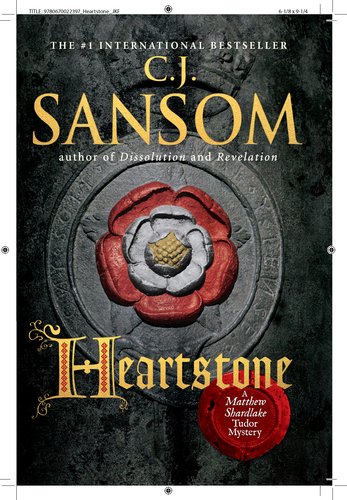
HEARTSTONE/C.J. SANSOM

Heartstone, the latest in the C.J. Sansom Shardlake, Tudor England mysteries carries forward the authors great images and twists and turns of the reign of Henry VIII and the characters developed that  are always tangential to the Throne, the Queen and the Court. 

Heartstone is no exception and those of you who were introduced to this series by my earlier blog  ( April 2, 2011) will not be disappointed. Sovereign, and Revelation are  also excellent reads but my choice from among the series remains Dissolution. 

From a historical point of view, Heartstone is set against a background of Henry  VIII embarking on yet another war with France. Yes, there is the usual Sansom twist in the plot that I doubt you will guess until the very end.

VENU MAGAZINE PUBLISHES GORDON’S GOOD READS

VENU,  the highly acclaimed Arts/Culture/Style magazine serving Fairfield County, Connecticut and Westchester County, New York has chosen Gordon’s Good Reads  as a regular feature in this celebrated bi-monthly publication. 

The current May/June, 2011 issue of  VENU is available this week at leading arts, culture and style locations throughout the two counties.  Gordon’s Good Reads appears beginning on page 20. The year-old publication noted for its excellent content and rich layout was co-founded by  Creative Director Michael Woodside and Executive Director Tracey Thomas.

Among the features in the May/June issue of VENU are articles on music including Rod Washburn,  The Norwalk Symphony Orchestra  and Songwriter’s Showcase. Other features include Off the Vine in Spain, and a most enjoyable short story, Spontaneous Combustion by Stephen Rhoades. The Motoring section features Ferrari’s Little GTO and Boating highlights The Intermarine 55 Luxury Yacht.

Pick up a copy of  VENU and you will quickly see why we are proud to be included in this excellent and prestigious publication.

Did Stephen Holden of the NYTimes Read/See The Same Water for Elephants?

Last week I suggested you read Water For Elephants by Sara Gruen then see the movie.  I had read the book then happened to read Stephen Holden’s New York Times review  of the movie before I went to the theater.  I came away from the movie asking myself if Holden read the same book and saw the same movie I did?  I also ask, did he have a bad day on April 22 when the review was posted?

All of us who love books have read and enjoyed a wide variety of authors ranging from great novels, memoirs , to non-fiction and biographies.  Books have vastly different appeal to different audiences. However, for Holden to call Gruen’s work Water for Elephants a lightweight page-turner  is a travesty.  Certainly the work may not be of the calibre of Gone with the Wind, Grapes of Wrath  or For Whom the Bell Tolls but neither are many books that are great reads! 

When I read Holden’s overly negative review of the movie Water for Elephants my enthusiasm  for seeing the picture was diminished. However, when I left the theater I realized Holden was wrong on all counts! 

Water for Elephants the movie  did in fact capture Gruen’s book, certainly not in every detail, but a film seldom does.  Contrary to Holden’s view, the nitty-gritty and cruelty of the world of a traveling circus was abundant, as was the  survival instinct of a circus family.  Hal Holbrook as narrator did in fact place the movie in perspective and drove home the book’s message that at the end of the day, good or bad, the circus, Marlena and Rosie was the only family that Jacob had!  I only regret that time on the screen did not allow further development of the aged Jacob in the nursing home prior to the circus’ arrival in town, thus opening the flashback with  even greater impact.

Before putting a wrap on this I must express my amazement at Holden’s  comment  that the love scene between Marlena and Jacob was disappointing because is was “dimly lighted!”   In retrospect that remark  revealed that Holden missed it all, the book, the movie and the message.

Reese Witherspoon and Robert Pattinson played extremely well both individually and in their roles together.  Surely the characters  we create in our minds from a book can never be totally replicated on-screen but that is why people read books! Despite Stephen Holden’s view,  I think Witherspoon did create an authentic period character and to suggest she was directed to do otherwise is foolishness!

If you have read  Water for Elephants you will enjoy the movie even more but see it whether you have read the book or not.   Don’t believe a word  of Stephen’s Holden’s review. I think he had a bad day and took it out on an enjoyable ” good read ” and a movie that did an admirable job with Sara Gruen’s novel.

WikiLeaks,The Brooklyn Bridge,Suspension

The New York Times revealed on Wednesday April 26th that the latest WikiLeaks distribution tells a story of plots to bring down the Brooklyn Bridge. “Al Qaeda has long had a fascination with suspension bridges, especially the Brooklyn Bridge. New documents reveal that before Sept. 11, 2001, methods for bringing down bridges were being taught at a terrorist training camp in Afghanistan, ” says the Times.

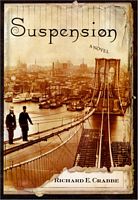
The longer I write this blog the more flashbacks I have to books I have read that connect with current events.  If you are interested in reading of terrorist plots, sabotage and sophisticated murder mysteries written on the level of Caleb Carr and wish at the same time to connect with the glorious history and construction of the Brooklyn Bridge I commend Suspension, a novel by Richard Crabbe. You will also discover an important Civil War connection with the bridge.

Written in 2010, Crabbe builds his story around a murder mystery that leads to a plot to sabotage the bridge by seven former Confederate soldiers who labored for years to hatch a plot to destroy the bridge because of a deep hatred for the Yankees who vanquished them in the Civil War. The Brooklyn Bridge?  Of Course! Washington Roebling the son of  Brooklyn Bridge designer John Roebling was placed in charge of the project upon the death of his father.  Washington Roebling was a distinguished Union Army Civil War officer having served with particular distinction at the Battle of  Gettysburg.  Thus Roebling’s ” Yankee-Bridge” became an even more meaningful target!

A wonderful mystery with vivid details on the construction and history of the most famous bridge in the world. Crabbe’s first novel qualifies as excellent in both plot and storytelling.

Water for Elephants Movie Vs. Book

You may have seen my previous comments on this blog concerning Water for Elephants, the book, by Sara Gruen. I urged those that had the time to read the book before seeing the movie.  Since the film opened last Friday I would be interested in your comments and comparisons.  If you like, please take the time to post your comments here on the blog.

Easter Week, What Jesus Meant, Garry Wills

First published in 2006, What Jesus Meant by New York Times best-selling author Garry Wills is 142 pages of important perspective, especially during Holy Week. I commend this wonderful work to you because it is an intelligent and insightful discussion of religion’s important role in our society. 

“Separation of Church and State”  or not, religion is part of everyday personal and political life in the nation.   Wills’ is critical of those who term Jesus merely an ethical teacher and allows that Jesus without the Resurrection is simply not the Jesus of the Gospels. Jesus came from the lower class, the working class and he spoke to and for that class.

Thoughtful, concise and captivating.  A good week for this read. Wills also wrote Why I Am a Catholic.

GOOD READS AT THE MOVIES

Two movies open in the next week that I am hopeful are worthy of the book Water for Elephants and the subject of many great reads the Lincoln assassination. Robert Redford’s The Conspirator opens on April 15 and Water for Elephants opens on April 22. Should be good films from good reads! I know, it is not always the case but lets be hopeful.

Civil War/ Lincoln Assassination/ Anniversary Week

Today, April 12, marks the 150th anniversary of the beginning of the Civil War with the firing on Fort Sumter, South Carolina.  April 15, Friday, marks the 146 anniversary of the assassination of Abraham Lincoln.  Earlier this week I commended to you Jay Winik’s April 1865,  an important work of non-fiction on the assassination and the tumultuous period that followed.

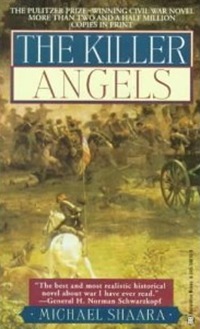
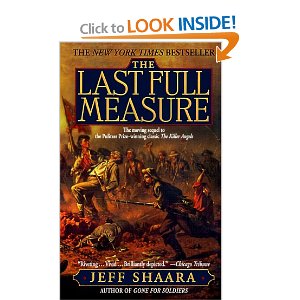
Hundreds of volumes have been written on the Civil War. On this anniversary I suggest to you three writings of fiction that I believe will give the reader the most vivid portrait of this monumental period in American History.  If you choose to read them all, I would suggest the following order.  Jeff Shaara’s  Gods & Generals, Michael Shaara’s Killer Angels ( The battle at Gettysburgand then Jeff Shaara’s The Last Full Measure. Jeff Shaara is the son of Michael Shaara.

These three historical novels describe the Civil War from the viewpoint of those who fought in and directed the great battles.  You will be present at the siege of Richmond, at Pickett’s Charge and on Little Round Top with the 20th Maine at Gettysburg and at the  Confederate surrender at Appomattox Courthouse .

The knowledge of the Civil War that you will gain from these three works of historical fiction is  priceless!

Jay Winik, April 1865 The Month That Saved America

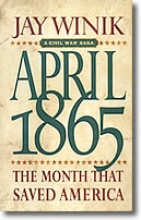
Robert Redford’s latest  offering as a movie director, The Conspirator opens across the country on April 15, which is the 146th anniversary of the assassination of Abraham Lincoln. The movie encompasses the trial of four accused conspirators including Mary Surratt. The publicity surrounding the release of this film, which I intend to see, caused my immediate recall of Jay Winik’s fabulous 2001 book April 1865, The Month That Saved America. 

Winik’s insightful analysis of what really happened during that last month of the Civil War and following Lincoln’s assassination is frightening.  He writes in detail of what occurred as the country fell into chaos and how a  few statesman turned to the United States Constitution to maintain order and establish a  transition not only of the presidency but for the country itself.

Whether you read April 1865 in conjunction with the movie or separately it is most worthy of the time of all who  have a passion for American History.