Easter Week, What Jesus Meant, Garry Wills

First published in 2006, What Jesus Meant by New York Times best-selling author Garry Wills is 142 pages of important perspective, especially during Holy Week. I commend this wonderful work to you because it is an intelligent and insightful discussion of religion’s important role in our society. 

“Separation of Church and State”  or not, religion is part of everyday personal and political life in the nation.   Wills’ is critical of those who term Jesus merely an ethical teacher and allows that Jesus without the Resurrection is simply not the Jesus of the Gospels. Jesus came from the lower class, the working class and he spoke to and for that class.

Thoughtful, concise and captivating.  A good week for this read. Wills also wrote Why I Am a Catholic.

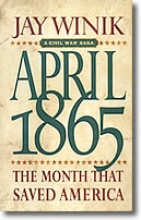
Jay Winik, April 1865 The Month That Saved America

Robert Redford’s latest  offering as a movie director, The Conspirator opens across the country on April 15, which is the 146th anniversary of the assassination of Abraham Lincoln. The movie encompasses the trial of four accused conspirators including Mary Surratt. The publicity surrounding the release of this film, which I intend to see, caused my immediate recall of Jay Winik’s fabulous 2001 book April 1865, The Month That Saved America. 

Winik’s insightful analysis of what really happened during that last month of the Civil War and following Lincoln’s assassination is frightening.  He writes in detail of what occurred as the country fell into chaos and how a  few statesman turned to the United States Constitution to maintain order and establish a  transition not only of the presidency but for the country itself.

Whether you read April 1865 in conjunction with the movie or separately it is most worthy of the time of all who  have a passion for American History.

I’VE ONLY READ 250 PAGES BUT GET THE SOCIAL ANIMAL NOW!

I will admit that I have forever been a fan of David Brooks’ columns in the New York Times and his ubiquitous television appearances.  I am now an even greater fan after consuming the first 250 pages of his new book The Social Animal.  You would never guess that David Brooks wrote this book! Is it a self-help book, business book, child rearing book?  That will be your decision. I will further report upon completion which at the current pace of consumption will be shortly!

Emotion and the role it plays in our lives and how important it is in our decisions.  Upon this basic premise Brooks  creates a composite couple Harold and Erica and the wonderful journey of understanding ourselves begins.

Head for the bookstore and begin seeing your own life unfold. The Social Animal becomes more absorbing with each page!

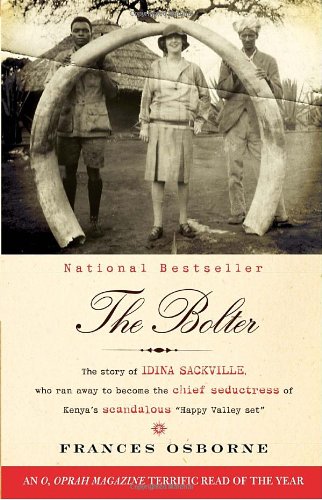
The Bolter/Chief Seductress Idina Sackville

The Bolter by Frances Osborne seemed an unlikely recommendation from my bookseller, but I am a trusting customer!

I  needed to remind myself chapter by chapter that I was not reading a novel. The Bolter, the true story of  British socialite Idina Sackville, who trashed  all the trappings of incredible wealth , her husband and two young children to lead her followers to nothing less than a scandalous and wild life as ” The Happy Valley Set”  in Kenya.

Osborne’s recounting the saga of Idina Sackville is representative of a group of women in the 1920s and 1930s who “bolted” from their marriages and ordered lives to live free from the yoke of society’s rules. The book leaves no doubt that Idina was the most famous and sensational of all ” The Bolters!”

A free spirit, enlightening, shocking, with an underlying sadness, emptiness and loneliness that came with abandoning all tradition. Friends come and go as passions rise and fall.

Enjoy The Bolter.  There is a lesson.

WORKING- STUDS TERKEL AND TOM BROKAW

Tom Brokaw  is doing a series this week on NBC Nightly News about jobs in America. His reporting incorporates the dramatically changing workplace, the need to re-educate workers and the rather old-fashioned concept of apprenticeship.

I urge anyone interested in this subject to read Studs Terkel’s book  WORKING ,written in 1974. ( I am sure Tom Brokaw has already done so, and I believe he interviewed Terkel  before his death in 2008.)  Terkel’s WORKING is typical of his attitude driven writing and reporting.  No one ever questioned that Studs Turkel had a point of view. 

However, through hundreds of interviews into the life of working men and women Terkel developed in WORKING a panoramic view from the factory floor, stock yards,  the highway crew, the ditch,  of just how people make a living. He writes exactly what workers think about their daily labors.

Anyone with more than a passing interest in the current crisis faced by many American working men and woman, please read this book!  It is a great platform for understanding the workplace of the 21st century and exactly how we  arrived at where we are today.  You may recall that Terkel won a Pulitzer for his 1985 book Hard Times an Oral History of the Great Depression.  Another timely read. 

This is one more instance whereby I can say, ” I am dam glad I read that book!”  I am tempted to read WORKING again!  Please share your thoughts in the comments below.

Atlantic/ Simon Winchester

Simon Winchester’s study of the history of the Atlantic Ocean, Atlantic,  is an examination of  the ocean’s creation and the evolution of civilization along its shores  

The Phoenicians venturing beyond the Pillars of Hercules, The Norsemen, The Age of Exploration, the great naval battles on Atlantic waters, Codfish,  Pirates, the Slave Trade, the Atlantic Cable, buried nuclear waste. Winchester examines in-depth the environmental concerns and of course envisions the great ocean’s geological destiny.

Atlantic is another respected scholarly work by Winchester but don’t expect the appearance of the characters you would find in a Michener novel. 

Atlantic is full of little known facts including speculation that the first rudiments of a democratic form of government were probably devised by Norsemen in Iceland in the fifteenth century.  You will learn that Canadian fisherman, after the Grand Banks had been placed under their protection by the Canadian Government, did more to devastate the native Atlantic Cod than had been previously done in all of history!

If you enjoy are a student of the Age of Exploration and the period of discovery of the New World, Atlantic fits very nicely into this body of knowledge.

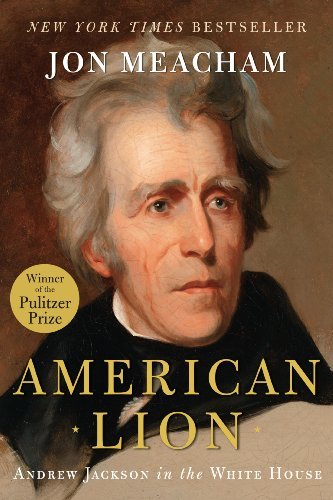
American Lion/ Andrew Jackson/ President’s Week Continues

Jon Meacham is back on my blog today with another great book on the American Presidency, American Lion a biography of  Andrew Jackson, the eighth President of the United States ( 1829-1837).   Reviewers  generally agree that American Lion is a definitive work on the Jackson presidency. I will readily admit that I knew little detail about Jackson before picking up this Pulitzer winner and I remain thrilled that it was recommended to me. 

” Old Hickory” was one of the more incredible characters  to ever inhabit the White House.  He was a zealot in his beliefs and in particular hated the Bank of United States which be believed was the basis of past, present and future corruption in America and a threat to the Federal Government itself.  He was a staunch  states rights advocate, believed in the sovereignty of the individual but at the same time believed that the Federal Government was essential!

There was no contradiction in the zealotry of his Indian removal policy. In 1830, just a year after taking office, Jackson pushed a new piece of legislation called the “Indian Removal Act” through both houses of Congress. It gave the president power to negotiate removal treaties with Indian tribes living east of the Mississippi. Under these treaties, the Indians were to give up their lands east of the Mississippi in exchange for lands to the west leading to the black-mark on his presidency and the nation itself,  “The Trail of Tears.”

Despite all of the controversy that surrounds the Jackson presidency he in reality created the foundation of the modern-day Democratic Party.  He is considered by historians to be the first ‘populist” president.

American Lion is a marvelous journey for the reader and once again Meacham exhibits excellence!  No matter how much material Meacham covers, his work is always manageable.

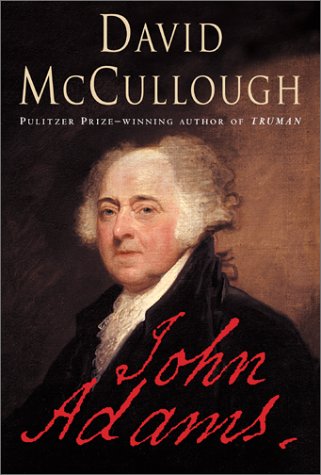
David McCullough/John Adams/ A Gift to all Americans

David McCullough’s  biography  John Adams can be credited with introducing 20th and 21st century Americans to the enormous impact John Admas, from patriot to president, had on early American History including The Revolution, The Presidency and the U.S. Constitution.

This magnificent work, incredibly well researched  is also a beautifully written story.  As one would expect from McCullough, all of the facts are in place, but the story of Adams the person and his relationship with his wife Abigail  is truly moving.  You will come to understand just how difficult it was to be President of the United States in 18th Century America.   You will read quotes from the trove of Adam’s letters both personal and public that are so enlightening about how critical decisions were made.  You will learn that the fact that America was born was itself a miracle!

Within the pages of John Adams, McCullough  portrays beautifully the love story between John  and Abigail.   He also captures the ruptured relationship between Adams and Thomas Jefferson and the reader is thrilled to learn of the two coming together as friends  in the later years of their lives.

You need not be a student of history to enjoy every page of John Adams.  It is a story about an incredibly gifted man’s love for his country, his wife and family.

David McCullough is a national treasure and his generosity in creativity is a gift to all Americans.

Empire of Liberty-More Timely Than Ever

With the revolution for freedom and democracy sweeping the Middle East, I can think of no better backdrop to recommend Empire of Liberty by Pulitzer Prize Historian Gordon S. Wood.   The work is part of the Oxford Series on American History and covers the period 1787 through the War of 1812.

This scholarly book traces the evolution of  the American Republic from the end of the Revolutionary War  into the great debates over the writing and ratification of the United States Constitution including the paradox of slavery, states rights, foreign influence and the very nature of the presidency.

What quickly becomes evident is the enormity of the issues surrounding establishing a society and government free from the old ways of European monarchies. Washington, Jefferson, Madison, Hamilton play leading roles in establishing a workable, permanent and cohesive  national government replacing the  looseness of the Articles of Confederation. 

Wood carefully brings alive individual contributions  and  the give and take,  often antagonistic, to reach compromise.  Jefferson and  Madison are  Wood’s  central figures with the contributions of John Adams  in my view somewhat marginalized.   Adams has his day in the sunshine in David McCulloch’s  biography, John Adams.

The more background the reader has in American history the easier the immersion into Empire of Liberty but that should not dissuade anyone with a love of our country’s history from tackling this landmark work. Despite the depth of the subject Wood has made his book an enjoyable journey and there is a clear and logical roadmap for the reader.  Yes, Empire of Liberty is a good read!

A New York Trilogy

Several years ago I had the privilege of an e-mail communication with Mike Wallace the co-author of Gotham just after I read the book. I shared my enthusiasm for this incredible volume and when I told him I actually read the 1236 pages sequentially he allowed that I might be the only person in captivity who did that!  This Pulitzer winner, written with Edwin G. Burrows, is the quintessential history of New York through the end of the 19th Century.

This preamble places in perspective my enthusiasm for New York the novel by Edward Rutherford.  Rutherford tells the New York story from the time of the city’s origins through the beginning of the twenty-first century through the lives of the fictional Van Dyck and Masters families. The story masterfully unfolds generation by generation.

Rutherford is every bit as captivating as is the standard-bearer of historical novels James Michener.  Every cell of Rutherford’s characters are believable as they wind, twist, love, fight, succeed and negotiate their lives through all of New York’s epic development. The Dutch settlement, Native Americans, independence, immigration, the classes, Civil War, financial booms and busts, politics, loyalists, revolutionaries, unions, heroes and villains, the swells and near-do-wells, all play a role.  You can taste the oysters at Frances Tavern!   Rutherford’s New York is comparable to the writing and character development in Michener’s Centennial, Chesapeake and Texas with the exception of Michener’s penchant for geological evolution! New York has earned a place on my Deserving of a Pulitzer shelf! New York will not give you the detail of Gotham but in living with the generations of the Van Dyck and Masters Families, you will  personally experience the story of the great city. 
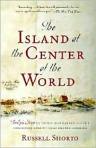
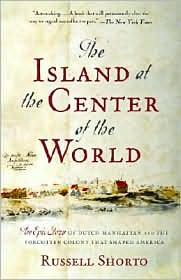
Complete your New York historical journey  by gaining a full understanding of the Dutch societal impact on the founding and ethos of the city by reading The Island in the Center of the World by Russell Shorto. This is a necessary read for all lovers of New York told through the voices of those that built the city and opened the New World long before the Pilgrims. You will come away with a deeper understanding of Peter Stuyvesant  an all of the other prevailing Dutch names and places rich in New York’s history.  You will learn why New York has always been open to new people, ideas, commerce and opportunity. Best of all you will enjoy more great storytelling.