Atlantic/ Simon Winchester

Simon Winchester’s study of the history of the Atlantic Ocean, Atlantic,  is an examination of  the ocean’s creation and the evolution of civilization along its shores  

The Phoenicians venturing beyond the Pillars of Hercules, The Norsemen, The Age of Exploration, the great naval battles on Atlantic waters, Codfish,  Pirates, the Slave Trade, the Atlantic Cable, buried nuclear waste. Winchester examines in-depth the environmental concerns and of course envisions the great ocean’s geological destiny.

Atlantic is another respected scholarly work by Winchester but don’t expect the appearance of the characters you would find in a Michener novel. 

Atlantic is full of little known facts including speculation that the first rudiments of a democratic form of government were probably devised by Norsemen in Iceland in the fifteenth century.  You will learn that Canadian fisherman, after the Grand Banks had been placed under their protection by the Canadian Government, did more to devastate the native Atlantic Cod than had been previously done in all of history!

If you enjoy are a student of the Age of Exploration and the period of discovery of the New World, Atlantic fits very nicely into this body of knowledge.

American Lion/ Andrew Jackson/ President’s Week Continues

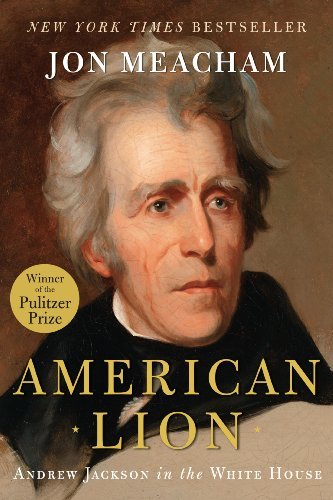
Jon Meacham is back on my blog today with another great book on the American Presidency, American Lion a biography of  Andrew Jackson, the eighth President of the United States ( 1829-1837).   Reviewers  generally agree that American Lion is a definitive work on the Jackson presidency. I will readily admit that I knew little detail about Jackson before picking up this Pulitzer winner and I remain thrilled that it was recommended to me. 

” Old Hickory” was one of the more incredible characters  to ever inhabit the White House.  He was a zealot in his beliefs and in particular hated the Bank of United States which be believed was the basis of past, present and future corruption in America and a threat to the Federal Government itself.  He was a staunch  states rights advocate, believed in the sovereignty of the individual but at the same time believed that the Federal Government was essential!

There was no contradiction in the zealotry of his Indian removal policy. In 1830, just a year after taking office, Jackson pushed a new piece of legislation called the “Indian Removal Act” through both houses of Congress. It gave the president power to negotiate removal treaties with Indian tribes living east of the Mississippi. Under these treaties, the Indians were to give up their lands east of the Mississippi in exchange for lands to the west leading to the black-mark on his presidency and the nation itself,  “The Trail of Tears.”

Despite all of the controversy that surrounds the Jackson presidency he in reality created the foundation of the modern-day Democratic Party.  He is considered by historians to be the first ‘populist” president.

American Lion is a marvelous journey for the reader and once again Meacham exhibits excellence!  No matter how much material Meacham covers, his work is always manageable.

David McCullough/John Adams/ A Gift to all Americans

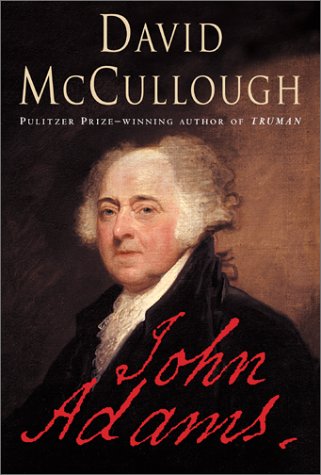
David McCullough’s  biography  John Adams can be credited with introducing 20th and 21st century Americans to the enormous impact John Admas, from patriot to president, had on early American History including The Revolution, The Presidency and the U.S. Constitution.

This magnificent work, incredibly well researched  is also a beautifully written story.  As one would expect from McCullough, all of the facts are in place, but the story of Adams the person and his relationship with his wife Abigail  is truly moving.  You will come to understand just how difficult it was to be President of the United States in 18th Century America.   You will read quotes from the trove of Adam’s letters both personal and public that are so enlightening about how critical decisions were made.  You will learn that the fact that America was born was itself a miracle!

Within the pages of John Adams, McCullough  portrays beautifully the love story between John  and Abigail.   He also captures the ruptured relationship between Adams and Thomas Jefferson and the reader is thrilled to learn of the two coming together as friends  in the later years of their lives.

You need not be a student of history to enjoy every page of John Adams.  It is a story about an incredibly gifted man’s love for his country, his wife and family.

David McCullough is a national treasure and his generosity in creativity is a gift to all Americans.

Empire of Liberty-More Timely Than Ever

With the revolution for freedom and democracy sweeping the Middle East, I can think of no better backdrop to recommend Empire of Liberty by Pulitzer Prize Historian Gordon S. Wood.   The work is part of the Oxford Series on American History and covers the period 1787 through the War of 1812.

This scholarly book traces the evolution of  the American Republic from the end of the Revolutionary War  into the great debates over the writing and ratification of the United States Constitution including the paradox of slavery, states rights, foreign influence and the very nature of the presidency.

What quickly becomes evident is the enormity of the issues surrounding establishing a society and government free from the old ways of European monarchies. Washington, Jefferson, Madison, Hamilton play leading roles in establishing a workable, permanent and cohesive  national government replacing the  looseness of the Articles of Confederation. 

Wood carefully brings alive individual contributions  and  the give and take,  often antagonistic, to reach compromise.  Jefferson and  Madison are  Wood’s  central figures with the contributions of John Adams  in my view somewhat marginalized.   Adams has his day in the sunshine in David McCulloch’s  biography, John Adams.

The more background the reader has in American history the easier the immersion into Empire of Liberty but that should not dissuade anyone with a love of our country’s history from tackling this landmark work. Despite the depth of the subject Wood has made his book an enjoyable journey and there is a clear and logical roadmap for the reader.  Yes, Empire of Liberty is a good read!

A New York Trilogy

Several years ago I had the privilege of an e-mail communication with Mike Wallace the co-author of Gotham just after I read the book. I shared my enthusiasm for this incredible volume and when I told him I actually read the 1236 pages sequentially he allowed that I might be the only person in captivity who did that!  This Pulitzer winner, written with Edwin G. Burrows, is the quintessential history of New York through the end of the 19th Century.

This preamble places in perspective my enthusiasm for New York the novel by Edward Rutherford.  Rutherford tells the New York story from the time of the city’s origins through the beginning of the twenty-first century through the lives of the fictional Van Dyck and Masters families. The story masterfully unfolds generation by generation.

Rutherford is every bit as captivating as is the standard-bearer of historical novels James Michener.  Every cell of Rutherford’s characters are believable as they wind, twist, love, fight, succeed and negotiate their lives through all of New York’s epic development. The Dutch settlement, Native Americans, independence, immigration, the classes, Civil War, financial booms and busts, politics, loyalists, revolutionaries, unions, heroes and villains, the swells and near-do-wells, all play a role.  You can taste the oysters at Frances Tavern!   Rutherford’s New York is comparable to the writing and character development in Michener’s Centennial, Chesapeake and Texas with the exception of Michener’s penchant for geological evolution! New York has earned a place on my Deserving of a Pulitzer shelf! New York will not give you the detail of Gotham but in living with the generations of the Van Dyck and Masters Families, you will  personally experience the story of the great city. 

Complete your New York historical journey  by gaining a full understanding of the Dutch societal impact on the founding and ethos of the city by reading The Island in the Center of the World by Russell Shorto. This is a necessary read for all lovers of New York told through the voices of those that built the city and opened the New World long before the Pilgrims. You will come away with a deeper understanding of Peter Stuyvesant  an all of the other prevailing Dutch names and places rich in New York’s history.  You will learn why New York has always been open to new people, ideas, commerce and opportunity. Best of all you will enjoy more great storytelling.

IF YOU ARE A LATE COMER TO HEMINGWAY READ HADLEY FIRST!

For many of us getting to the classics was a long journey, first developing  the zeal and then at last the time!  I discovered the works of Ernest Hemingway later in life, long after the corporate mountains were climbed and descended and children raised and sent off to college. Looking back, I am glad that my sojourn  arrived then because I think my mind was much more receptive , and appreciative.

Life experience  elevates the enjoyment of so many great writers, broadening perspective and understanding.  Now at the right time and place I was ready to consume For Whom the Bell Tolls, Death in the Afternoon, A Moveable Feast, The Sun Also Rises, The Old Man and the Sea, and A Farewell to Arms.

Now, what does Hadley by  Gioia Diliberto have to do with this?  I wish I had read it first! Hadley is a marvelous biography of Hemingwey’s first wife Hadley Richardson . For those who are reading  Hemingway for the first time, Hadley is an excellent introduction and a must read. It is Diliberto’s gift to the Hemingway reader offering  deep insight into his  mind, personality, relationships and lifestyle.  In the pages of Hadley you will see  The Sun Also Rises and A Moveable Feast evolving in Hadley and Hemingway’s  love story and their life together and apart. If you have not already begun your Hemingway journey take my suggestion and read Hadley first then move quickly on to the main course!

The Worst Hard Time: Insightful Parallells

The Worst Hard Time by Timothy Egan dramatizes remarkable similarities between the Great Depression of the 1920s and the 1930s and the Great Recession of 2008-2011. The land grab in the High Plains, the breaking of the virgin sod, and the rampant speculation in wheat by homesteaders and suitcase farmers alike all fueled by easy money.  Sounds a lot like no income check mortgages home equity loans!

If you interchange  a few names: Housing Bubble for High Plains land, wheat speculation for Mortgage Backed Securities and suitcase farmers for real estate and Wall Street speculators Tim Egan could have very well been describing today’s financial crisis.

Egan wrote The Worst Hard Time in 2005 and uncannily described exactly what was coming in the next Worst Hard Time! 

Another fine Tim Egan book is The Big Burn which includes many additional lessons on what happens when financial speculation and politics trumps common sense.

Both books are timely reads.

Yes, Colonel Roosevelt is a Page-Turner!

He is sitting just above a cowcatcher railroading out of Mombasa, hunting White Rhino in the Dark Continent, receiving a triumphant hero’s royal welcome in the palaces of Europe. A spoiler in an election campaign, living on the edge of death exploring an unknown Brazilian River, the presidency yet again within reach, a passionate advocate of the war and duty loses a son in battle.

The epic image of Theodore Roosevelt reaches another crescendo in Edmund Morris’ new biography Colonel Roosevelt (2010 Random House). Morris’ two previous historical masterpieces The Rise of Theodore Roosevelt and Theodore Rex received critical acclaim including the former receiving the Pulitzer Prize. Colonel Roosevelt completes the trilogy and is worthy of the praise which will undoubtedly be forthcoming.    
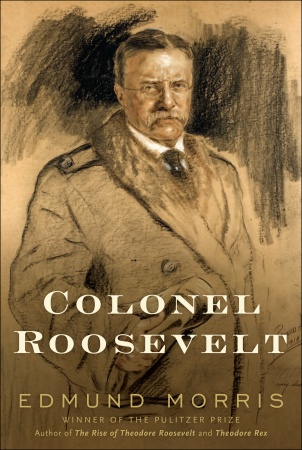
Colonel Roosevelt continues Morris’ biographical work after Roosevelt leaves the presidency following the election of William Howard Taft in 1908. It ends with Roosevelt’s death in 1919.

 Roosevelt embarks upon a lifelong dream of an African big game safari. He follows that with a heroic post presidential tour of the capitols of Europe.  Morris’s detail is so vivid it is as though the author were present. Roosevelt returns home to find the Republican Party in disarray. He is greatly disappointed in President Taft, his friend and chosen successor. He sees his Republican Progressivism platform in shambles.

 Morris’ study of Roosevelt Progressivism and the resulting split in the Republican Party is telling in its relevance to the divide that exists in the modern day GOP. A century ago, the ultra conservatives were the Taft Republicans and the more moderate Republicans became Roosevelt’s Progressives. The split resulted in Roosevelt’s Bull Moose Party and his failed election bid in 1912 that saw the GOP divided between Taft and Roosevelt with the resulting election of Woodrow Wilson. It raises an interesting comparison to the Tea Party split within the current GOP.

Morris’ treatment of the Roosevelt-Wilson acrimony through the conclusion of the First World War is riveting. It is so well written that for the non-historian it becomes an insightful overview of the political momentum of the entire tragedy and the tremendous divide it created in what was then an isolationist America.

 Morris deserves his just accolades as a historian. His research is impeccable. Best of all he is also a great storyteller.  His style in all three Roosevelt books presents personalities and huge volumes of historical facts in a flowing, manageable and memorable landscape.

 The term Page-Turner is most often used in reference to fast-paced novels, not a biography. However, Edmund Morris consistently writes monumental Page-Turners combining facts and clear interpretation with artistry to bring history and personalities vividly into focus. Start by turning the pages of The Rise of Theodore Roosevelt, hit the campaign trail to the presidency with Theodore Rex, and then be a witness to Roosevelt’s incredible later life as so beautifully detailed in Colonel Roosevelt. During the many hours of pleasure it will take to absorb all three, Edmund Morris will personally place you amidst the Roosevelt memorabilia in the great room at Sagamore Hill.