EMPIRE OF THE SUMMER MOON

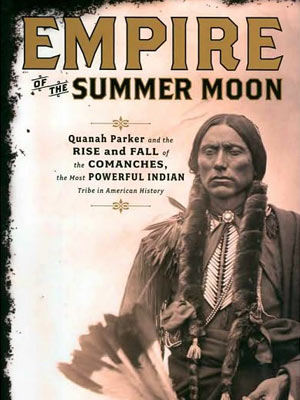
S.C. Gwynne’s Empire of the Summer Moon is a work of non-fiction deserving of its finalist status for a  2011 Pulitzer.  What is so haunting about this book is an un-avoidable love-hate relationship with the Comanche’s of West Texas and the High Plains in the period  1830-1875. 

You will come to respect the greatest mounted warriors  that ever lived in North America. Witness the absolute freedom of Comanche life on the high plains, totally in harmony with the soil, water, wind, buffalo, and of course the horse.   Then there is the depravity, ruthless killing of rival tribes and  later the slaughter of white settlers.  Men, women and children hacked to death or kidnapped, raped and mutilated without remorse. 

Within this barbaric tale evolves the portrait of Cynthia Ann Parker, captured at 9 years of age after watching her family slaughtered  by a Comanche raiding party.  Parker  embraces the Indian culture, marries a head man and bears two sons. Later, found by the U.S. Army among a wandering Comanche tribe, she is returned to ” civilization”  and put on display almost as a freak show.  Members of the Parker family hand her off from one to another as she tried desperately to return to Indian life and her sons.  She died broken-hearted never knowing what happened to her husband and two sons.  Son Quanah who saw his mother taken away by soldiers at age twelve grows to become the most brutal Comanche  worrier of his time.

Gwynne’s research  is worthy of the book’s sub-title. Quanah Parker the Rise and Fall of the Comanches, the Most Powerful Indian Tribe in American History.  Gwynne’s vivid detail and attention to the historical record forces the reader to try to reconcile the many faces of the Comanche, mounted nomads of the Great Plains.  It is all here, Spanish Colonialism in West Texas, The Civil War,  Manifest Destiny, the destruction of the great buffalo herds and of course the true story of Cynthia Ann Parker and her son Quanah.  Quanah from wild murdering Comanche orhpan to dinner with President Teddy Roosevelt.

Empire of the Summer Moon places this incredible tale in proper historical perspective. Don’t look for a historical novel here, this is a well researched narrative and wonderful story.

UNBROKEN-LAURA HILLENBRAND-ASTONISHING!

There is little wonder why Unbroken by Laura Hillenbrand has been atop the New York Times Best Seller List since its publication last year.

The epic story  of the survival, resilience and redemption of  Lieutenant Louis Zamperini is a triumphant accomplishment . It is a literary and historical work by Hillenbrand worthy of the highest accolades. Unbroken equals and in its research even surpasses the excellence of Hillenbrand’s wonderful  Seabiscuit . Warning, it is a disturbing read

Hillenbrand traces the life of Louis Zamperini from delinquent teen to local track hero and Olympian to a World War Two  B-24 bombardier shot down with his crew over the Pacific. Forty seven days in a raft first with three fellow crew members, then  only two. The horror of that ordeal is trumped by his capture and incarceration for two and a half years as a  Japanese POW under the most sadistic circumstances imaginable. Zamperini’s story of human survival defies belief. Hillenbrand’s  research and writing misses no detail, including the story of Louie’s Post Traumatic Syndrome long before anyone had diagnosed the tragedy of post combat emotional illness.

Unbroken’s historical perspective on the war in the Pacific ranks Hillenbrand’s writing in a league with  Stephen Ambrose (D-Day) and ( Citizen Soldiers), James Bradley ( Flyboys),  Jeff Shaara ( The Final Storm), and Doug Stanton ( In Harms Way-The Sinking of the USS Indianapolis).

It is not easy to  digest Hillenbrand’s  descriptions of the horror’s faced by Louie Zamperini and thousands of other POW’s but the outcome is triumphant for the author, the reader and Louie Zamperini! 

There are many months ahead for this great book on top of best seller lists, and it is most deserving of a place in your personal library.

Thank you Laura Hillendrand.

Reckless Endangerment-Excellent Reporting-Pulitzer Worthy

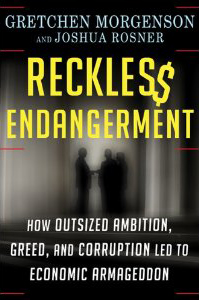
Gretchen Morgenson has again distinguished herself as the finest reporter of financial matters in the  American free press.  The added research of Joshua Rosner raises the new book RECKLESS ENDANGERMENT to an even higher level of excellence and credibility. Recognition of the full title of this work is essential. RECKLESS-ENDANGERMENT, HOW OUTSIZED AMBITION, GREED, AND CORRUPTION LED TO ECONOMIC ARMAGEDDON.

Morgenson’s  and Rosner’s  investigative reporting and writing ( an appropriate description) ) not only tells this nearly unbelievable story but it is a statement about the importance of newspapers and journalists who are committed to upholding the tenants of a free press in a democracy.

The following paragraphs from  RECKLESS ENDANGERMENT  preview the depth to which the book travels to tell the story leading up to the  economic meltdown of 2008 and more disturbingly raises the prospect that at this very moment it may well be happening all over again.

“Just as drug lords know that their products pose hazards to their customers, the Wall Street firms packaging and selling mortgage pools to investors knew well before their customers did that the loans inside the securities had begun to go bad. But with the mortgage mania raging and profits still flowing the investment bankers had no interest in coming clean.”

“The Incident was the first of many times that the heads of organizations accused of improper conduct were not held accountable for the damage they did to shareholders and , later, to taxpayers.”

“Will a debacle like the credit crisis of 2008 ever happen again? Most certainly, because Congress decided against fixing the problem of too-big-to-fail institutions when it had the chance.”

Page by page with incredibly impressive detail , facts and substantiation, Morgenson and Rosner describe  the lead-up to the carnage to the American economy and citizenry, and to the financial crisis that the government is still facing.

There are pages in this book that you simply will not want to believe. However, you will! All of the economic meltdown characters are there with the ironic twist that nearly all of them are still controlling the levers of economic power. The list of key players in the meltdown who are still  on stage  spans pages 305-308!


Midnight in Paris, Hemingway, Hadley, The Paris Wife

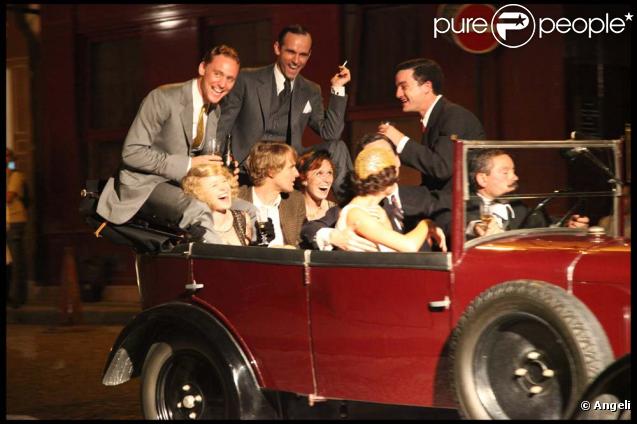
Several months ago on this blog I posted a review of Hadley by Gioia Diliberto. ( Biography blog archives February 11)  Hadley is a wonderful biography of Hemingway’s first wife and their early life together including their move to Paris in 1921.  Woody Allen may well have read the book before writing Midnight in Paris the newly released movie receiving rave reviews, including mine! I saw it this week and it is a wonderful movie, even better having read Hadley first!  The irony is that Hadley Hemingway does not appear in the film but the scenario set by Deliberto in her book makes the movie all the more impactful. All the  characters are there, Ernest , LuTrec, Gertrude Stein, Picasso , T.S. Eliot, et al!  

Another book on Hadley Hemingway which I have not read as yet, The Paris Wife by Paula McLain, is also appearing on best seller lists and receiving good reviews.  Hadley Hemingway is receiving much attention from both the new book by McLain and from Midnight in Paris . In the past week it has topped all hits on this blog! Not bad for a book published in 1992!

Personally, I am delighted to have read Hadley before seeing Midnight in Paris because it set the scene  for the movie’s Moveable Feast,  in a sense reincarnated in the Woody Allen film. I am sure that reading The Paris Wife  would work in the same manner.   It is a Hemingway renaissance! Enjoy the new but if you have not already done so, please go back to the originals! There lies the prose including a wonderful lines by Hemingway in the movie that begs you to read or re-read The Sun Also Rises and For Whom The Bell Tolls!

Gray Lady Down by William McGowan

 GRAY LADY DOWN, WHAT THE DECLINE AND FALL OF THE NEW YORK TIMES MEANS FOR AMERICA (2010) by William McGowan  leaves little optimism for the newspaper that for generations has set the standard for American journalism.

In this book, McGowan longs for a return to a New York Times under the stewardship of the legendary Executive Editor and newspaperman A.M. (Abe) Rosenthal and Publisher Arthur Ochs Sulzberger.

McGowan lays the continuing problems at the Times squarely at the feet of Arthur Sulzberger Jr. who began his reign as publisher in 1991.   The author establishes through reference after reference that the Times continues an ethos of reporting with an “attitude,” something that Rosenthal would never allow. For decades, Rosenthal  with the full support of Arthur Ochs Sulzberger established and cherished independent news reporting at the Times, “clearly and sometimes defiantly separate from the editorial and opinion pages.”

Arthur Sulzberger Jr. according to McGowan brought his personal 1960s political views and attitude to the Times and hired and promoted reporters and editors who clearly supported his personal focus.  “The newspaper left the American mainstream to become obsessed with causes and societal change” to the point where McGowan establishes through the Times own reporting that during the 1990s the line between news and opinion was clearly crossed.  The “reporting with attitude” not only determined what was covered by the Times but who covered it and from what point of view.

As you read Grey Lady Down, you may think it to be a “hatchet job.”  Sadly, as you progress through example after example from the Times own pages you will see otherwise.  The reporting of  the Duke University Lacrosse Team rape accusation according to McGowan is one of dozens of unsettling  examples of how a story was covered by the Times based upon reporter’s perceptions.  McGowan makes strong cases in story after story that the “point of view” came from the “attitude” established in the corner office.

McGowan strongly believes that now more than ever America needs the Times of A.M. Rosenthal.  He correctly states that the New York Times continues to set the daily national news agenda. Whoever reports the news, print, broadcast, or cable ,the day begins with what is on the front page of the New York Times. “ The Times will continue to wield enormous influence over what the average American reads, hears and sees. Whether it appears in the paper or on a digital screen, it will continue to be the polestar for American journalism.”

Quoting Times Columnist Thomas Friedman  from Grey Lady Down, “The reason why Rosenthal was obsessed with keeping editors and reporters from putting their ‘thumbs on the scale’ was because he believed a ‘straight’ New York Times was essential to keeping democracy healthy and our government honest.”

McGowan does not see a return to the “Golden Age” during Times Executive Editor Bill Keller’s watch. 

McGowan also wrote Coloring the News, How Political Correctness Has Corrupted American Journalism ( 2001)

Another book of this genre I would commend to you is Bernard Goldberg’s Bias, (2002) an inside look at CBS News.  Goldberg spent three decades at CBS and came away with the belief that a CBS liberal slant on its reporting is not intentional but institutional!  Goldberg castigated television news reporting and reporters as being a product of the closed society in which the reporters themselves live and work.  The entire cast of TV news is present in Goldberg’s book and nearly all of the reviews took him seriously.

Easter Week, What Jesus Meant, Garry Wills

First published in 2006, What Jesus Meant by New York Times best-selling author Garry Wills is 142 pages of important perspective, especially during Holy Week. I commend this wonderful work to you because it is an intelligent and insightful discussion of religion’s important role in our society. 

“Separation of Church and State”  or not, religion is part of everyday personal and political life in the nation.   Wills’ is critical of those who term Jesus merely an ethical teacher and allows that Jesus without the Resurrection is simply not the Jesus of the Gospels. Jesus came from the lower class, the working class and he spoke to and for that class.

Thoughtful, concise and captivating.  A good week for this read. Wills also wrote Why I Am a Catholic.

Jay Winik, April 1865 The Month That Saved America

Robert Redford’s latest  offering as a movie director, The Conspirator opens across the country on April 15, which is the 146th anniversary of the assassination of Abraham Lincoln. The movie encompasses the trial of four accused conspirators including Mary Surratt. The publicity surrounding the release of this film, which I intend to see, caused my immediate recall of Jay Winik’s fabulous 2001 book April 1865, The Month That Saved America. 

Winik’s insightful analysis of what really happened during that last month of the Civil War and following Lincoln’s assassination is frightening.  He writes in detail of what occurred as the country fell into chaos and how a  few statesman turned to the United States Constitution to maintain order and establish a  transition not only of the presidency but for the country itself.

Whether you read April 1865 in conjunction with the movie or separately it is most worthy of the time of all who  have a passion for American History.

I’VE ONLY READ 250 PAGES BUT GET THE SOCIAL ANIMAL NOW!

I will admit that I have forever been a fan of David Brooks’ columns in the New York Times and his ubiquitous television appearances.  I am now an even greater fan after consuming the first 250 pages of his new book The Social Animal.  You would never guess that David Brooks wrote this book! Is it a self-help book, business book, child rearing book?  That will be your decision. I will further report upon completion which at the current pace of consumption will be shortly!

Emotion and the role it plays in our lives and how important it is in our decisions.  Upon this basic premise Brooks  creates a composite couple Harold and Erica and the wonderful journey of understanding ourselves begins.

Head for the bookstore and begin seeing your own life unfold. The Social Animal becomes more absorbing with each page!

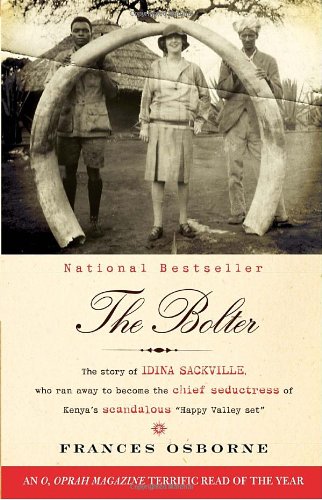
The Bolter/Chief Seductress Idina Sackville

The Bolter by Frances Osborne seemed an unlikely recommendation from my bookseller, but I am a trusting customer!

I  needed to remind myself chapter by chapter that I was not reading a novel. The Bolter, the true story of  British socialite Idina Sackville, who trashed  all the trappings of incredible wealth , her husband and two young children to lead her followers to nothing less than a scandalous and wild life as ” The Happy Valley Set”  in Kenya.

Osborne’s recounting the saga of Idina Sackville is representative of a group of women in the 1920s and 1930s who “bolted” from their marriages and ordered lives to live free from the yoke of society’s rules. The book leaves no doubt that Idina was the most famous and sensational of all ” The Bolters!”

A free spirit, enlightening, shocking, with an underlying sadness, emptiness and loneliness that came with abandoning all tradition. Friends come and go as passions rise and fall.

Enjoy The Bolter.  There is a lesson.

WORKING- STUDS TERKEL AND TOM BROKAW

Tom Brokaw  is doing a series this week on NBC Nightly News about jobs in America. His reporting incorporates the dramatically changing workplace, the need to re-educate workers and the rather old-fashioned concept of apprenticeship.

I urge anyone interested in this subject to read Studs Terkel’s book  WORKING ,written in 1974. ( I am sure Tom Brokaw has already done so, and I believe he interviewed Terkel  before his death in 2008.)  Terkel’s WORKING is typical of his attitude driven writing and reporting.  No one ever questioned that Studs Turkel had a point of view. 

However, through hundreds of interviews into the life of working men and women Terkel developed in WORKING a panoramic view from the factory floor, stock yards,  the highway crew, the ditch,  of just how people make a living. He writes exactly what workers think about their daily labors.

Anyone with more than a passing interest in the current crisis faced by many American working men and woman, please read this book!  It is a great platform for understanding the workplace of the 21st century and exactly how we  arrived at where we are today.  You may recall that Terkel won a Pulitzer for his 1985 book Hard Times an Oral History of the Great Depression.  Another timely read. 

This is one more instance whereby I can say, ” I am dam glad I read that book!”  I am tempted to read WORKING again!  Please share your thoughts in the comments below.