THE FIRST ” CITY UPON A HILL ” EDEN ON THE CHARLES THE MAKING OF BOSTON

The contemporary reference to  City Upon A Hill  is Ronald Reagan’s famous quote, Shining City Upon A Hill.  His comment was sourced all the way back to Massachusetts Bay Colony Puritan founder John Winthrop. When  Winthrop spoke these memorable words ( minus the word shining) , he was poised to disembark on the American shore on land that is now Boston. The man who eventually became governor of the Massachusetts Bay Colony accurately predicted that the new community would be a City Upon a Hill to be watched by the world. I think Winthrop would have liked Reagan’s addition of shining!

Winthrop’s inspiration came from Matthew 5:14. In the Sermon on the Mount, Jesus tells his listeners: You are the light of the world. A city on a hill cannot be hidden. Neither do people light a lamp and put it under a bowl. Instead they put it on its stand and it gives light to everyone in the house. In the same way, let your light shine before men, that they may see your good deeds and praise your Father in heaven. From this scripture comes the ethos of Michael Rawson’s Eden On The Charles THE MAKING OF BOSTON, a work of non-fiction that was a finalist in the 2010 Pulitzer competition.

Eden on The Charles is very different from a typical historical perspective of the founding of the Massachusetts Bay Colony.  It is the story of how over two and one half centuries a community with an enormously varied socio-economic strata came together to build America’s first great city in harmony with the natural environment.  It is a study of how within a political structure of fierce independence and private enterprise a community used the forces of government to act in behalf of the well-being of the citizenry and the natural environment.  Boston was indeed the very first American city to recognize that the  new world’s resources were not unlimited. From the mid-seventeenth century establishment of Boston Common as public land for everyone’s benefit there came a cascade of new ideas and concepts that established development patterns for cities throughout America.  These far-sighted yet fiercely independent citizens of varied rank established a pattern over two centuries wherby Boston Common went from cow pasture to the nation’s first public park,  Boston Harbor was saved from encroachment and destruction, greenways were established to prevent urban sprawl,  huge public parks were created on the outskirts of the city, and perhaps most important of all as early as the 19th century Boston built a public water supply providing free water for the city’s burgeoning population. It also built a public sewer system. There is some irony in the fact that the wealthy industrialists who became the Boston Brahmins were many of the most ardent environmentalists of the time. One of Boston’s early reformers and leaders of the public water supply movement, Walter Channing said,  Whatever a society judged to be essential to the health and happiness of its people must never be the responsibility of a profit-driven entity. It must ,instead, be made the responsibility of government.  Channing’s 175 year-old concept still rings loudly in contemporary political discourse.

Eden On The Charles  falls within a text-book reference and yet it reads so easily that concepts which are now fundamental  to the nation’s conversation regarding the preservation of the natural environment are easily understood and eye-opening. My being a New Englander and having spent a considerable amount of time in Boston made the book even more vivid.

In the closing paragraph of Eden On The Charles Rawson issues a wonderful challenge.  We should aim our sights high, as nineteenth century Bostonians did, and work to new environmental relationships that are worthy of a City Upon A Hill.

ROBERT CARO’S PASSAGE OF POWER-HISTORICALLY IMPECCABLE-RELEVANT TODAY

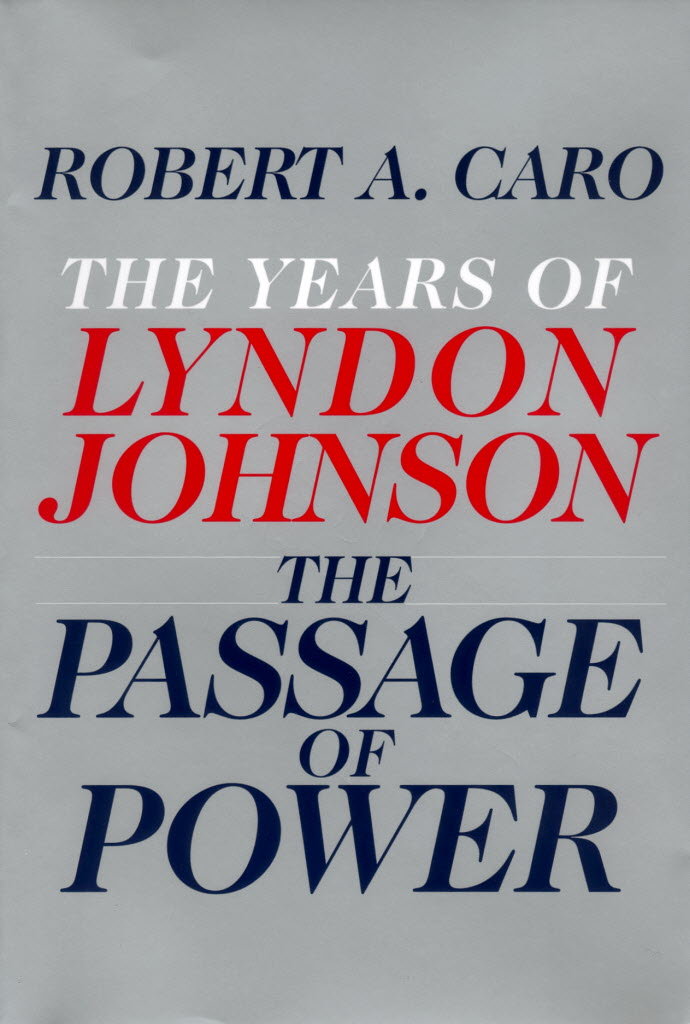
My immediate take-away after completing all 605 pages of Robert Caro’s The Years of  Lyndon Johnson The Passage of Power  is both awe and marvel at Lyndon Johnson’s  accidental presence at the pinnacle of power from November, 1963 through 1965.  If Lyndon Johnson was president or senate majority leader in today’s political environment, for better or worse, there would likely be no gridlock in Washington D.C.  Never in the modern presidency has more of significance been accomplished in such short period then what transpired in the year and a half  of the Lyndon Johnson  presidency following the assassination of President  John F. Kennedy.

This incomparable work by Caro illuminates, for both the student of history and the observer, that regardless of a like or dislike of his tactics or the man himself, Lyndon Johnson’s accomplishment in moving historic legislation through a gridlocked congress is beyond comparison.  The Civil Rights Act of 1964 and the Voting Rights Act of 1965 turned years of political rhetoric and decades of delay into law, and Lyndon Johnson made that happen during a most improbable time in  American history.  LBJ with all of his ruthlessness,  cajoling, bravado, insecurity, impatience and meanness did what no other president had done.  Deeply seeded in the memory of the poverty of his youth, LBJ’s empathy for the poor and underprivileged surfaced, often with a vengeance, to overcome the impossible obstacles standing before these two pieces of landmark legislation. For this reader, understanding how the  aforementioned was accomplished became the centerpiece of this Pulitzer destined work.  But, there is so much more.

The mutual hatred that existed between Lyndon Johnson and Robert Kennedy and the inordinate effect that it had upon a functioning government is made manifest throughout the book. Robert Kennedy’s unsuccessful multiple efforts to convince Johnson to withdraw from  his brother’s selection of Johnson as the vice-presidential candidate in 1960 depicts a near maniacal RFK. The relegation of LBJ’s vice-presidency to a meaningless and often humiliating position often punctuated by RFK’s ” corn pone vice-president” references are almost unimaginable and would normally be thought relegated to a school-yard bully.  While LBJ is often lionized in Caro’s pages, Robert Kennedy is given faint if any praise at all in this carefully researched book.

Caro details the brilliance with which Johnson handled the passage of power upon Kennedy’s assassination . How LBJ managed the emotional devastation of the Kennedy team  is a remarkable story in itself. He convinced the great majority of them to stay on because , ” I need you , the country needs you and John  Kennedy’s legacy needs you.”  The overnight transformation of the ruthless master of the senate and insignificant, irrelevant  vice-president to become the nation’s hope, healer and steady hand is so magnificently detailed by Caro, so real, that it places the reader in the midst of a current event, not a bygone era!

You will learn from Caro’s research sources that  it was widely speculated that Robert Kennedy’s inability to move beyond the grief over his brother’s death may have been tied to a feeling of self guilt; that he and the president’s pursuit of  the assassination of Fidel Castro ( Operation Moongose) and the Mafia  may have in  fact been  a direct retaliation that killed President Kennedy.  Caro, despite the Warren Commission report, raises that speculation to the level of plausibility.

The Passage of Power  at times elevates Johnson to the heroic level but the narrative is equally balanced with the reality of the often brutal, threatening and unforgiving methods by which LBJ accomplished his goals.  From Johnson’s euphoric highs and the compassion demonstrated for minorities and the downtrodden surrounding of the passage of the Civil Rights and Voting Rights Acts, Caro, concludes Passage of Power with bombs dropping upon helpless villagers in Vietnam.  That era is left for another telling.

This is the fourth in Caro’s  The Years of Lyndon Johnson. The Passage of Power will have even greater meaning if you have already consumed The Path to Power ( 1982), Means of Ascent ( 1990) and Master of the Senate ( 2002).  However, Caro does such a good job in placing The Passage of Power in the context of Johnson’s lifetime that it is easily stand-alone read.  Throughout the book, Caro makes numerous references to another great work on Lyndon Johnson which I wholeheartedly commend to you, Lyndon Johnson and the American Dream by Doris Kearns Goodwin. I also recommend This Time,This Place, by Johnson aid and confidant Jack Valenti, who later left government for a distinguished career as the president on the Motion Picture Association of America. ( Check Gordon’s Good Reads Archives).

A  Robert Caro book of equal substance and a Pulitzer honoree  is his The Power Broker, Robert Moses and the Fall of New York.   Use of power to accomplish common good or abuse of power for personal gain; both books in a different time and place tell a significantly similar story.

THE STORM OF WAR- PROFOUNDLY ACCOMPLISHED OVERVIEW OF WORLD WAR II

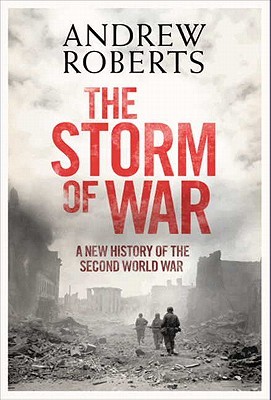
Andrew Roberts The Storm of War is without question the best and most complete overview of World War II that I have read. Extraordinary research, crammed with detail and revelations that  even well read students of the war will find enlightening.

Roberts, Britain’s  premiere military historian, writes with clarity and transforms this enormous subject into an understandable read that  links nearly every facet of the war to a logical conclusion. His penchant for detail and numbers easily falls into place making the narrative more exciting, eye-opening and impactful.  He clearly demonstrates that this two theater war,   based upon what he terms “false ideologies,”  is what led to the ultimate downfall of both Germany and Japan. Beginning with the rationale for Hitler’s failure to seize a victory at Dunkirk, the fall of France ( more French fought on the side of the Axis than the Allies,)  an explanation as to why Operation Sealion ( the invasion of Britain) was never carried out , the catastrophic blunder of Germany declaring War on the United States giving Roosevelt the green light to enter the war in  Europe, Roberts courses each twist and turn and his story is  often explosive and emotionally disturbing.  

Aficionados of military statistics are led through details of  comparison of  weapons, tanks, airplanes, submarines, troop strength.  In 1943, just over a year after Pearl Harbor the United States was building  98,000 war planes per year compared to Germany’s 40,000.  The Russians suffered 2-million casualties at Stalingrad and replaced the loses in a month. Germany lost 238,000 but had exhausted its reserves. His use of facts, rather than confuse, come together to strengthen the forcefulness of the book.

All of the major players are front and center, Churchill,  Roosevelt, Hitler, Hirohito, Eisenhower, Montgomery, Nimitz, Rommel, and the Nazi  cast of Field Marshalls, SS Officers plus  Goebbels, Goring, and Rundstedt. The author’s denunciation of the murder of millions of Jews is carefully calibrated and leaves absolutely no avenue for anyone involved to escape responsibility. 

Roberts brings insight into the Eastern front and Russia’s stalwart defence of Moscow, the  battle of Stalingrad and the siege of Leningrad.  The author outlines the impact of the failure of Hitler’s Operation Barbarossa ( the conquest of Russia based upon his ideological hatred of  Bolshevism.)  To highlight the fallacy of Hitler’s fanatical focus on Russia, the German’s lost 2.4 million men killed in Operation Barbarossa as compared to 202,000 fighting the Allies on the Western front. Despite these losses  on the Eastern front, Hitler maintained a “stand and die policy” nearly to the end. Ideology again!

The war in Pacific receives equal attention. From Pearl Harbor  through the dropping of the atomic bombs the reader learns why the great battles in the Pacific were won and lost in many cases  because the ideological leaders in Japan, like Germany, refused to listen to the generals on the ground. “The awakening of the sleeping giant.” ” The miracle at Midway.”

If I were asked to recommend just one volume as an overview of the Second World War my choice would be The Storm of War. However, this work will be appreciated even more  by those who have read extensively individual works by other renowned World War Two Historians such as Max Hastings , who is referenced throughout the volume by Roberts.

I met Andrew Roberts at a lecture in New York City. It became immediately clear that The Storm of War  would require reading every page, packed with facts and few wasted words. No quick read here and definitely not a historical novel. However, despite the immersion in detail, this epic story is profound and the conclusions logical because in the end Andrew Roberts seems to have missed nothing.

For W Roberts history on the World War II Western front, read Masters and Commanders: How Four Titans Won The War in the West ( 1941-1945)


NEW FROM ROBERT CARO- GREAT NEW YORK TIMES PREVIEW PERSPECTIVE

I am an unabashed fan of Pulitzer Prize winning historian Robert Caro.  Ever since first reading The Path to Power, the beginning of his epic study of the life of Lyndon Johnson. My second and equally enlightening exposure to Caro’s work was The Power Broker his Pulitzer prize-winning biography of Robert Moses. Next month the fourth book in Caro’s study of Johnson , The Path to Power will be published, in a process that began in 1976. Caro’s other Johnson volumes are in order of publication are Means of Ascent and Master of the Senate.

I commend to all Robert Caro fans a marvelous article by Charles McGrath published in The New York Times on April 14 putting all of Caro’s works in an insightful perspective.  A most worthwhile article for those of us anticipating The Path to Power.

SEYMOUR HERSH GOT IT RIGHT IN 1997! DARK SIDE OF CAMELOT

Pulitzer Prize winning journalist Seymour Hersh received heavy criticism for his 1997 book The Dark Side of Camelot ,which is filled with assertions regarding the sexual exploitations of JFK , both in and outside the White House. Some of his critics went so far as to say  Hersh “ made it up.”   Well, it appears not that he was right on!

Mimi Alford’s Once Upon a Secret: My Affair with President John F. Kennedy and its Aftermath largely substantiates  Hersh’ s reporting in The Dark Side of Camelot, including the pool parties and the interns.   Hersh’ s writing also includes much inside detail on more substantative political subjects including the Bay of Pigs Invasion and  Kennedy’s  relationships with mob boss Sam Giancana.  

Hersh may be best known when in 1969, he broke the story of the My Lai Massacre, in which hundreds of unarmed Vietnamese civilians were murdered by US soldiers in March 1968. The report prompted widespread condemnation around the world and reduced public support for the Vietnam War in the United States.  He received the Pulitzer Prize for International Reporting.

So if you have doubts about Mimi Alford’s account and want to establish a  base line reference add The Dark Side of Camelot to your reading. Truthfully, in The Dark Side of Camelot the sexual exploits are a side bar to a very well written inside look at the Kennedy Administration and all of the players in the cast.  A “ good read.”


UNFULFILLED EXPECTATIONS/THE PRESIDENCY THE NATION URGENTLY NEEDED

In Destiny of the Republic Candice Millard has composed a work of non-fiction on the assassination  of the nation’s 20th president, James Garfield.  In a book that reads like a historical novel, Millard weaves the  true story of a man who never sought the presidency,  but accepted the Republican nomination in 1880 with a sense of responsibility to the nation. 

Garfield, born into abject poverty, was the last of the  “log cabin” presidents. He came into office at a time when the nation sorely needed a person with the vision to bring the country together and move on from the lingering tragedy of the Civil War’s division. Garfield rose to that challenge and was welcomed by the citizenry as a healer.

Millard carefully combines the promise of the Garfield presidency with the tragedy of  the bullet of  deranged assassin Charles Guiteau that left Garfield clinging to life over four months. The author uncovers the fear of Vice President Chester Arthur, placed in that position by New York power broker Roscoe Conkling, who after Garfield’s death sought to return to the levers of power through Arthur.  You will discover a positive turn of hand in this relationship.

Destiny of the Republic also exposes the ignorance within the country’s medical community by it’s refusal to adopt the standards of modern antiseptic medicine developed in England by Joseph Lister. Tragically, Garfield did not die from Guiteu’s gunshot wound but rather from infection caused by the ignorance and ego of Dr. D. Willard Bliss, who’s unclean hands and instruments  along with his enormous ego, caused the deadly infection that killed Garfield.  Millard tells the story of Alexander Graham Bell, the inventor of the telephone and admirer of Garfield, trying desperately to develop an instrument to find the bullet in Garfield’s body.

Yes, it reads like a novel, but every word is true ,including the revelation of the little known fact that Todd Lincoln was the only person present at the death of three of the four assassinated American presidents, his father,  Garfield and McKinley.  

I believe that Pulitzer Prize winning author  Debby Applegate  who wrote The Most Famous Man in America correctly summarizes  Destiny of the Republic in her dust cover quote, ” Candice Millard has rediscovered one of the great forgotten stories in American history. Millard has turned Garfield’s story into a crackling tale of suspense and a panoramic picture of a fascinating but forgotten era.”

Millard also wrote River of Doubt which was named best book of the year by the New York Times Book Review in 2006. River of Doubt is the story of Theodore Roosevelt’s journey into an uncharted part of the Amazon. For you Roosevelt fans, this is another great recommendation to add to the Roosevelt postings on Gordon’s Good Reads.

NON ZERO SUM- WE ARE ALL IN THIS TOGETHER!

Conversations with friends can quickly lead to  book recommendations. A discussion of Tom Friedman’s That Used To Be Us, resulted in  a recommendation and  a gift copy of Robert Wright’s  NON ZERO SUM THE LOGIC OF HUMAN DESTINY. 

Heavy duty subject? Yes indeed! However, Wright presents the subject matter in a logical and understandable progression.  The basic  premise is that throughout the development of civilization, Non- Zero Sum cooperation, just the opposite of  Zero- Sum with only winners and losers, is what advanced our civilization from savages, barbarians, chiefdoms and tribes to a cooperative civilization.  Take a look at this quote from Wright. “Judging by history, the current turbulence will eventually yield to an era of relative stability, an era when global political, economic and social structures have largely tamed the new forms of chaos. The world will reach a new equilibrium. Or on the other hand, we could blow up the world.”

Or, “As history progresses, humans find themselves playing non-zero-sum games. Interdependence expands, and social complexity grows in scope and depth.”

“Innovate or die! Population density drives technological and social development not by creating opportunities, but by creating problems. Problems that must be solved  for the greater good!”

Not at all unlike many of Tom Friedman’s theories so ably expressed in The World is Flat,  Hot Flat and Crowded. and That Used To Be Us. Wright, like Friedman has the ability to take sweeping concepts and break them down into logical elements. He outlines how throughout history  man has managed to turn acute need and chaos into opportunity, not with a Zero-Sum  I win you lose approach, but with the concept of working together for a common good or what he calls Non-Zero!

Non-Zero is a tremendous exploration of how we have become who we are and the implication is clearly that the evolution of our civilization as a cooperative society will play a key role in what we become. 

Zero -Sum has no winners! With Non-Zero  everyone can win.  There are  many lessons here , especially in today’s political climate domestically and around the globe. If you have a friend in the U.S. House of Representatives or the U.S. Senate send them a copy!

Income Inequality Threatens Capitalism- Who Said That- Surprise!

You might be surprised but here is the direct quote from non other than Andrew Carnegie who was one of the first capitalists, along with John D. Rockefeller Sr, to become American billionaires.  Here is Carnegie’s exact quote from 1889. 

” The gulf between rich and poor threatened the very survival of capitalism.” 

You might not think that view was espoused by the self-made bobbin boy who came to America and worked his way into the founding of U.S.  Steel!  Carnegie and John D. Rockefeller Sr.  competed daily to see who would become the wealthiest magnate in America! Rockefeller with Standard Oil may have edged out Carnegie for the title but the great irony is that both men  became two of the world’s greatest philanthropists benefiting nearly every conceivable worthwhile socially important endeavor. However, as both biographies clearly reveal, it was not pretty along the way. Just ask Ida Tarbell!

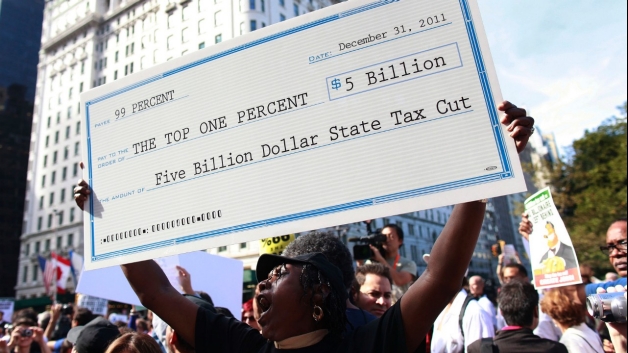
I write this post today after reading  in the New York Times the latest government figures on the distribution of wealth in America . It ties in perfectly with my Occupy Wall Street post of earlier this week.  In that post I commended to you Gretchen Morgenson’s Reckless Endangerment and Tom Friedman’s  That Used To Be Us.

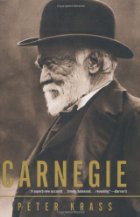
Why Carnegie and Rockefeller?  If you want a solid historical perspective on the accumulation of wealth by two of America’s richest men , Ron Chernow’s TITAN The Life of John D. Rockefeller Sr. and Peter Krass’s  CARNEGIE offer the reader tremendous insight. 

Never before in the  American capitalistic system had so much wealth been accumulated by just two industrialists.  Both books are complete in their historical perspective of the personal lives of Carnegie and Rockefeller and admirably translate their personas into their business and later their philanthropic philosophy. 

As  I have read the daily accounts of Occupy Wall Street my memory clicked upon these two most worthy biographies.  They provide a meaningful and  necessary historical backdrop to the discourse of today. Chernow’s book was published in 1998 and Krass’s work  in 2002. 

If you have the time, these are wonderful back to back reads.  By chance , I read TITAN first and having done so would recommend that order. Each is of course deserving of a stand alone read.

Occupy Wall Street? Two Insightful Books Morgenson and Rosner,Friedman and Mandelbaum

Anyone who questions the “why” in the Occupy Wall Street movement that is sweeping the nation and the world need only pick up a copy of Reckless Endangerment by Gretchen Morgenson and Joshua Rosner! ( See Gordon’s Good Reads July 16, 2011 blog post.)  The book did not predict that folks would be manning the barricades by October but I would assume the  Occupy Wall Street movement came as no surprise to these two  excellent reporters. Reckless Endangerment is a must read for all who are trying to put Occupy Wall Street in context.  The mantra ” We are the  Ninety-Nine Percent” will become abundantly clear after reading Morgenson’s and Rosner’s work.

Nor will the Occupy Wall Street movement come as any  surprise to readers of  Tom Friedman’s and Michael Mandelbaum’s That Used To Be Us, How America Fell Behind in the World We Invented and How we Can Come Back.  That Used To Be Us  places in focus the circumstances leading up to the economic and social turbulence in America.

Friedman and Mandelbaum cite four major challenges facing America: How to adapt to globalization, how to adjust to information technology, how to cope with large and soaring budget deficits and how to manage in a world of rising energy consumption and rising threats to the climate and environment.  Though That Used  To Be Us was written before Occupy Wall Street  it clearly enlightens the reader on the years of ignorance in all quarters leading up to the nations current economic straits.  Whereas Reckless Endangerment is an investigative chronology of  America’s financial meltdown, That Used To Be Us  meticulously peals back the covers of missed opportunities to right the ship by both government and business. The  How We Come Back  subtitle of the book brings forth big challenges and a hint of optimism but ironically it ties directly into the public protests of today.   Friedman and Mandelbaum call for an end to the political “gross irresponsibility” demonstrated during the budget crises. ” Anyone who proposes solutions that are not at the scale of the problem and don’t require immediate action is not serious. ” They call for  equipping the citizenry with the skills and tools essential for economic growth in a global economy, rebuilding America’s infrastructure,  and emphasize that ” cutting ”  is not the answer unless it is coupled with major tax increases to create hope for a future balanced budget. ” Anyone who says that we can restore order to our national finances today without raising taxes is not being serious.”

Global warming is a major subject in That Used to Be Us, and the twist is that the authors see global warming as a huge economic opportunity to get out in front of new technology with inventions and production that can lead America out of the Great Recession and place its future on a sound economic growth pattern. The authors  urge America to seize the green energy initiatives being undertaken in China and make them America’s own. Stop exporting our science and technology at our own expense, reference the authors.

Great books are timeless and many have been posted on Gordon’s Good Reads.  Reckless Endangerment and That Used To Be Us my not go down in the annals of literature  as timeless or iconic but in 2011 they are certainly timely and both add greatly to broadening ones understanding of this critical American crossroads.

My blog of last week on That Used To Be Us, promoted by last Sunday’s  New York Times Op-Ed by Tom Friedman was written with 100 pages of the book left to read. The finish line is an eye opener no matter what your politics.

Where Have You Gone Joe DiMAGGIO? ASKS TOM FRIEDMAN

I am 100 pages short of finishing Tom Friedman’s and Michael Mandelbaum’s new book That Used To Be Us. How America Fell Behind In The World It Invented and How We Can Come Back. However, after reading Tom’s opinion column in today’s ( October 9, 2011 New York Times) I feel compelled to get the word to you right away. 

 The column title Where Have You Gone Joe DiMaggio? poses the conundrum  that Friedman and Mandelbaum answer in their carefully crafted and researched book.  Anyone who is vested in figuring out what is wrong with America  ( aren’t we all?), and what we need to do to fix it, is encouraged to read this book now.  THAT USED TO BE US  is  about the important national dialogue being played out in print, over the air, in Washington DC  and now in the streets!  It will not go away. The book is not about philosophy but rather solutions! This quote from Friedman’s  New York Times Op-Ed  truly sets the agenda for That Used To Be Us.

“We cannot bail or tax-cut our way to prosperity. We can only, as  ( Steve) Jobs understood, invent our way there. That is why America needs to be for the world in the 21st century what Cape Canaveral was to American the 1960s: the place where everyone everywhere should want to come to start-up and make something — something that makes people’s lives more productive, healthy, comfortable, entertained, educated or secure. To do that, we need to reinvigorate our traditional formula for success — quality education and infrastructure, open immigration, the right rules to incentivize risk-taking and government-financed scientific research.”

That Used  To Be Us is worthy as a stand alone Tom Friedman read but it is even more compelling if you have read his The World is Flat (2005) and Hot Flat and Crowded. (2008)

All of Friedman’s work is a reasoned approach to identifying problems and pointing to proven and in many cases obvious solutions.  Michael Mandelbaum adds to the excellence in this new volume. Both authors  spare no individual, political party or company in bringing issues to the feet of those responsible for our problems and giving due credit  in recognition of wisdom.

When I have finished the last 100-pages I will be even more impressed  but having completed 256 and today reading Tom’s Op Ed  I am compelled to post this blog today!