THE OVERSTORY/RICHARD POWERS

I think that I will never see a poem as lovely as a tree. Those famous words opening the poem TREES by Joyce Kilmer came immediately to mind as I open the pages of The Overstory, a Pulitzer winning novel by Richard Powrs.
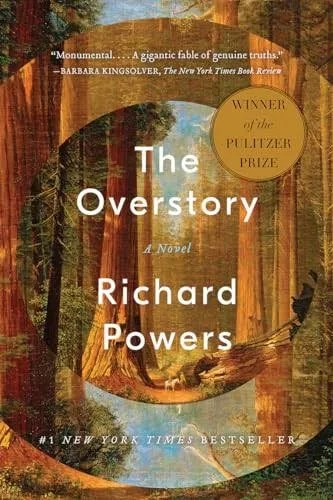
Just as reading Kilmer’s verse, after reading The Overstory ,you will never look at the forest the same wasy again.

No one sees trees. We see fruit, we see nuts, we see wood, we see shade. We see ornaments of pretty fall foliage. Obstacles blocking the road or wrecking a ski slope. Dark, threatening places that must be cleared. We see branches about to crash our roof. We see a cash crop. But trees-trees are invisible.

Power’s cast of human characters are environmentalists, scientists, anarchists, families, mindless entrepreneurs. However its the trees, the forest floor, the ancient sentinels and the whispers and interactions between them that create a gripping theme of survival.

The best argument in the world won’t change a person’s mind. The only thng that can do that is a good story.

Indeed- The Overstory succeeds!

BARKSKINS/ANNIE PROULK

The cast in Annie Proulx’s new novel, Barkskins, is enormous. It rapidly grows as each chapter follows generations of fur traders, adventurers and would be entrepreneurs  from the old world to the new. The family tree ( no pun intended) expands and the blood line grows to encompasses Native Americans and Native Canadians.  The story landscape ranges from Europe to the Canadian Maritimes, China, New Zealand and the Pacific Northwest.

Barkskins  makes a profound environmental statement as the perceived good folks along with lots of bad guys begin their devastation of the American colonial landscape long before mechanization and 19th Century greed. It is the era of wood,  white pine,  New England ship building ,the axe, logging, spring river runs and hard men who live harder lives in the deep woods.

“A thousand men could not cut all this in a thousand years.”  But they did.  ” He hated the American clear-cut despoliation, the insane waste of sound valuable wood, the destruction of the soil, the gullying and erosion, the ruin of the forest world, with no thought for the future.”   A strong woman  inherits a modest lumber enterprise  and converts it into a family fortune by developing a mechanized deforestation machine.

The book is not just about the forests but of the devastation brought upon the native people of Nova Scotia, New Brunswick and Maine.  It is the sad saga so often heard of American expansion, this time telling the story of the Mi’Kmaq.

“Now when the forest were gone there had never been so few Mi’Kmaq since the beginning of time, less than fifteen hundred, the remains of a people who had numbered more than one hundred thousand in the time before the white-man came.”

A fortune created by destroying the forests and an entire Indian culture. In the end a desperate search for an heir to the ill-gotten gains, and it comes full circle. Who is the family?

You may work at this read in the beginning but you will quickly be captured. Such  brilliant writing.

Annie Proulx is famous for The Shipping News and Brokeback Mountain.