COOLIDGE, REVISIONIST OR ACCURATE PORTRAIT OF THE PRESIDENT?

Amity Shlaes new biography COOLIDGE  has received its share of controversial reviews including  charges of  a “white-washed” Coolidge presidency. There is little doubt that Shlaes places  ” silent Cal” in a favorable light. However, that is not at all unusual as historians review a presidency in a perspective from a hundred years distance.  Perhaps the best example of the retrospective is David McCullough’s  reincarnation  of John Adams.  I am not suggesting that the two books or presidencies are comparable but the passage of time allows authors the opportunity to look through a different prism.  Be assured that Shales portrait of Calvin Coolidge does not attempt to elevate him to John Adams status, however, she clearly establishes the image of a strong, independent thinking president capable of making unpopular decisions that he deemed correct for the country.

images

Coolidge served as president, during the roaring 20s, from 1923 to 1929.  He remains famous for small government, balanced budgets and ” the business of America is business.”   Unlike some reviews, I do not think Coolidge is a whitewash of the administration, but rather an overview of the thinking in America following the First World War and the national desire to return to ” normalcy.”  Ironically, Coolidge came into his political career as an acolyte of Teddy Roosevelt  progressivism and acted accordingly during his tenure as Governor of Massachusetts.  Coolidge was a reluctant recruit as Warren Harding’s Vice-President, he disliked the position, but his New England work ethic underscored his making a best effort to support Harding’s policies.  The two were exact opposites, Harding the gregarious politician telling the electorate what they wanted to hear,  Coolidge, quiet and reserved.

Shlaes does an excellent job in depicting Coolidge’s transition to the presidency following Harding’s unexpected death.  He moves into the oval office with no great fanfare and picks up the reins of governing turning quickly to his zeal for a balanced budget, eliminating the war-time bureaucracy and establishing the concept of reducing taxes to stimulate the economy out of a post war recession.  Shlaes makes a case that Coolidge handed off a strong economy to Herbert Hoover after Coolidge kept his commitment that he would not run  for a second term.  However, Shlaes  book makes no mention of the rampant speculation on Wall Street that occurred during the later years of the Coolidge Administration which lead to the crash of 1929 and the beginning of the Great Depression.  Does Coolidge share the blame or does it all fall at the feet of  Herbert Hoover?

A most interesting part of the book is that once again we go back over 100 years to discover recurring themes facing today’s American economy:  The fairness of the tax policy, protective tariffs, balanced federal budget, government spending, the deficits of war-time spending, and the overriding argument of  big government versus small government.

COOLIDGE is well written and for lovers of history it is a look back at a presidency almost forgotten.  COOLIDGE  offers a  glimpse at the expectations of life in America following  World War I , the “War to end all wars. ”  It was the period of the first automobiles produced on the Ford assembly line, electrification,  the birth of the aviation industry, Lindbergh and the  passage of the Kellogg-Briand international treaty, the successor to the failed  Woodrow Wilson League of Nations.

You will learn much about Coolidge the family man, his wife Grace and the tragedy of the death of his son  Calvin, Jr. while Coolidge was in office.  The journey— from his birth in  Plymouth Notch, Vermont  to Amherst College, small town attorney in Northampton, Massachusetts, Massachusetts Senate, Massachusetts Governor,  Vice-President and President of the United States–a remarkable life.


GRAND CENTRAL-THE BOOK-A DESTINATION UNTO ITSELF

It is fitting that my son who has just begun a daily commute to Grand Central gave me a copy of Sam Roberts  book Grand Central, How A Train Station Transformed America.

images

During the better part of four decades , I commuted through Grand Central during periods of its greatest decay and glorious rebirth.  For me, and millions of others, the book is personal and the FOREWORD by Pete Hamill gives the work a New York City imprimatur that only Hamill could provide. Hamill: ” It was a week before Christmas in 1945.  Wait my mother said. I want to show you something. And she led me into the largest space I had ever seen. There were people moving across shiny marble floors in many directions, a gigantic clock, and a large board with numbers and the names of cities. A deep voice kept speaking from somewhere, the voice echoing off gleaming walls. We were in a place called Grand Central Station.”

The name is technically not Grand Central Station but rather Grand Central Terminal although few have ever called it anything but the former. The short-lived original named Grand Central Station, located nearby on 42nd Street,  was demolished  when the brilliant New York Central Railroad Chief Engineer William Wilgus convinced Commodore Cornelius Vanderbilt’s son, William, that the future  of railroading was electric locomotives that would allow the Park Avenue rail lines to be placed underground leading to a new two tiered Grand Central Terminal.

Roberts brings the detail of the construction of the terminal into a readable and understandable epic, with a coupling of wonderful photography.  The magic and glamour of long distance train travel abounded in Grand Central long before it became a commuter hub. Track 34, today a common departure point for the Harlem Line, was where nightly they rolled out the celebrity red carpet for the 20th Century Limited to Chicago. The train with speeds up to 123 miles per hour made the trip in 20 hours, therefore the name.  The 20th Century made its inaugural trip on June 17, 1902 and its last on December 2, 1967. By that time the once glorious Grand Central along with long-distance train travel had fallen into disrepair and neglect and the terminal was  only a  shadow of the wonder in Pete Hamill’s youthful eyes back in 1945.

Robert’s history of  Grand Central is complete,  but the excitement surrounding  the terminal’s renewal,  in  many ways, lays the foundation of the renewal of New York City itself,  and the indomitable spirit of  New Yorker’s following the city-wide declines during the 1970s. This spirit, prevalent  today, harkens back to the introduction of a popular radio program in the 1940s on NBC titled Grand Central Station. See if you don’t agree that even though the 20th Century Limited and Empire Express are distant memories,  the preamble to each radio show remains real  as you walk through Grand Central today.

As a bullet seeks its target, shining rails in every part of our great country are aimed at Grand Central Station, heart of the nations greatest city. Drawn by the magnetic force of the fantastic metropolis, day and night great trains rush toward the Hudson River, sweep down its eastern bank for 140 miles, flash briefly by the long red row of tenement houses south of 125th Street, dive with a roar into the two-and-one-haf-mile tunnel which burrows beneath the glitter and swank of Park Avenue, and then…Grand Central Station! Crossroads of a million private lives! Gigantic stage on which are played a thousand dramas daily. 

Sam Roberts has given anyone who has ever paced the marble floors of Grand Central a great gift.  Beyond rails, renovation, railroad barons , conductors, porters and engineers, this is the story of how for over 100 years a building   has played such a huge role in defining New York City.  For those of us for whom Grand Central has been part of our lives we owe Sam Roberts a special debt of gratitude. Grand Central celebrates a victory for a city we love.

Sam Roberts has covered New York City for the Daily News and the New York Times for over 40 years. He has written seven books of non-fiction including The Changing Face of America in the 21st Century.

WHEN PRESIDENT BUSH 41 TOLD THE NRA TO TAKE A HIKE!

Several weeks ago on this blog I referenced the updated version of former President George H.W. Bush’s book,  ALL THE BEST, My Life In Letters and Other Writings.  In 1995  the NRA’s  Wayne La Pierre  issued a fund-raising letter the basis of which was to raise fear over government troops, in this case the ATF’s use of force at at Waco, Texas, bearing arms against U.S. citizens!  Here from ALL THE BEST is President Bush’s letter of May 3, 1995 to then NRA President Thomas Washington with reference to La Pierre’s tactics!

images

Dear Mr. Washington,

I was outraged when, even in the wake of the Oklahoma City tragedy, Mr. Wayne La Pierre, executive vice president of N.R.A., defended his attack on federal agents as “jack-booted thugs.” To attack Secret Service agents or A.T.F. people or any government law enforcement people as “wearing Nazi bucket helmets and black storm trooper uniforms” wanting to “attack law abiding citizens” is a vicious slander on good people.

Al Whicher, who served on my [ United States Secret Service ] detail when I was Vice President and President, was killed in Oklahoma City. He was no Nazi. He was a kind man, a loving parent, a man dedicated to serving his country — and serve it well he did.

In 1993, I attended the wake for A.T.F. agent Steve Willis, another dedicated officer who did his duty. I can assure you that this honorable man, killed by weird cultists, was no Nazi.

John Magaw, who used to head the U.S.S.S. and now heads A.T.F., is one of the most principled, decent men I have ever known. He would be the last to condone the kind of illegal behavior your ugly letter charges. The same is true for the F.B.I.’s able Director Louis Freeh. I appointed Mr. Freeh to the Federal Bench. His integrity and honor are beyond question.

Both John Magaw and Judge Freeh were in office when I was President. They both now serve in the current administration. They both have badges. Neither of them would ever give the government’s “go ahead to harass, intimidate, even murder law abiding citizens.” (Your words)

I am a gun owner and an avid hunter. Over the years I have agreed with most of N.R.A.’s objectives, particularly your educational and training efforts, and your fundamental stance in favor of owning guns.

However, your broadside against Federal agents deeply offends my own sense of decency and honor; and it offends my concept of service to country. It indirectly slanders a wide array of government law enforcement officials, who are out there, day and night, laying their lives on the line for all of us.

You have not repudiated Mr. LaPierre’s unwarranted attack. Therefore, I resign as a Life Member of N.R.A., said resignation to be effective upon your receipt of this letter. Please remove my name from your membership list. Sincerely,

[ signed ] George Bush

La Pierre was later forced to apologize. However, reading today’s discourse from the NRA, not much has changed?

In an ironic twist, the very next letter in ALL THE BEST, following his NRA resignation letter,  is one that George Bush wrote in September of that same year to grieving parents who had lost a child.  The letter is so much the measure of the man and especially relevant today following the Newtown, Connecticut shootings, I felt compelled to reprint it here.

Our caring son, Marvin, called today, broken-hearted. He told me of your sadness, of the loss of your young son, of the terrible blow to you and your many friends.

I know that at this, the moment of your anguish, there is little that words can do to console. I’ll bet it does help a little, however, to know that you have so many loving friends who really care.

Long ago Barbara and I lost a tiny four-year old to Leukemia. Of course we felt  she was the most beautiful, wonderful little girl that God had ever put on this earth. We kept saying “Why our Robin? Why our gentle child of smiles and innocence”

Lots of people tried to help us find the answer. One woman wrote us and said, misquoting scripture, ” Let the little children suffer so they can come unto me.”  Maybe she had it right, though.

I can expect you are now saying ” Why.”

Well, I can’t, even now, pretend to know the real answer; but let me tell you something that might help a little bit.

Only a few months after Robin died, the grief and awful aching hurt began to disappear, to give way to only happy memories of our blessed child. Oh we’d shed a tear when we’d think of something she’d said or done; but the hurt that literally racked our bodies literally went away–gone, vanished, replaced by happy thoughts.

Now , 40 years later, Robin brings us only happiness and joy–no sadness. She’s never left us. The ugly bruises, trade marks of dread Leukemia, are gone now. We can’t see them at all.

I’ll bet your son, Chase, was the best kid ever. I hope your hurt goes away soon. I hope you will live the rest of your lives with only happy memories of that wonderful son who is now safely tucked in, God’s loving arms around him.

Barbara and I send our most sincere condolences. And all of us in the Bush family send out love.

Signed

Respectfully,

George Bush  ( Also known as Marvin’s Dad)


THE GIRLS OF ATOMIC CITY/ EVIDENCE OF THINGS UNSEEN

The title of this posting  incorporates  two books, a work of non fiction and a novel. Both detail the secrets of the U.S. government’s  World War II  Oak Ridge Tennessee Laboratory from its creation in 1943 to the end of the Second World War in 1945.

images

Denise Kiernan’s book The Girls of Atomic City, The Untold Story of the Women Who Helped Win World War II , tells the incredible story of the overnight construction of  a  secret huge industrial complex ( Site X)  in Oak Ridge Tennessee, the sole purpose of which was to convert uranium into enriched nuclear fuel for the construction of the first atomic bomb under the stealth Manhattan Project. Within a year, Oak Ridge Tennessee grew to a community of 75,000 inhabitants and into one of the largest industrial complexes in the world!

Kiernan details  how thousands of young women were recruited to Oak Ridge from throughout the country  with the promise of good paying  jobs that would ,” Help Win The War.”   These young recruits , mostly in their early 20s ,  boarded buses and trains without knowing exactly where they were going and  not having any idea of the position they were about to assume.  Adding to this remarkable story is that for the duration  of their stay, none of the workers at Oak Ridge  ever knew the true nature of the work.  Only after the atomic bomb was dropped on Hiroshima in 1945 was the nature of their work revealed to them.

The Girls of Atomic City  tells the Oak Ridge story from the standpoint of the sociological  interaction of the thousands of young men and women living together in camp-like accommodations, finding a way to establish a social life while at the same time working on a top-secret project that even talking about to friends was forbidden.  Additionally, the book translates into layman’s language  the scientific process of creating the fuel ( enriched uranium)  for  ( The  Gadget )  which was to become the atomic bomb.

images-1

What Kiernan does not develop  is the story of the enormous health hazards that these young women  and everyone at Oak Ridge were exposed to every day.  Marianne Wiggins’  novel  Evidence of Things Unseen,  accomplishes that in a beautiful love story that winds its way from Tennessee to the  eastern shore of North Carolina and the  back to the Oak Ridge Laboratory  to uncover the horror of the impact of radiation sickness upon unknowing workers.  In an odd twist, Wiggins’ novel completes Kiernan’s  work of non-fiction.

Denise Kiernan is also the author of Signing Their Lives Away and Signing Their Rights Away, the fame and mis-fortune of the men who signed The Declaration  of Independence.   Her work has appeared in The New York Times and the Wall Street Journal. 

BEHIND THE BEAUTIFUL FOREVERS-A SHOCKING LOOK AT INCOME INEQUALITY IN INDIA

Katherine Boo’s best seller Behind The Beautiful Forevers, Life, Death and Hope In a Mumbai Undercity is a shocking examination of how income inequality can condemn hundreds of thousands of humans, men, women and children,  as slum dwellers with no possible exit from their condition.  After completing Behind The Beautiful Forevers I wondered why the author placed the word HOPE in the title, as I came away with none.

imgres

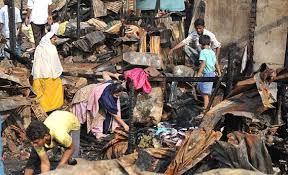
Boo illuminates the contrast in India’s caste system by establishing her story line in a Mumbai slum, Annawadi, beneath the shadow of India’s “other world”, the gleaming high-rise hotels that surround the international airport.  In Annawadi,  young and old, mothers, fathers and children live at the edge of a sewage lake in cardboard and tin shacks with no walls, doors or plumbing. Boo takes the reader through their daily lives of survival, picking through the garbage and waste of the upper classes and ironically paying bribes to the political bureaucracy for the privilege!

Hope?  Farmers borrow money to remain on their farms to avoid  conditions in the cities like Mumbai. Then, crop failure, a huge loan for seed with no way to pay. ” He was slow-minded, short on his lights and worked the fields, then took additional loans for his daughter’s wedding and felt trapped. Then he went and drank the poison ( insecticide).”

images

Hope?  ” When a new school opened in the pink temple by the sewage lake, many of them gravitated to it, but it closed as soon as the leader of the nonprofit had taken enough photos of children studying to secure the government funds.”

Hope ? Boo details a society in which the poorest of the poor must pay bribes for the  most basic essentials in life, including food, water, the privilege to work, and inadequate medical care.

The very same week I completed Boo’s book, the March 30th addition of The Economist arrived at my desk with the headline CAN INDIA BECOME A GREAT POWER?  Behind The Beautiful Forevers makes a commanding case for a resounding NO!

imgres-1

Katherine Boo is a staff writer for The New Yorker and a former reporter for the Washington Post. She has received a Pulitzer prize for her journalism.  This work of non-fiction is also worthy of high honors.  It has already been granted a National Book Award. Author Adrian Nicole Leblanc said it best in her praise for  Boo, ” There are books that change the way you feel and see; this is one of them.”

FRANCONA-THE RED SOX YEARS-A MUST FOR FANS

Former Red Sox Manager Terry  “Tito” Francona’s book FRANCONA, The Red Sox Years written with Boston Globe columnist Dan Shaughnessy leaves little to the imagination with its insight into  the rise and fall of the Boston Red Sox under Francona’s leadership.

images-2

All of the glory and  drama of the 2004 and 2007 championship seasons and the collapse of 2011 are played out within the intrigue of the relationship between Francona, Theo Epstein and the Red Sox ownership trio of John Henry, Tom Werner and Larry Lucchino. Certainly this is a book for Red Sox fans but like  Moneyball  by Michael Lewis it provides wonderful insight into the inner workings of major league baseball. FRANCONA  also offers an inside look at Terry Francona’s personal life, his relationship with his Dad and his struggle with major health issues resulting from injuries during his career as a player.

Why did the downfall of the Red Sox occur after the incredible accomplishments of 04 and 07?  The narrative makes clear that winning the World Series in 2004 was all about the sport  but following the repeat victory in 2007 it became all about the money.  The Red Sox franchise at the behest of ownership became money machine in which everything Red Sox was for sale. When the performance on the field faltered in 2008 and 2009 and television ratings on the club owned cable channel began to plummet the financial concerns from the front office further impacted the play on the field. By 2010 fan and media pressure for another championship became so intense that the quick fix was to adopt the New Yankee strategy of throwing money at the problem. The result was the John Lackey, Carl Crawford  disaster and the ruination of Francona’s ability to control, the club house ethos.

FRANCONA is clearly a thinly veiled rout of the Red Sox top brass with Larry Lucchino receiving the bulk of the wrath. However, there is much in this book that reflects wonderfully on  the game and the Boston clubhouse culture established by Francona when he arrived from Philadelphia catapulting the Sox into  two World Championships.  Clearly, Tito and Dan Shaughnessy leave the impression that Terry Francona is a  “players manager”  and the perhaps best ever in the most difficult managers spot in all of baseball.  It was an impossible position for Bobby Valentine to fill in 2012 and Valentine quickly fell into the trap of making all of the wrong moves with Tito’s boys.  Will John Farrell have better luck?  As Francona’s former Red Sox pitching coach he has a better understanding of the culture,  ownership,  fans and the Boston media. What about Francona in Cleveland?  We will see how the “player’s manager” will perform. However, we can guarantee a hero’s reception when the  Tito and the Tribe arrive for their first game at Fenway this spring.

images-3

By the way for avid  Red Sox and all baseball fans read Glenn Stout’s FENWAY 1912, The Birth of a Ballpark.  Baseball in simpler times!  Refreshing!


BUSH 41 UPDATES ALL THE BEST-MY LIFE IN LETTERS AND OTHER WRITINGS

You may have caught the news that President George H.W Bush has updated the 1999 compendium All The Best, My Life in Letters and Other Writings. The new volume includes correspondence between father and son during the two terms of the George W. Bush presidency, including poignant comments regarding the war in Iraq and insight into Bush 41’s friendship with former President Clinton.

images-1

George H.W. Bush has been a life-long writer of letters.  I received a personally autographed copy of the original All The Best when the then former president visited his hometown of Greenwich at a breakfast conducted by Just Books,  a prominent book store at the time that has since closed.  During Bush’s comments it became quickly apparent how emotionally involved he is when referencing his children and grandchildren. He readily admits and it was in evidence that he finds it difficult to read his own personal letters without tears.

I became aware of this up-dated version of All The Best while reading Richard Ben Cramer’s  What it Takes a wonderful work of non-fiction regarding the 1988 presidential election and Bush’s victory over Bob Dole and then Michael Dukakis.   Cramer credits Bush’s great communications skills as a key ingredient in the Bush victory.  Never in the course of that campaign was an opportunity missed to write a personal letter to thank a donor, to accompany a photograph or recognize a favor or personal introduction. That same discipline served Bush during his presidency and over a fifty year career in public life.

Letter writing is of course a lost art, replaced by e-mail and text messaging. It seems to me however that neither of the aforementioned leave the indelible impact of a hand-written letter. Letter writing is as inspiring for the author and the recipient.   Each of my children, grandchildren, loved ones and personal friends have received a letter upon all of the important occasions, accomplishments and challenges in their lives.  I have discovered that despite all of the e-mails, telephone calls and texts, it is these letters  that remain in their possession and often rekindle the importance of love, milestones and friendships. They become a landmark in an otherwise sea of words.  No surprise that All The Best strikes a chord with me!

Thoughts penned by one’s own hand are permanent fingerprints of the mind, ethos and soul. All The Best  may  define George H.W. Bush better than the  thousands of words written about him by others.

February, 10, 1997: Former President George H.W. Bush writing to a young girl whose Dad was killed while serving in the United states Army in Panama: All The Best, pp: 597 excerpts)

Dear Britnay,” You never knew your Dad. I didn’t know him either. I had to make the call that sent him into battle.— Your father was one of the ones that made the ultimate sacrifice. He gave his life. I think  your Dad felt he might die for he wrote a most beautiful letter to your grandmother, a letter that said among other things, ‘I am frightened by what lays beyond the fog, and yet do not mourn for me. Revel in the life that I have died to give you.’ — I shared this letter with our entire nation during my State of the Union Address on January 31, 1990. As I did I choked up because I knew your entire family was hurting.— I wish I had known your Dad personally. I think I would be a better man if I had known him, for his kind of courage lifts men up and inspires them. May God bless you in your life ahead.

George Bush.

WHAT IT TAKES-RICHARD BEN CRAMER -DOES MUCH CHANGE IN AMERICAN POLITICS ?

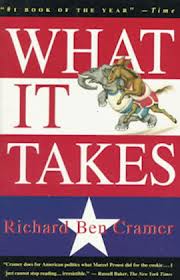
Pulitzer Prize winning author and journalist Richard Ben Cramer died in January of this year. Cramer is considered by many insiders to have been the best student of American presidential politics. His death brought to my attention the 1992 book What It Takes, The Way To The White House.  I can only express regrets for not having devoured this magnificent work sooner.

images

What it Takes, the detailed narrative of the 1988 presidential primary and election,  is not for the casual reader. Its 1000-plus pages has been quoted as ” The ultimate insiders book on presidential politics.” Richard Ben Cramer places under a microscope the inner thinking and personalities of those who would place themselves into the 1988 race to become President of the United States. What makes the work even more provocative  is the relevancy of the 1988 election, including a bitter Democratic Primary that resembled in great part the divisive Republican Primary of 2012.

Cramer details with precision the backgrounds, personalities and political aspirations of George H.W. Bush, Bob Dole, Michael Dukakis, Gary Hart, Richard Gephardt, Joe Biden, Jesse Jackson and the lesser players as well.  Of particular contemporary interest is the insight into the mind and ambitions of Joe Biden that may well play out again in the 2016 campaign for the White House. Cramer’s research into the Biden personality is so complete that these pages of What It Takes could well qualify as a Biden biography!  More on that to follow.

The 1988 Republican primary election is a match up between  Vice-President George H.W. Bush and Senator Bob Dole which results in an ultimate  November face-off between Bush and Democrat Michael Dukakis.  While we think we know Bush better his having had What It Takes to win the presidency in 1988,  Cramer’s insight into how the Bush personality and family background made certain that victory is remarkable.  Bush had spent a lifetime building friendships, communicating and never burning a bridge.  He maintained a big picture view of the oval office.   The comparison with Dukakis is stark.  The Massachusetts Governor prided himself on being a micro manager and believed right up until election night that the job of the president what that of a manager with the words “leader and vision” rarely in his campaign vocabulary.

In many ways What it Takes is a series of biographies. While the book is commendable for this reason alone, don’t look for neat compartmentalized chapters on each personality. Cramer’s prose and story telling is much more sophisticated.  The reader will learn why Bob Dole, the “Bobster” became the “Hatchet Man,” why Gary Hart’s personality demanded that even after withdrawing over the Donna Rice scandal, he re-entered the race in denial that he had no chance. Joe Biden withdrew over a plagiarism scandal and re-entered the campaign only to be sidelined a second time by a nearly fatal aneurism.  Richard Gephardt worked harder than any Democratic candidate but failed to find a message. There is Kitty Dukakis, Barbara Bush, Jill Biden, Lee Hart, Lee Gephardt and of course Elizabeth Dole.

Along with all of the candidates the “press” and of course the  handlers, consultants and political advisors  have a constant presence in the narrative bringing out the often shameless  positions that candidates take to win elections.  Paraphrasing Cramer, the presidential election process ” cheapens the issues or ignores them,  reduces the dialogue to noise, is spendthrift, exhausting and hurtful.” Cramer leaves no doubt the attaining the presidency is a brutal obsession and leaving little left of individuality. Winning the presidency and moving into the bubble changes very little.

A most memorable reference from What it Takes concerns  the first Gulf War, Desert Storm.  How  did President Bush manage to put together the coalition to force Saddam Hussein out of Kuwait?  “He was the only man alive who had  personal  friends as the heads of states in 30 countries. ” He called in the favors.

My takeaway is that George H.W. Bush was the only candidate in 1988 who understood in totality what was required to be elected president and  who was willing to make the sacrifices to attain the goal. He had learned that from a life-time in public service and from his family’s heritage.  Ironically, four years later Bush 41 may not have had the willingness to repeat the same sacrifices necessary to defeat Bill Clinton in 1992. Yet,  after the fray, they became good friends.

What it Takes is a big commitment of time but if you love the American political system and wish to gain a rare biographical insight into the minds of the players in 1988 your investment will be rewarding. Like all good historical research and writing the knowledge gained is relevent in the present.   Listen to what Bob Dole said at a convention  of Young Republicans in Seattle in 1988. ” Conservative does not mean callous. I’d like to see fifty wheelchairs in this audience, fifty black faces, fifty Hispanics, fifty Asian Americans. We have a responsibility to open up the doors of this party.”  Did anyone in the 2012 GOP inner circle hear the Bobster or were his words simply lost in the cacophony of just another campaign?

Other books by  Richard Ben Cramer: Ted Williams: The Seasons of the Kid (1991), Bob Dole (1994), Joe DiMaggio: The Hero’s Life (2000), What Do You Think of Ted Williams Now? A Remembrance (2002), How Israel Lost: The Four Questions (2004)


A FALSE DAWN FOR FREE MARKETS- LAISSEZ-FAIRE?

John Gray is among Britain’s  ” former ” conservative  thinkers who had major influence on Margaret Thatcher during her tenure as British Prime Minister.

imgres

Gray, a long-standing  unfettered free enterprise advocate , had an epiphany regarding his economic views and in 1998 published False Dawn, a highly academic discussion and prediction as to why a laissez-faire global economic system was unworkable and forecast the economic calamity that fell upon the U.S. and the world in 2008. Gray’s thesis in  False Dawn is that  the American-style unregulated free market system was the major contributor leading up to the world economic implosion of 2008!

False Dawn is a heavy reading assignment!  However, the perspective Gray brings to the discussion of  government’s role in the free enterprise system is both provocative and startling.  Of particular note is his reasoned analysis of why he now conversely believes that only government involvement in the framework of free-enterprise can prevent the income disparity that exists in both the U.S. and  international economic system.  Gray makes the case that income disparity, now seen in largely un-regulated world-wide free-enterprise economies, has led to economic perdition.  He  warns of the danger of the IMF for trying to impose the US economic model on the world.

So what is the take-away?  Has Gray gone from a Thatcher conservative to socialist?  I think not, but he is a strong advocate for the necessity of some government role in fostering growth and regulating free enterprise. The growth side of the Gray proposition comes from his advocacy of government  investment in infrastructure, scientific research and new technologies, all of which is  part of the contemporary economic and political dialogue!

Ironically, as I was finishing False Dawn  the January 12, 2012 issue of The Economist arrived with a cover story The Great Innovation Debate. While the article does not focus upon income disparity, it makes a strong case for government spending on infrastructure and basic research. As might be expected, the government investment advocacy does not come without The Economist warning of too much regulation “getting in the way of the 21st century’s innovative juices.” Many sides to a complex issue.

False Dawn is a great companion read to those fans of Tom Friedman, in particular Hot-Flat and Crowded and Robert Wright’s Non Zero. In all three cases you may wish to take notes!

LINCOLN-NARROW FOCUS-TIMELY MESSAGE

Gordon’s Good Reads does not make a practice of reviewing movies but when a film is based upon a book that I have enjoyed, written by an author in whom I have the highest regard, I broaden my license. Doris Kerns Goodwin is among the country’s most respected presidential historians. Goodwin’s book Team of Rivals, upon which the movie Lincoln is loosely based, falls into the category of an intimate study not only of Lincoln but also of those with whom he surrounded himself in his cabinet.

images

I read the Goodwin book and also the early reviews of the movie Lincoln so I had some idea of what to expect before seeing the picture. I understand that the movie was about Lincoln’s political genius but I left the theater wondering what impression anyone who had not read Team of Rivals would have come away with. They certainly saw an excellent performance by Daniel-Day Lewis and learned how the Thirteenth Amendment was passed, but was this the Lincoln they expected to see? Did the movie leave too narrow an impression for such a broad title? I think so.

Lincoln is depicted as a brilliant politician pursuing whatever tactics necessary to pass the Thirteenth Amendment, abolishing slavery. Missing from Lincoln was the remarkable story of the end of the Whig Party and the evolution of the anti-slavery Republican Party. Goodwin’s book fills in the important detail that positioned Lincoln for the 1860 presidential nomination including the Lincoln-Douglas debates of the 1858 senatorial campaign and Lincoln’s Cooper Union address in New York  in 1860. Equal to Lincoln’s brilliant political strategy in getting the Thirteenth Amendment passed was the fact that he won the Republican nomination by defeating the heir apparent, William Seward, which laid the basis for Lincoln bringing all of his challengers for the presidential nomination into his cabinet. The Goodwin book details how the interaction of this disparate group influenced Lincoln’s conduct of the Civil War. The film’s short clips of Lincoln viewing battlefields and Lee’s surrender did little to place the enormity of the Lincoln presidency and his team of rivals in context.

images-1

There is no doubt that Daniel Day-Lewis is on track for a Best Actor nomination and that the film will be among the nominees for Best Picture but the title Lincoln was a huge reach and likely a disappointment for many. Would you title a movie The Civil War and only tell the story of Gettysburg?  On the other hand, if Spielberg had instead titled the movie The Passing of the Thirteenth Amendment, would anyone have come? I get it. It will take a five-part Ken Burns PBS Series titled Lincoln to fill this history buff’s canvas.

One thing for sure, the film has provoked a great deal of talk from the pundits about a president’s need to be very much a politician in order to attain lofty goals.  As the nation again approaches the edge of the partisan fiscal cliff the timing of the release of the film and renewed interest in Team of Rivals could not be better! Maybe the narrow focus of the movie is a good thing after all!  Required congressional viewing?