UNFULFILLED EXPECTATIONS/THE PRESIDENCY THE NATION URGENTLY NEEDED

In Destiny of the Republic Candice Millard has composed a work of non-fiction on the assassination  of the nation’s 20th president, James Garfield.  In a book that reads like a historical novel, Millard weaves the  true story of a man who never sought the presidency,  but accepted the Republican nomination in 1880 with a sense of responsibility to the nation. 

Garfield, born into abject poverty, was the last of the  “log cabin” presidents. He came into office at a time when the nation sorely needed a person with the vision to bring the country together and move on from the lingering tragedy of the Civil War’s division. Garfield rose to that challenge and was welcomed by the citizenry as a healer.

Millard carefully combines the promise of the Garfield presidency with the tragedy of  the bullet of  deranged assassin Charles Guiteau that left Garfield clinging to life over four months. The author uncovers the fear of Vice President Chester Arthur, placed in that position by New York power broker Roscoe Conkling, who after Garfield’s death sought to return to the levers of power through Arthur.  You will discover a positive turn of hand in this relationship.

Destiny of the Republic also exposes the ignorance within the country’s medical community by it’s refusal to adopt the standards of modern antiseptic medicine developed in England by Joseph Lister. Tragically, Garfield did not die from Guiteu’s gunshot wound but rather from infection caused by the ignorance and ego of Dr. D. Willard Bliss, who’s unclean hands and instruments  along with his enormous ego, caused the deadly infection that killed Garfield.  Millard tells the story of Alexander Graham Bell, the inventor of the telephone and admirer of Garfield, trying desperately to develop an instrument to find the bullet in Garfield’s body.

Yes, it reads like a novel, but every word is true ,including the revelation of the little known fact that Todd Lincoln was the only person present at the death of three of the four assassinated American presidents, his father,  Garfield and McKinley.  

I believe that Pulitzer Prize winning author  Debby Applegate  who wrote The Most Famous Man in America correctly summarizes  Destiny of the Republic in her dust cover quote, ” Candice Millard has rediscovered one of the great forgotten stories in American history. Millard has turned Garfield’s story into a crackling tale of suspense and a panoramic picture of a fascinating but forgotten era.”

Millard also wrote River of Doubt which was named best book of the year by the New York Times Book Review in 2006. River of Doubt is the story of Theodore Roosevelt’s journey into an uncharted part of the Amazon. For you Roosevelt fans, this is another great recommendation to add to the Roosevelt postings on Gordon’s Good Reads.

NON ZERO SUM- WE ARE ALL IN THIS TOGETHER!

Conversations with friends can quickly lead to  book recommendations. A discussion of Tom Friedman’s That Used To Be Us, resulted in  a recommendation and  a gift copy of Robert Wright’s  NON ZERO SUM THE LOGIC OF HUMAN DESTINY. 

Heavy duty subject? Yes indeed! However, Wright presents the subject matter in a logical and understandable progression.  The basic  premise is that throughout the development of civilization, Non- Zero Sum cooperation, just the opposite of  Zero- Sum with only winners and losers, is what advanced our civilization from savages, barbarians, chiefdoms and tribes to a cooperative civilization.  Take a look at this quote from Wright. “Judging by history, the current turbulence will eventually yield to an era of relative stability, an era when global political, economic and social structures have largely tamed the new forms of chaos. The world will reach a new equilibrium. Or on the other hand, we could blow up the world.”

Or, “As history progresses, humans find themselves playing non-zero-sum games. Interdependence expands, and social complexity grows in scope and depth.”

“Innovate or die! Population density drives technological and social development not by creating opportunities, but by creating problems. Problems that must be solved  for the greater good!”

Not at all unlike many of Tom Friedman’s theories so ably expressed in The World is Flat,  Hot Flat and Crowded. and That Used To Be Us. Wright, like Friedman has the ability to take sweeping concepts and break them down into logical elements. He outlines how throughout history  man has managed to turn acute need and chaos into opportunity, not with a Zero-Sum  I win you lose approach, but with the concept of working together for a common good or what he calls Non-Zero!

Non-Zero is a tremendous exploration of how we have become who we are and the implication is clearly that the evolution of our civilization as a cooperative society will play a key role in what we become. 

Zero -Sum has no winners! With Non-Zero  everyone can win.  There are  many lessons here , especially in today’s political climate domestically and around the globe. If you have a friend in the U.S. House of Representatives or the U.S. Senate send them a copy!

Income Inequality Threatens Capitalism- Who Said That- Surprise!

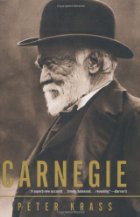
You might be surprised but here is the direct quote from non other than Andrew Carnegie who was one of the first capitalists, along with John D. Rockefeller Sr, to become American billionaires.  Here is Carnegie’s exact quote from 1889. 

” The gulf between rich and poor threatened the very survival of capitalism.” 

You might not think that view was espoused by the self-made bobbin boy who came to America and worked his way into the founding of U.S.  Steel!  Carnegie and John D. Rockefeller Sr.  competed daily to see who would become the wealthiest magnate in America! Rockefeller with Standard Oil may have edged out Carnegie for the title but the great irony is that both men  became two of the world’s greatest philanthropists benefiting nearly every conceivable worthwhile socially important endeavor. However, as both biographies clearly reveal, it was not pretty along the way. Just ask Ida Tarbell!

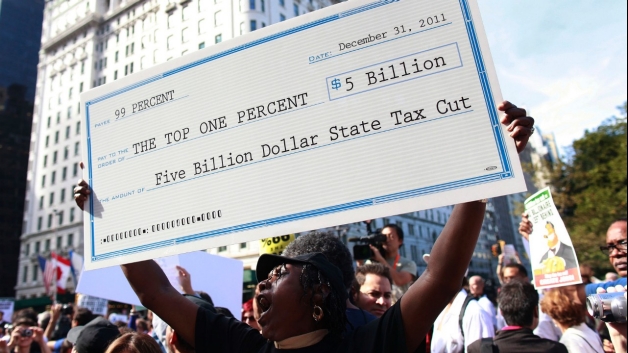
I write this post today after reading  in the New York Times the latest government figures on the distribution of wealth in America . It ties in perfectly with my Occupy Wall Street post of earlier this week.  In that post I commended to you Gretchen Morgenson’s Reckless Endangerment and Tom Friedman’s  That Used To Be Us.

Why Carnegie and Rockefeller?  If you want a solid historical perspective on the accumulation of wealth by two of America’s richest men , Ron Chernow’s TITAN The Life of John D. Rockefeller Sr. and Peter Krass’s  CARNEGIE offer the reader tremendous insight. 

Never before in the  American capitalistic system had so much wealth been accumulated by just two industrialists.  Both books are complete in their historical perspective of the personal lives of Carnegie and Rockefeller and admirably translate their personas into their business and later their philanthropic philosophy. 

As  I have read the daily accounts of Occupy Wall Street my memory clicked upon these two most worthy biographies.  They provide a meaningful and  necessary historical backdrop to the discourse of today. Chernow’s book was published in 1998 and Krass’s work  in 2002. 

If you have the time, these are wonderful back to back reads.  By chance , I read TITAN first and having done so would recommend that order. Each is of course deserving of a stand alone read.

Occupy Wall Street? Two Insightful Books Morgenson and Rosner,Friedman and Mandelbaum

Anyone who questions the “why” in the Occupy Wall Street movement that is sweeping the nation and the world need only pick up a copy of Reckless Endangerment by Gretchen Morgenson and Joshua Rosner! ( See Gordon’s Good Reads July 16, 2011 blog post.)  The book did not predict that folks would be manning the barricades by October but I would assume the  Occupy Wall Street movement came as no surprise to these two  excellent reporters. Reckless Endangerment is a must read for all who are trying to put Occupy Wall Street in context.  The mantra ” We are the  Ninety-Nine Percent” will become abundantly clear after reading Morgenson’s and Rosner’s work.

Nor will the Occupy Wall Street movement come as any  surprise to readers of  Tom Friedman’s and Michael Mandelbaum’s That Used To Be Us, How America Fell Behind in the World We Invented and How we Can Come Back.  That Used To Be Us  places in focus the circumstances leading up to the economic and social turbulence in America.

Friedman and Mandelbaum cite four major challenges facing America: How to adapt to globalization, how to adjust to information technology, how to cope with large and soaring budget deficits and how to manage in a world of rising energy consumption and rising threats to the climate and environment.  Though That Used  To Be Us was written before Occupy Wall Street  it clearly enlightens the reader on the years of ignorance in all quarters leading up to the nations current economic straits.  Whereas Reckless Endangerment is an investigative chronology of  America’s financial meltdown, That Used To Be Us  meticulously peals back the covers of missed opportunities to right the ship by both government and business. The  How We Come Back  subtitle of the book brings forth big challenges and a hint of optimism but ironically it ties directly into the public protests of today.   Friedman and Mandelbaum call for an end to the political “gross irresponsibility” demonstrated during the budget crises. ” Anyone who proposes solutions that are not at the scale of the problem and don’t require immediate action is not serious. ” They call for  equipping the citizenry with the skills and tools essential for economic growth in a global economy, rebuilding America’s infrastructure,  and emphasize that ” cutting ”  is not the answer unless it is coupled with major tax increases to create hope for a future balanced budget. ” Anyone who says that we can restore order to our national finances today without raising taxes is not being serious.”

Global warming is a major subject in That Used to Be Us, and the twist is that the authors see global warming as a huge economic opportunity to get out in front of new technology with inventions and production that can lead America out of the Great Recession and place its future on a sound economic growth pattern. The authors  urge America to seize the green energy initiatives being undertaken in China and make them America’s own. Stop exporting our science and technology at our own expense, reference the authors.

Great books are timeless and many have been posted on Gordon’s Good Reads.  Reckless Endangerment and That Used To Be Us my not go down in the annals of literature  as timeless or iconic but in 2011 they are certainly timely and both add greatly to broadening ones understanding of this critical American crossroads.

My blog of last week on That Used To Be Us, promoted by last Sunday’s  New York Times Op-Ed by Tom Friedman was written with 100 pages of the book left to read. The finish line is an eye opener no matter what your politics.

Where Have You Gone Joe DiMAGGIO? ASKS TOM FRIEDMAN

I am 100 pages short of finishing Tom Friedman’s and Michael Mandelbaum’s new book That Used To Be Us. How America Fell Behind In The World It Invented and How We Can Come Back. However, after reading Tom’s opinion column in today’s ( October 9, 2011 New York Times) I feel compelled to get the word to you right away. 

 The column title Where Have You Gone Joe DiMaggio? poses the conundrum  that Friedman and Mandelbaum answer in their carefully crafted and researched book.  Anyone who is vested in figuring out what is wrong with America  ( aren’t we all?), and what we need to do to fix it, is encouraged to read this book now.  THAT USED TO BE US  is  about the important national dialogue being played out in print, over the air, in Washington DC  and now in the streets!  It will not go away. The book is not about philosophy but rather solutions! This quote from Friedman’s  New York Times Op-Ed  truly sets the agenda for That Used To Be Us.

“We cannot bail or tax-cut our way to prosperity. We can only, as  ( Steve) Jobs understood, invent our way there. That is why America needs to be for the world in the 21st century what Cape Canaveral was to American the 1960s: the place where everyone everywhere should want to come to start-up and make something — something that makes people’s lives more productive, healthy, comfortable, entertained, educated or secure. To do that, we need to reinvigorate our traditional formula for success — quality education and infrastructure, open immigration, the right rules to incentivize risk-taking and government-financed scientific research.”

That Used  To Be Us is worthy as a stand alone Tom Friedman read but it is even more compelling if you have read his The World is Flat (2005) and Hot Flat and Crowded. (2008)

All of Friedman’s work is a reasoned approach to identifying problems and pointing to proven and in many cases obvious solutions.  Michael Mandelbaum adds to the excellence in this new volume. Both authors  spare no individual, political party or company in bringing issues to the feet of those responsible for our problems and giving due credit  in recognition of wisdom.

When I have finished the last 100-pages I will be even more impressed  but having completed 256 and today reading Tom’s Op Ed  I am compelled to post this blog today!


EMPIRE OF THE SUMMER MOON

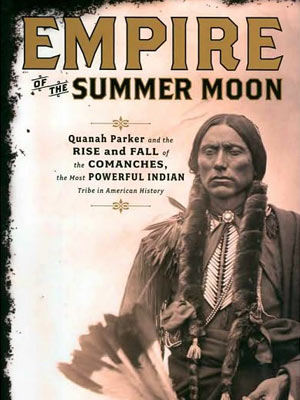
S.C. Gwynne’s Empire of the Summer Moon is a work of non-fiction deserving of its finalist status for a  2011 Pulitzer.  What is so haunting about this book is an un-avoidable love-hate relationship with the Comanche’s of West Texas and the High Plains in the period  1830-1875. 

You will come to respect the greatest mounted warriors  that ever lived in North America. Witness the absolute freedom of Comanche life on the high plains, totally in harmony with the soil, water, wind, buffalo, and of course the horse.   Then there is the depravity, ruthless killing of rival tribes and  later the slaughter of white settlers.  Men, women and children hacked to death or kidnapped, raped and mutilated without remorse. 

Within this barbaric tale evolves the portrait of Cynthia Ann Parker, captured at 9 years of age after watching her family slaughtered  by a Comanche raiding party.  Parker  embraces the Indian culture, marries a head man and bears two sons. Later, found by the U.S. Army among a wandering Comanche tribe, she is returned to ” civilization”  and put on display almost as a freak show.  Members of the Parker family hand her off from one to another as she tried desperately to return to Indian life and her sons.  She died broken-hearted never knowing what happened to her husband and two sons.  Son Quanah who saw his mother taken away by soldiers at age twelve grows to become the most brutal Comanche  worrier of his time.

Gwynne’s research  is worthy of the book’s sub-title. Quanah Parker the Rise and Fall of the Comanches, the Most Powerful Indian Tribe in American History.  Gwynne’s vivid detail and attention to the historical record forces the reader to try to reconcile the many faces of the Comanche, mounted nomads of the Great Plains.  It is all here, Spanish Colonialism in West Texas, The Civil War,  Manifest Destiny, the destruction of the great buffalo herds and of course the true story of Cynthia Ann Parker and her son Quanah.  Quanah from wild murdering Comanche orhpan to dinner with President Teddy Roosevelt.

Empire of the Summer Moon places this incredible tale in proper historical perspective. Don’t look for a historical novel here, this is a well researched narrative and wonderful story.

UNBROKEN-LAURA HILLENBRAND-ASTONISHING!

There is little wonder why Unbroken by Laura Hillenbrand has been atop the New York Times Best Seller List since its publication last year.

The epic story  of the survival, resilience and redemption of  Lieutenant Louis Zamperini is a triumphant accomplishment . It is a literary and historical work by Hillenbrand worthy of the highest accolades. Unbroken equals and in its research even surpasses the excellence of Hillenbrand’s wonderful  Seabiscuit . Warning, it is a disturbing read

Hillenbrand traces the life of Louis Zamperini from delinquent teen to local track hero and Olympian to a World War Two  B-24 bombardier shot down with his crew over the Pacific. Forty seven days in a raft first with three fellow crew members, then  only two. The horror of that ordeal is trumped by his capture and incarceration for two and a half years as a  Japanese POW under the most sadistic circumstances imaginable. Zamperini’s story of human survival defies belief. Hillenbrand’s  research and writing misses no detail, including the story of Louie’s Post Traumatic Syndrome long before anyone had diagnosed the tragedy of post combat emotional illness.

Unbroken’s historical perspective on the war in the Pacific ranks Hillenbrand’s writing in a league with  Stephen Ambrose (D-Day) and ( Citizen Soldiers), James Bradley ( Flyboys),  Jeff Shaara ( The Final Storm), and Doug Stanton ( In Harms Way-The Sinking of the USS Indianapolis).

It is not easy to  digest Hillenbrand’s  descriptions of the horror’s faced by Louie Zamperini and thousands of other POW’s but the outcome is triumphant for the author, the reader and Louie Zamperini! 

There are many months ahead for this great book on top of best seller lists, and it is most deserving of a place in your personal library.

Thank you Laura Hillendrand.

Reckless Endangerment-Excellent Reporting-Pulitzer Worthy

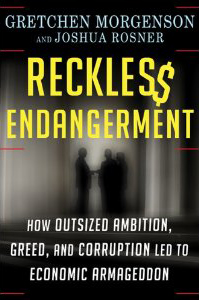
Gretchen Morgenson has again distinguished herself as the finest reporter of financial matters in the  American free press.  The added research of Joshua Rosner raises the new book RECKLESS ENDANGERMENT to an even higher level of excellence and credibility. Recognition of the full title of this work is essential. RECKLESS-ENDANGERMENT, HOW OUTSIZED AMBITION, GREED, AND CORRUPTION LED TO ECONOMIC ARMAGEDDON.

Morgenson’s  and Rosner’s  investigative reporting and writing ( an appropriate description) ) not only tells this nearly unbelievable story but it is a statement about the importance of newspapers and journalists who are committed to upholding the tenants of a free press in a democracy.

The following paragraphs from  RECKLESS ENDANGERMENT  preview the depth to which the book travels to tell the story leading up to the  economic meltdown of 2008 and more disturbingly raises the prospect that at this very moment it may well be happening all over again.

“Just as drug lords know that their products pose hazards to their customers, the Wall Street firms packaging and selling mortgage pools to investors knew well before their customers did that the loans inside the securities had begun to go bad. But with the mortgage mania raging and profits still flowing the investment bankers had no interest in coming clean.”

“The Incident was the first of many times that the heads of organizations accused of improper conduct were not held accountable for the damage they did to shareholders and , later, to taxpayers.”

“Will a debacle like the credit crisis of 2008 ever happen again? Most certainly, because Congress decided against fixing the problem of too-big-to-fail institutions when it had the chance.”

Page by page with incredibly impressive detail , facts and substantiation, Morgenson and Rosner describe  the lead-up to the carnage to the American economy and citizenry, and to the financial crisis that the government is still facing.

There are pages in this book that you simply will not want to believe. However, you will! All of the economic meltdown characters are there with the ironic twist that nearly all of them are still controlling the levers of economic power. The list of key players in the meltdown who are still  on stage  spans pages 305-308!


Midnight in Paris, Hemingway, Hadley, The Paris Wife

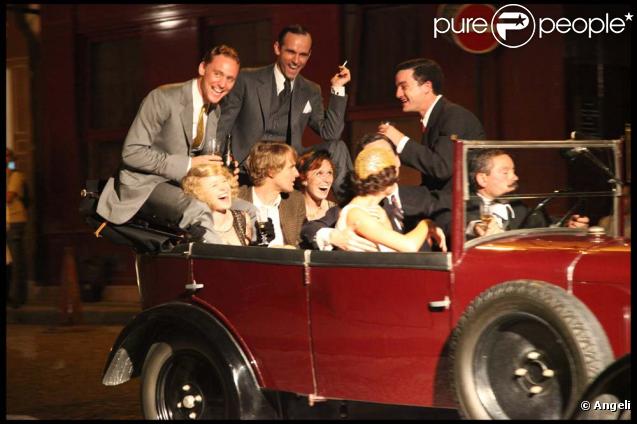
Several months ago on this blog I posted a review of Hadley by Gioia Diliberto. ( Biography blog archives February 11)  Hadley is a wonderful biography of Hemingway’s first wife and their early life together including their move to Paris in 1921.  Woody Allen may well have read the book before writing Midnight in Paris the newly released movie receiving rave reviews, including mine! I saw it this week and it is a wonderful movie, even better having read Hadley first!  The irony is that Hadley Hemingway does not appear in the film but the scenario set by Deliberto in her book makes the movie all the more impactful. All the  characters are there, Ernest , LuTrec, Gertrude Stein, Picasso , T.S. Eliot, et al!  

Another book on Hadley Hemingway which I have not read as yet, The Paris Wife by Paula McLain, is also appearing on best seller lists and receiving good reviews.  Hadley Hemingway is receiving much attention from both the new book by McLain and from Midnight in Paris . In the past week it has topped all hits on this blog! Not bad for a book published in 1992!

Personally, I am delighted to have read Hadley before seeing Midnight in Paris because it set the scene  for the movie’s Moveable Feast,  in a sense reincarnated in the Woody Allen film. I am sure that reading The Paris Wife  would work in the same manner.   It is a Hemingway renaissance! Enjoy the new but if you have not already done so, please go back to the originals! There lies the prose including a wonderful lines by Hemingway in the movie that begs you to read or re-read The Sun Also Rises and For Whom The Bell Tolls!

Gray Lady Down by William McGowan

 GRAY LADY DOWN, WHAT THE DECLINE AND FALL OF THE NEW YORK TIMES MEANS FOR AMERICA (2010) by William McGowan  leaves little optimism for the newspaper that for generations has set the standard for American journalism.

In this book, McGowan longs for a return to a New York Times under the stewardship of the legendary Executive Editor and newspaperman A.M. (Abe) Rosenthal and Publisher Arthur Ochs Sulzberger.

McGowan lays the continuing problems at the Times squarely at the feet of Arthur Sulzberger Jr. who began his reign as publisher in 1991.   The author establishes through reference after reference that the Times continues an ethos of reporting with an “attitude,” something that Rosenthal would never allow. For decades, Rosenthal  with the full support of Arthur Ochs Sulzberger established and cherished independent news reporting at the Times, “clearly and sometimes defiantly separate from the editorial and opinion pages.”

Arthur Sulzberger Jr. according to McGowan brought his personal 1960s political views and attitude to the Times and hired and promoted reporters and editors who clearly supported his personal focus.  “The newspaper left the American mainstream to become obsessed with causes and societal change” to the point where McGowan establishes through the Times own reporting that during the 1990s the line between news and opinion was clearly crossed.  The “reporting with attitude” not only determined what was covered by the Times but who covered it and from what point of view.

As you read Grey Lady Down, you may think it to be a “hatchet job.”  Sadly, as you progress through example after example from the Times own pages you will see otherwise.  The reporting of  the Duke University Lacrosse Team rape accusation according to McGowan is one of dozens of unsettling  examples of how a story was covered by the Times based upon reporter’s perceptions.  McGowan makes strong cases in story after story that the “point of view” came from the “attitude” established in the corner office.

McGowan strongly believes that now more than ever America needs the Times of A.M. Rosenthal.  He correctly states that the New York Times continues to set the daily national news agenda. Whoever reports the news, print, broadcast, or cable ,the day begins with what is on the front page of the New York Times. “ The Times will continue to wield enormous influence over what the average American reads, hears and sees. Whether it appears in the paper or on a digital screen, it will continue to be the polestar for American journalism.”

Quoting Times Columnist Thomas Friedman  from Grey Lady Down, “The reason why Rosenthal was obsessed with keeping editors and reporters from putting their ‘thumbs on the scale’ was because he believed a ‘straight’ New York Times was essential to keeping democracy healthy and our government honest.”

McGowan does not see a return to the “Golden Age” during Times Executive Editor Bill Keller’s watch. 

McGowan also wrote Coloring the News, How Political Correctness Has Corrupted American Journalism ( 2001)

Another book of this genre I would commend to you is Bernard Goldberg’s Bias, (2002) an inside look at CBS News.  Goldberg spent three decades at CBS and came away with the belief that a CBS liberal slant on its reporting is not intentional but institutional!  Goldberg castigated television news reporting and reporters as being a product of the closed society in which the reporters themselves live and work.  The entire cast of TV news is present in Goldberg’s book and nearly all of the reviews took him seriously.